
Distressed Commercial Real Estate Loans: The Workout

A regional UK office building loses its anchor tenant fourteen months before its senior loan matures. Occupancy falls from 92 per cent to 68 per cent, the income no longer covers the interest, and a valuation that supported 60 per cent leverage in 2019 now puts the loan above the value of the building. The sponsor has not missed a payment yet. The lender has already started its recovery analysis.
That is the position many distressed commercial real estate loans are actually in when the workout conversation starts: not a foreclosure, not an insolvency, but a loan that the current numbers can no longer carry and a lender deciding which of four routes gets its capital back fastest.
The causes are well documented and covered elsewhere in this Playbook. The Credit Market 2026: The Reset explains why refinancing proceeds have contracted even for performing assets, Cap Rate in Commercial Real Estate shows how yield expansion alone can push a fully let building into a shortfall, and Refinancing Risk 2026 covers what late engagement costs.
This post starts where those end: the asset is already distressed, junior capital cannot fix it, and the question is what the lender and the sponsor each do next.
The scenario that follows is illustrative. The asset, the sponsor and every figure are constructed to show the decision points, not drawn from a live transaction.
Why Distressed Commercial Real Estate Loans Are a Different Financing Problem
A refinancing shortfall and a distressed loan look similar from outside and are structurally different underneath.
In a shortfall, the asset still supports debt, just less of it, and the gap between old and new facility can be closed with mezzanine, preferred equity or fresh sponsor equity.
Those routes are covered in Mezzanine Financing in Real Estate and Preferred Equity in Real Estate and they all depend on one thing: there being equity value left for the junior capital to sit on.
Distress is the point at which that stops being true. Either the income no longer covers debt service, so no lender will underwrite the existing balance at any structure, or the value has fallen through the loan, so the sponsor’s equity is already gone on paper.
Often both. In that position the loan is not refinanced. It is restructured, bought out at a discount, sold to a third party, or enforced.
The scale of the problem is smaller than the headlines suggest and more concentrated than lenders would like.
Bayes Business School’s UK Commercial Real Estate Lending Report for year-end 2025 put outstanding UK CRE debt at £174 billion, with 3.8 per cent of loans in default, down from 6.3 per cent in mid-2025.
The more telling figure for anyone holding office exposure is that 13 per cent of loans tested had interest cover below 1x. Those are the loans that are not in default yet and are heading towards a workout unless something changes. One reference point among several a lender would weigh, but a useful one.
The Scenario: A Regional Office Loan That No Longer Works
For illustration, assume the following.
A private sponsor acquired a 110,000 sq ft multi-let office building in a regional UK city in 2019 for £30 million.
The building was 92 per cent occupied, producing net operating income of £2.0 million, and was financed with an £18 million senior loan from a UK clearing bank at 60 per cent LTV, five-year term, interest-only, with an LTV covenant at 70 per cent and an interest cover covenant at 1.5x.
The sponsor’s £12 million of equity sat in a special purpose vehicle with a non-recourse structure and standard carve-out guarantees, of the kind described in Recourse vs Non-Recourse Loans in Commercial Real Estate.
The loan matured in 2024. The bank granted an 18 month amend and extend at a 75 basis point fee and a margin step-up, on the basis that the building was still 88 per cent let and that a refinancing would be achievable once the sponsor completed a lease renewal programme. That extension carried the loan to early 2026.
Then the anchor tenant, occupying 24 per cent of the floor area, exercised a break clause and consolidated into a newer building nearby. Occupancy fell to 68 per cent. Net operating income dropped to £1.3 million after an allowance for void costs and rates on the vacant floors.
Higher interest rates had taken the all in cost of the £18 million facility to roughly 7.6 per cent, or £1.37 million a year. Interest cover was now below 1x. A fresh valuation, reflecting both the vacancy and a regional office yield that had moved out to around 8 per cent, came in at £16 million.
At that point the loan was at 112 per cent LTV. The sponsor’s equity was gone on paper, the income no longer covered the interest, and the maturity was four months away. Both covenants were in breach, which is the mechanical trigger described in Covenant Breach in 2026 and, once the maturity passed unpaid, an Event of Default that would give the bank the right to accelerate and enforce.
The sponsor still believed in the building. The vacant floors were lettable with a £2.5 million refurbishment, the local market had limited new supply, and the sponsor had a live enquiry for two of the four vacant floors.
The problem was not the asset. The problem was that £18 million of debt could not be carried by £1.3 million of income at current rates, and no new lender would refinance that balance.
How the Lender Actually Assesses the Workout Options
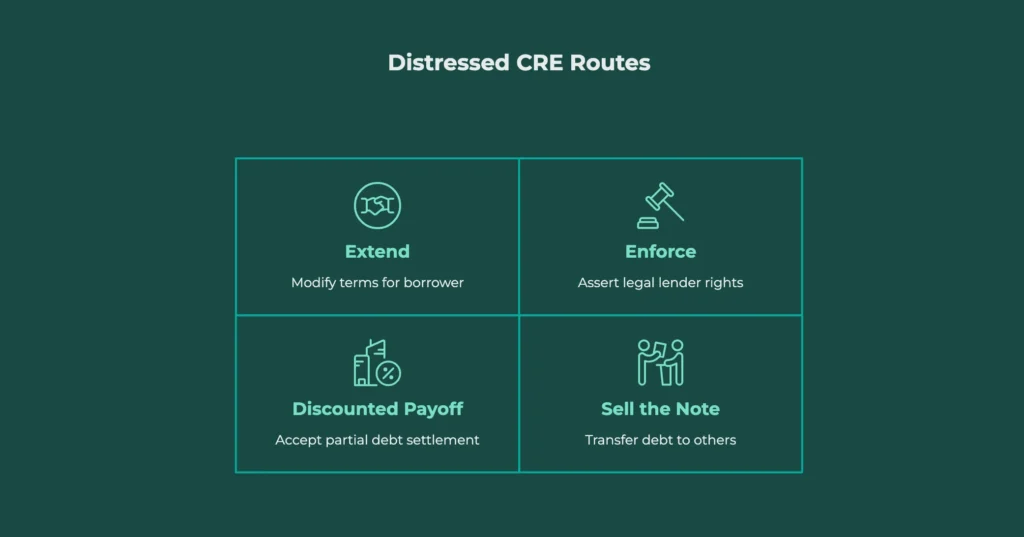
The bank’s decision is a recovery analysis, not a relationship decision. Its credit and restructuring teams model each available route on two axes: what the bank gets back, and when. For illustration, assume the numbers came out as follows.
Enforcement: Appointing a fixed charge receiver under the Law of Property Act and selling the building as a 68 per cent let regional office into a thin buyer pool. The bank’s advisers estimated a distressed sale at £13.5 million to £14.5 million after a nine to twelve month process, less receivership, agency and legal costs of roughly £600,000.
Net recovery of around £13 million to £14 million, twelve months out, with the bank carrying the asset and the vacancy risk in the meantime. Distressed sales of secondary offices also tend to price against the buyer’s assumption that the seller has no alternative, which the bank knew.
Extend again: A second amend and extend, with the sponsor injecting equity to cure the covenants and fund the refurbishment. The bank’s view was that a further extension without a material paydown left it with the same problem in 18 months, with a loan still above 100 per cent LTV and interest cover still below 1x.
The amend and extend mechanics in Liability Management Exercises 2026 work when the borrower’s business has a credible path back to covenant compliance. Here the path required the bank to fund the vacancy for another cycle.
Note sale: Selling the loan to a debt fund or special situations investor. Buyers of single non-performing office loans in 2026 were pricing at meaningful discounts to face, and the bank’s advisers indicated indicative bids in the low 80s, so roughly £14.5 million to £15 million, with execution in eight to ten weeks.
Clean exit, no asset management burden, but the bank would be selling its position to a buyer whose plan was to enforce or to negotiate its own discounted payoff with the sponsor, capturing the upside the bank was giving away.
Discounted payoff: Accepting less than par from the sponsor, funded by a new lender and fresh equity, in return for a full and final settlement.
The sponsor’s advisers proposed £15 million. That was above the enforcement recovery, at or above the note sale bids, and it would be received in six to eight weeks rather than twelve months.
Set out that way, the lender’s choice was not difficult. The DPO offered the bank the strongest combination of recovery, speed and execution certainty. The bank’s loss of £3 million against an £18 million balance was real, but smaller than the loss on any other route and taken in the current financial year rather than the next.
How the Sponsor Financed the Discounted Payoff
The sponsor’s side of the workout was a different calculation. On paper the equity was worthless and the SPV structure meant the sponsor could, in principle, hand back the keys.
The carve-out guarantees did not bite on a straightforward default, and the springing recourse provisions were triggered only by a voluntary insolvency filing or interference with the collateral, neither of which the sponsor intended.
Walking away was therefore an option. The reason the sponsor did not take it was the same reason the bank preferred a DPO to enforcement: the building was worth more to someone with a plan than to a receiver with none.
The sponsor had the plan, the enquiry for two floors, and the local knowledge. What it needed was a capital structure the income could carry.
For illustration, assume the DPO was funded as follows:
A new senior facility of £9.5 million from a debt fund, sized at roughly 59 per cent of the £16 million valuation.
The debt fund’s underwriting was closer to the value-add approach described in Value-Add Financing in Commercial Real Estate than to a stabilised loan: it tested the refurbishment budget, the leasing assumptions and the sponsor’s track record on comparable re-lets before pricing.
At £1.3 million of current income, the facility’s debt yield on the initial draw was 13.7 per cent, comfortably above the fund’s floor.
On the initial £9.5 million draw, current NOI produced interest cover of roughly 1.44x, at an all-in cost of roughly 9.5 per cent. A further £2.5 million capex commitment, taking the total facility to £12 million, would be drawn against verified leasing and refurbishment milestones rather than funded up front.
Fresh sponsor equity of £5.5 million, contributed by the original sponsor and a co-investor, with the new money receiving a preferred return until the refurbishment was let.
The DPO consideration of £15 million was paid to the bank from the £9.5 million initial drawdown and the £5.5 million of new equity. The bank released its security, the SPV was recapitalised, and the loan that had been distressed no longer existed.
The sponsor’s position after the workout: an asset valued at £16 million with £9.5 million of debt against it, £2.5 million of committed refurbishment funding, and a lender whose return depended on the leasing plan working.
The £12 million of original equity was gone. The £5.5 million of new equity was sitting behind 59 per cent leverage on a building with a credible path to 85 per cent occupancy and a valuation that would move with it.
What Determined Whether the Workout Was Available at All
Three things made the DPO route achievable in this scenario, and their absence is what turns most distressed commercial real estate loans into enforcements.
The sponsor engaged before the maturity, not after. The bank’s recovery analysis was run while the sponsor’s proposal was on the table, so the DPO was assessed as one live option against the others rather than as a late attempt to stop a process already under way.
Once a receiver is appointed, the sponsor’s negotiating position collapses because the bank has already incurred the cost and committed to the route. The standstill mechanics in Standstill Agreement 2026 describe how that pause is structured when a formal breathing space is needed; in this scenario the sponsor’s early approach meant no formal standstill was required.
The sponsor arrived with a funded proposal, not a request. The new lender’s term sheet and the co-investor’s commitment were in hand when the DPO figure was put to the bank. A DPO proposal that depends on capital the sponsor has not yet secured is a request for time, and the bank prices it accordingly.
The new lender underwrote the plan, not the history. A debt fund willing to look at a 68 per cent let regional office on the basis of a refurbishment and leasing programme is not a bank, and its pricing reflected that.
But the difference between a 9.5 per cent facility on £9.5 million and no facility at all was the difference between the sponsor keeping the building and the bank selling it.
What to Consider Before a Distressed Commercial Real Estate Loans Reach Maturity
Run the lender’s recovery analysis yourself, on their numbers, before proposing anything. A DPO or restructuring proposal that returns the lender less than enforcement will not be entertained; one that returns more, faster, usually will.
Understand what the recourse structure actually permits. Non-recourse SPV lending gives the sponsor a walk away option, but springing recourse on insolvency filings or collateral interference can close it. Know which acts convert the guarantee before making any move.
Secure the replacement capital before the DPO conversation, not after. A funded proposal is a workout; an unfunded one is an extension request.
Expect the new senior facility to be smaller and more expensive than the loan it replaces, and structure it so current income covers it with headroom. The workout fails if the replacement debt is itself distressed within a cycle.
Treat a note sale as a live risk. If the bank sells the loan before the sponsor engages, the counterparty changes to a buyer whose business model is the discount the bank gave away, and the sponsor negotiates with a party that paid 80 for the right to demand 100.
Conclusion
The workout on distressed commercial real estate loans is decided by a recovery table, not by the history of the relationship or the quality of the sponsor’s intentions. Every route the lender has, enforcement, extension, note sale or discounted payoff, gets modelled on the same two axes, and the sponsor’s proposal wins only if it sits at the top of that table on both.
The sponsors who keep their buildings through a distressed cycle are the ones who bring the lender a funded number that beats the receiver’s, early enough for it to be assessed as an option rather than an obstruction.
That requires replacement capital from a lender prepared to underwrite a plan rather than a track record, and equity prepared to sit behind it.
If you hold or are advising on a commercial real estate loan approaching maturity where the current income or value no longer supports the balance, and want to understand which workout route is realistically available and how it would be funded, we welcome a discreet conversation. Contact us to discuss the position.
For a more structured breakdown of how these strategies are applied in practice, see the Commercial Real Estate Finance Playbook.