
Standstill Agreement 2026: Managing Default Without Collapse
Default is rarely a sudden event. Pressure builds through covenant stress, liquidity constraints and delayed refinancing before any formal breach occurs.
In 2026, many borrowers only encounter a standstill agreement once that pressure has already peaked and lender control is increasing.
This is a strategic decision point. Lenders are acting earlier, with less tolerance for ambiguity, and covenant pressure is building well before any formal default.
In this environment, the standstill agreement is often misunderstood, frequently entered into under duress, and almost always a pivotal moment in a borrower’s trajectory. It appears to offer a reprieve, but in reality it is a negotiation of control and risk.
What is a Standstill Agreement?
At its core, a standstill agreement is a contractual arrangement between a borrower and its creditors, typically lenders, to temporarily suspend enforcement of certain rights or obligations.
In a debt and restructuring context, creditors agree not to exercise immediate rights such as accelerating repayment, seizing collateral or initiating insolvency proceedings for a defined period.
This legally binding contract provides limited time for the borrower to address underlying issues, negotiate a restructuring plan or secure alternative financing without immediate enforcement.
A standstill agreement is a temporary pause on enforcement, not a resolution of the underlying problem. It is a contract designed to prevent rapid escalation, allowing parties to assess, negotiate and move forward.
What a Standstill Actually Means for the Borrower
While the immediate benefit of a standstill agreement is the cessation of enforcement actions, it is crucial for borrowers to understand that this is not a neutral act, nor is it a panacea. The reality for the borrower is far more nuanced:
- Enforcement is Paused, Not Removed: The default or breach still exists. Enforcement is suspended, not eliminated.
- Lender Control Typically Increases: Creditors usually require tighter oversight, including enhanced reporting, operational restrictions and sometimes independent advisors.
- Borrower Flexibility Narrows: The standstill agreement limits decisions around assets, debt and operations, directly constraining recovery options.
When Standstill Agreements Are Used
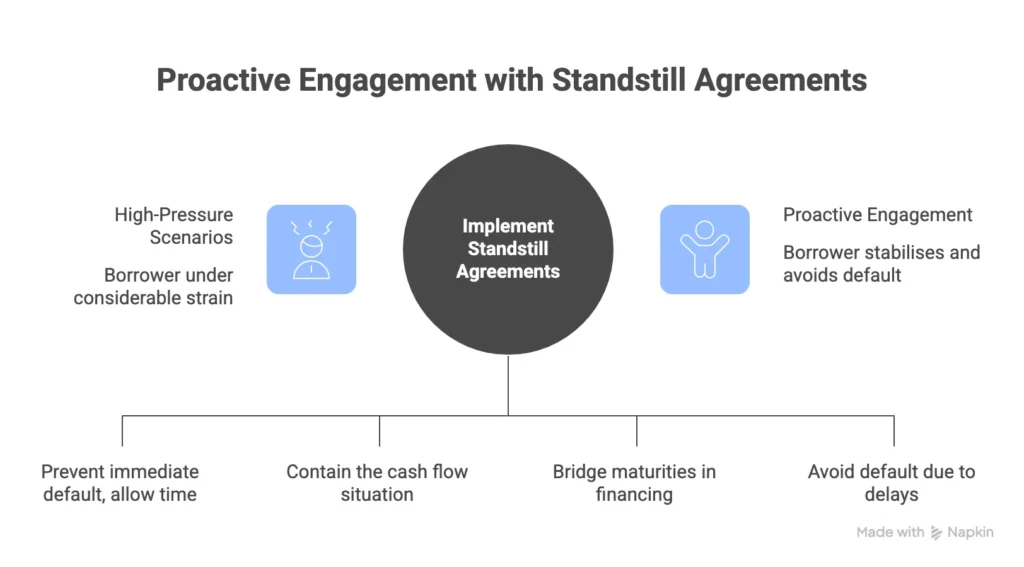
Standstill agreements are not theoretical constructs; they are practical tools deployed in specific, high-pressure scenarios. For high-level decision-makers, recognising these triggers is paramount for proactive engagement:
- Covenant Breach or Imminent Breach: Financial covenants (e.g., debt-to-EBITDA, interest coverage) are often early warning signs. A standstill agreement can prevent immediate default and allow time to stabilise.
- Liquidity Shortfall: A sudden lack of cash flow can trigger defaults. A standstill agreement helps contain the situation.
- Refinancing Delays: In transactions such as Luxury Asset Finance or Commercial Real Estate Finance, delays in securing new funding may require a standstill agreement to bridge maturities.
- Asset Sale Timelines Slipping: If repayment depends on an asset sale, delays in execution can require a standstill agreement to avoid default.
These are real-world pressures, and the decision to enter into a standstill agreement is often made when the borrower is already under considerable strain.
What Borrowers Often Get Wrong
Most mistakes happen in how borrowers approach the standstill itself. For sophisticated borrowers, understanding these pitfalls is critical:
- Assuming Time Equals Safety: The “breathing space” is not safety. It is a period of scrutiny and negotiation.
- Underestimating Lender Leverage: By this stage, the creditor holds leverage. Negotiating power is already reduced.
- Ignoring New Conditions Attached: Standstill agreements come with tighter terms, including reporting, restrictions and higher costs. Missing these creates further risk.
- Entering Too Late: Waiting until pressure peaks weakens the borrower’s position and limits negotiation options.
Used poorly, a standstill agreement accelerates loss of control rather than stabilising the situation, particularly where the underlying debt structure compounds the lender’s position. Understanding structural subordination is key to assessing where that risk sits.
Key Terms to Focus On
- Duration: Standstill periods are short (typically 30–90 days). Extensions are conditional and require progress.
- Restrictions: Lender control is enforced through limits on what the borrower can do, including:
- incur new debt
- dispose of assets
- make capital expenditures
- pay dividends
- enter new material contracts
- Information Requirements: Expect increased reporting on cash flow, performance and asset values. Transparency is mandatory.
- Milestones and Triggers: Specific targets must be met within the standstill period. Failure can trigger immediate enforcement.
- Consequences if Breached: Breach allows lenders to terminate the standstill agreement and pursue remedies immediately, often with increased liability.
Why This Matters More in 2026
The economic landscape in 2026 makes standstill agreements more critical for borrowers:
- Lenders Less Patient: The “extend and pretend” era is largely over. Lenders are acting earlier and protecting positions faster.
- Capital More Selective: Refinancing options are limited, with higher costs and tighter terms.
- Earlier Intervention: Lenders are moving before formal default, based on anticipated breaches or risk signals.
- Reduced Flexibility: Tighter credit conditions leave borrowers with fewer alternatives during a standstill period.
In this environment, a standstill agreement is less about buying time and more about a lender-driven process to manage risk and push restructuring.
What to Consider Before Entering a Standstill Agreement
Entering a standstill agreement is a strategic decision. Focus on what impacts control and outcome:
- Assess Alternatives First: Explore all options before agreeing, including bridge financing, asset sales or equity injection. This strengthens the negotiating position.
- Understand Control Transfer: Know exactly what control is being ceded and how it affects execution.
- Align Timeline to Reality: Standstill periods are short. Ensure recovery or restructuring plans are achievable within that window.
- Negotiate Early: Engage before pressure peaks to retain leverage and improve terms.
This is about foresight, not damage control.
A standstill agreement pauses enforcement, but it is not neutral and not a solution.
Conclusion: Control, Not Just Time
A standstill agreement buys time, but usually transfers control. It does not resolve the underlying problem; it changes how it is managed.
The outcome depends on timing and negotiation. In 2026, with less patient lenders and more selective capital, understanding this dynamic is critical.
It is a strategic pause, not a solution. The objective is to stabilise and regain control, not delay the inevitable.
Discreet Discussions for Strategic Solutions
If you are approaching a covenant breach, facing refinancing delays, or under pressure from lenders, understanding your position before entering into a standstill agreement is critical.
Discreet discussions are available for borrowers evaluating structured, asset-backed or private credit solutions where timing, control and certainty of execution matter.