
Value Add Financing in Commercial Real Estate: How Lenders Underwrite the Deal

A 180 unit build to rent scheme in a UK regional city reaches practical completion at 55 per cent occupancy, eleven months behind the developer’s original lease up projection. The asset is sound and the location has not changed. What has changed is which lenders will even look at the deal, and on what basis they will price it.
That is the real dividing line in value add financing. It is not about which instrument gets used, bridge debt, mezzanine, preferred equity, all three are documented in detail elsewhere in this Playbook. It is about whether the lender is willing to underwrite a business plan that has not yet delivered the numbers a conventional facility requires. For where value add sits against a stabilised acquisition, see the CRE Financing Guide. This post goes further: how lenders actually assess the plan itself, how the capital stack gets built around a repositioning timeline rather than a purchase price, and where recourse and covenants get set when the asset’s current numbers are not yet the numbers the deal depends on.
What Value Add Financing Actually Requires Lenders to Underwrite
On a value add or transitional asset, lenders may assess debt yield against a conservatively adjusted view of projected NOI rather than relying solely on current in-place income, but only once the underlying business plan has been tested for credibility. That word, credible, is doing the real work, and it is worth being precise about what it means in practice.
A lender assessing a value add business plan is not simply checking whether the numbers add up on a spreadsheet. Three things get tested independently before pricing is even discussed.
Leasing and rental growth assumptions get stress-tested against comparable schemes, not against the sponsor’s own projections. Knight Frank’s 2026 research put the regional UK multifamily leasing pace at 23 units a month against 20 in London, a useful reference point rather than a universal underwriting benchmark, since a lender will still weigh scheme size, unit mix, pricing, local supply, incentives, competing schemes, seasonality and the quality of the leasing team on top of it.
A projection that sits meaningfully above that reference point without a specific reason attached will still get discounted before it reaches the debt yield calculation.
Capex contingency gets sized against the specific scope, not a flat percentage. A cosmetic amenity refresh and a full unit-turn programme carry different overrun risk, and experienced lenders price that difference explicitly rather than applying a generic 10 per cent buffer.
Sponsor track record on comparable repositioning carries more weight than on a stabilised acquisition, because the lender is underwriting execution as much as the asset. A sponsor who has completed one comparable scheme prices meaningfully better than a sponsor attempting their first, regardless of how strong the asset looks on paper.
Sizing the Capital Stack Around the Repositioning Timeline
Where senior debt sits and how much of it is available follows a different logic on a value add financing deal to a stabilised one. Senior secured CRE lending typically sizes at 50 to 65 per cent LTV on stabilised assets, but a lender underwriting a business plan rather than in-place income will often size proceeds against a haircut version of projected stabilised NOI, not the headline figure the sponsor is modelling.
That gap, between what the plan needs and what senior debt against haircut projections actually supports, is what mezzanine debt or preferred equity is structured to close. How each of those instruments is documented and enforced is covered in full in Mezzanine Financing in Real Estate and Preferred Equity in Real Estate. What is specific to value add is how the junior capital gets released, not just how much of it there is.
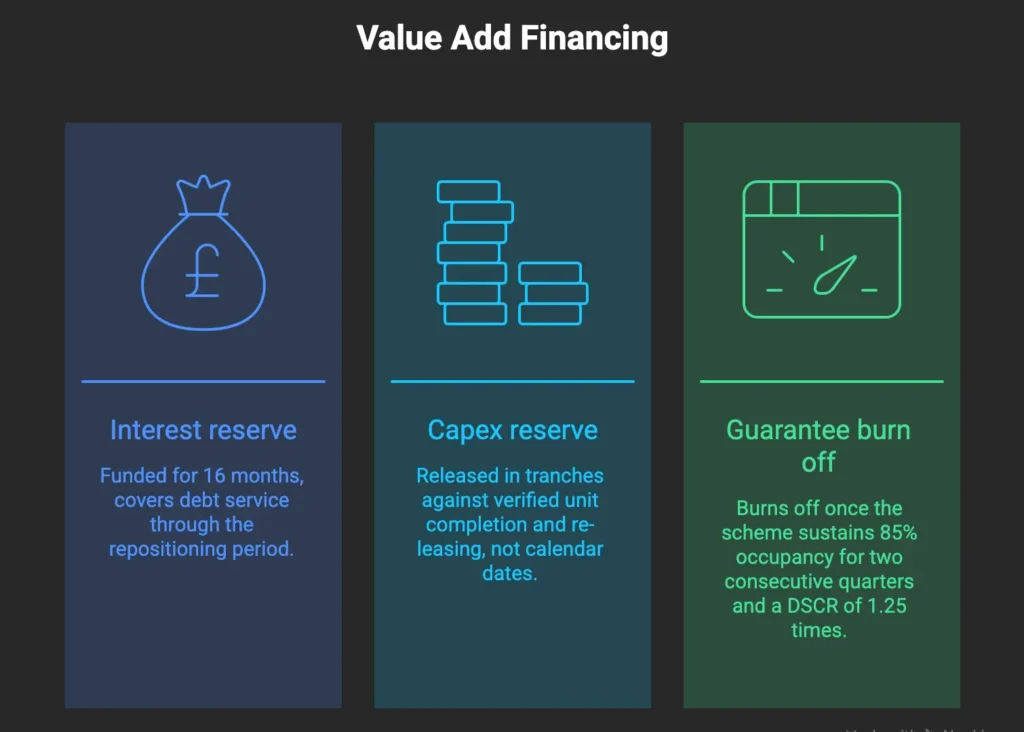
Rather than a single advance, value add facilities typically stage capital in two ways. An interest reserve, funded upfront, covers debt service through the repositioning period so the facility does not depend on in-place income it does not yet have. A capex reserve then releases in tranches against completed milestones, unit-turn completion tied to actual re-leasing rather than a calendar date, which protects the lender from funding renovation work that is not converting into occupied, rent-paying units.
That distinction matters more than it sounds. A sponsor who structures capex release against calendar milestones alone, rather than against verified leasing progress, is accepting a facility that keeps funding work even if the leasing plan falls behind, which is precisely the scenario a lender’s risk committee prices against.
Recourse and Covenant Design Built Around the Business Plan
Partial guarantees are, as covered in Recourse vs Non Recourse Loans in Commercial Real Estate, the workhorse of transitional lending because they price the gap between an asset’s current performance and its business plan. What is worth expanding on here is how the burn-off trigger actually gets negotiated on a value add financing deal specifically, because this is where sponsors leave the most value on the table.
A generic burn-off clause references stabilisation in the abstract. A well negotiated one specifies exactly what stabilisation means for this asset: an occupancy threshold sustained for a defined number of consecutive quarters rather than hit once, and a DSCR test calculated against the loan’s actual terms rather than the sponsor’s pro forma.
The difference between a burn-off trigger a sponsor can hit through ordinary execution and one that references a discretionary lender valuation is, in practical terms, the difference between a facility that becomes non-recourse in substance and one that does not.
Where a value add financing plan underperforms materially rather than simply slips on timing, the mechanics of what happens next, covenant testing, cure rights, and how control shifts if a breach is not resolved, are covered in full in Covenant Breach in 2026 and Events of Default in 2026. Building the covenant package correctly at the outset is what determines whether that scenario is ever reached.
Case Study: Refinancing a Stalled Build to Rent Lease Up
The following scenario is illustrative only and does not describe an actual transaction or client.
A family office acquires a 180 unit build to rent scheme in a UK regional city for £42 million, twelve months after practical completion. The original developer’s lease up plan targeted stabilisation, defined internally as 90 per cent occupancy, within nine months of completion. At the point of acquisition the scheme sits at 55 per cent occupancy, roughly eleven months behind that original plan, with the shortfall driven by underinvestment in amenity space and a lettings team stretched across three schemes rather than dedicated to this one.
The family office’s plan is straightforward on paper: complete a £2.1 million capex programme reworking the amenity floor and finishing 40 remaining units to a slightly upgraded specification, replace the lettings agency with a dedicated team, and reach 88 per cent occupancy within 16 months.
Two lenders quote the deal, and the terms illustrate exactly where value add underwriting diverges from a stabilised facility. A UK clearing bank declines outright once it establishes that in place income does not support the requested loan on a standard DSCR basis, regardless of the plan, consistent with the general pattern that banks underwrite in place income and will not underwrite a leasing plan on a transitional asset.
For illustration, assume a debt fund is prepared to offer £26 million, 62 per cent of purchase price, priced off the credibility of the plan itself: an interest reserve funded for 16 months, a capex reserve releasing in three tranches against verified unit completion and re-leasing rather than calendar dates, and a 30 per cent top slice guarantee alongside an interest shortfall guarantee, both burning off once the scheme sustains 85 per cent occupancy for two consecutive quarters and a DSCR of 1.25 times against the facility’s actual terms.
The specific figures are illustrative only, intended to show how a lender might structure the risk, not a representation of terms any debt fund would actually offer.
The leasing assumption behind the plan, roughly 24 to 26 units a month once the dedicated team is in place, sits close to but slightly above the 23 units a month Knight Frank recorded as the 2026 regional average outside London, which the debt fund’s credit team flags explicitly during underwriting and prices with a modestly larger capex contingency rather than declining the assumption outright.
By month ten, leasing is tracking at 22 units a month against the 24 to 26 modelled, comfortably within the contingency built into the facility but a live example of why the capex reserve was structured against verified leasing rather than a fixed drawdown schedule.
The interest reserve absorbs the additional debt service months the slower pace requires, and the guarantee burn off tests, tied to sustained occupancy rather than a single snapshot, remain achievable on a revised but still credible timeline rather than triggering a covenant conversation.
At month 15, with occupancy at 84 per cent and DSCR approaching the 1.25 times threshold, the sponsor begins the refinance conversation with a permanent multifamily lender, having agreed the take out terms in principle at month twelve rather than waiting until stabilisation to start the process.
That sequencing, agreeing the exit financing well before the metrics that trigger it are actually met, is what converts a value add financing facility’s maturity from a live risk into an administrative step.
What to Consider Before Structuring Value Add Financing
Stress test leasing and rental growth assumptions against genuine comparables, not the sponsor’s own model, before approaching lenders. Size capex contingency to the specific scope of works, not a flat percentage. Structure capex reserve release against verified leasing progress, not calendar milestones alone.
Negotiate burn off triggers that reference sustained, objective performance tests, not a single snapshot or lender discretion. Agree take out or refinance terms in principle well before the metrics that trigger them are actually met.
Conclusion
Value add financing is not a distinct product so much as a different underwriting question. A stabilised acquisition asks whether the asset supports the loan today.
A value add financing deal asks whether the plan to get there is credible, and prices accordingly. Sponsors who arrive at that conversation with leasing assumptions benchmarked against real comparables, a capex reserve structured around verified progress rather than a calendar, and covenant terms negotiated to their own execution risk consistently secure better terms than those who treat the underwriting as a formality once the instrument has been chosen.
If you are structuring for a value add financing or transitional commercial property and want the business plan itself to be priced on its merits, we welcome a discreet conversation.
For a more structured breakdown of how these strategies are applied in practice, see the Commercial Real Estate Finance Playbook