
Recourse vs Non Recourse Loans in Commercial Real Estate: How Lenders Allocate the Risk
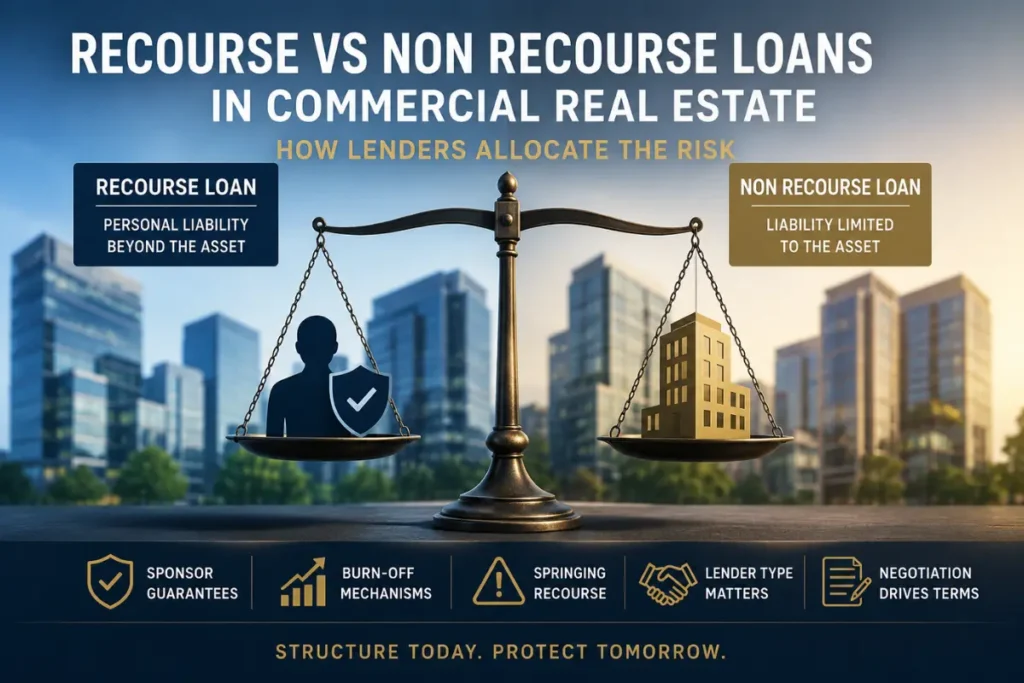
Ask most borrowers to explain the difference between recourse vs non-recourse loans and they will give you the textbook answer.
In a recourse loan, if the borrower defaults and the sale of the collateral does not cover the outstanding loan balance, the lender can pursue the borrower’s other assets for the remaining debt.
In a non-recourse loan, the lender’s recovery is limited to the loan collateral. The lender can foreclose on the property, seize and sell the collateral, and absorb whatever shortfall remains. The borrower is not personally liable beyond the asset.
That answer is correct, and in commercial real estate it is almost useless on its own. Institutional CRE lending is conducted through special purpose vehicles, which means the borrowing entity usually has no assets beyond the property anyway. Entity-level non-recourse is the market’s starting point, not a concession. The real negotiation, the one that determines who carries what when a transaction deteriorates, happens one level up: what the sponsor personally stands behind, in what amount, and for how long.
This post covers recourse vs non recourse loans as the decision actually plays out in commercial real estate: the guarantee spectrum lenders use, how recourse obligations burn off as an asset performs, how springing recourse works, and how different lender types trade recourse against pricing and leverage.
Recourse Loan vs Non Recourse Loans: The Difference in Practice
Every secured loan gives the lender a claim on the collateral specified in the loan agreement. The difference between recourse vs non-recourse loans is what happens when that collateral is not enough.
Recourse debt gives the lender two lines of recovery. If the borrower defaults on the loan, the lender can foreclose, sell the collateral at market value, and then pursue the borrower for any gap between the sale proceeds and the full amount of the loan. Personal liability survives the enforcement.
Non-recourse debt limits the lender’s recovery to the value of the collateral. If the property sells short of the outstanding loan balance in a case of default, the lender cannot pursue additional assets to recover the loan. The shortfall is the lender’s loss.
Because non-recourse debt is riskier for the lender, the textbook trade follows: non-recourse loans come with more conservative leverage and can carry a pricing premium, while full recourse loan terms buy the borrower a lower interest rate and higher proceeds. In retail lending that trade is roughly where the analysis ends. In commercial real estate it is where the analysis begins.
Why the Recourse Question Changes in Commercial Real Estate
Institutional CRE transactions are structured through a special purpose vehicle: a company created to own one asset, with no operating history, no other assets and no covenant strength of its own. Lend to an SPV on notionally full recourse terms and the recourse is worth little, because there is nothing behind the entity to pursue.
Lenders solved this decades ago by separating the loan from the liability. The loan sits with the SPV, typically on non-recourse terms against the property. The liability question is then answered separately, through guarantees given by the sponsor: the individual, family office or fund with the actual balance sheet standing behind the transaction.
This is why comparing recourse vs non recourse loans at entity level tells you almost nothing in CRE. The right questions are: which obligations has the sponsor guaranteed, in what amount, subject to which triggers, and until when.
Two facilities can both be labelled non-recourse and allocate radically different risk to the sponsor once the guarantee schedule is read. How that liability allocation interacts with the layers above senior debt is covered in Capital Stack Structuring 2026.
The Guarantee Spectrum: What Sponsors Actually Sign
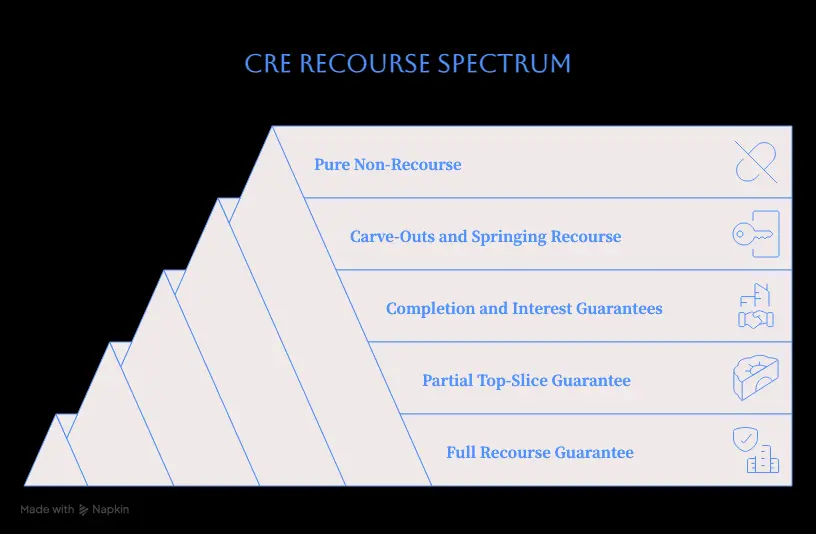
The choice between recourse vs non recourse loans in commercial real estate is not binary. It is a spectrum of instruments, each transferring a defined slice of risk from lender to sponsor.
Full recourse guarantee
The sponsor stands behind the entire loan amount. Rare in institutional transactions on stabilised assets, more common at smaller loan sizes, with untested sponsors, or where the asset’s income cannot yet carry the leverage requested.
Partial guarantees
The sponsor guarantees a defined percentage of the loan, commonly a top-slice of 25 to 50 per cent. The lender’s most exposed layer is covered; the sponsor’s downside is capped and known. Partial guarantees are the workhorse of transitional lending, because they price the gap between the asset’s current performance and its business plan.
Completion guarantees
On development and heavy refurbishment, the sponsor guarantees that the project reaches practical completion, on budget, regardless of cost overruns. Lenders treat this as non-negotiable on most development facilities: construction risk is a sponsor risk, not a collateral risk.
Interest shortfall and carry guarantees
The sponsor covers debt service and holding costs during a defined period, typically until the asset’s income reaches an agreed coverage level. Common on assets acquired vacant or part-let.
Environmental and other indemnities
Standing indemnities for liabilities that sit outside the property’s value entirely, such as contamination. These typically survive even where every other obligation has fallen away.
A sponsor evaluating loan terms should read the guarantee schedule as a priced menu. Each item is a risk transfer with a value, and each is negotiable against the economics of the facility.
Recourse Burn-Off: The Clause Sponsors Under-Negotiate
The guarantee a sponsor signs at closing does not need to be the guarantee they carry at maturity. Well-structured facilities include burn-off provisions: defined performance tests that reduce or extinguish the sponsor’s recourse obligations as the asset proves itself.
Typical triggers include the asset reaching a stabilised occupancy level, sustaining a minimum DSCR over consecutive quarters, or achieving a debt yield threshold. When the test is met, a partial guarantee steps down or falls away entirely, and the facility becomes non-recourse in substance as well as label.
The commercial logic is sound for both sides. The lender required the guarantee to cover business plan risk; once the plan is delivered, the risk it priced has gone. The sponsor’s incentive is to negotiate burn-off triggers that are objective, measurable and achievable within the loan term, and to resist tests that reference lender discretion or valuations the sponsor cannot influence.
In practice, sponsors negotiate margin to the basis point and accept burn-off language on the lender’s template. That is backwards. Over the life of a transitional facility, the difference between a guarantee that burns off at stabilisation and one that runs to maturity is usually worth more than the margin negotiation.
Springing Recourse and Carve-Out Guarantees
Non-recourse protection in CRE is conditional, and the conditions arrive through two mechanisms.
The first is the carve-out guarantee, signed by the sponsor rather than the SPV, under which defined bad acts, fraud, misappropriation of funds or interference with the collateral, convert specific losses or the entire loan into a personal obligation. The scope of that schedule, not the non-recourse label, defines where the sponsor’s protection actually ends, and it warrants legal review before heads of terms are signed.
Standard English-law documentation for these facilities follows the Loan Market Association’s real estate finance framework, examined from the borrower’s side in Jones Day’s guide to the LMA REF facility agreement.
The second is springing recourse, and it is CRE-specific. Most institutional loan agreements provide that a voluntary insolvency filing by the borrower, or sponsor interference with the lender’s enforcement, springs the loan from non-recourse to full recourse against the guarantor.
The purpose is deterrence: the lender is removing the sponsor’s incentive to use an insolvency process tactically to frustrate enforcement. This clause is close to universal and close to non-negotiable. What is negotiable is precision: exactly which acts spring the recourse, and ensuring involuntary proceedings initiated by third parties do not. For the wider set of triggers that shift control to lenders, see Events of Default in 2026.
Lender Insight: How Lender Type Determines Recourse Appetite
How lenders price recourse vs non recourse loans varies more by lender type than by asset, and approaching the wrong lender type is how sponsors end up carrying guarantees the market would not have required.
Banks sit at the recourse-heavy end. Regulatory capital treatment rewards credit enhancement, and bank credit committees are institutionally reluctant to hold pure asset risk, so bank facilities on anything other than prime stabilised assets typically arrive with partial guarantees or interest support attached. The compensation is pricing: bank debt remains the cheapest senior money available.
Insurance company lenders are the traditional non-recourse channel on prime, long-let assets, consistent with their preference for clean, long-dated exposures. Securitised lending is structurally non-recourse apart from carve-outs, because a guarantee from a sponsor cannot follow a loan into a securitisation.
Debt funds and private credit lenders treat recourse as a pricing variable rather than a policy. A fund quoting a transitional asset will often present alternatives: higher leverage with a partial guarantee, or lower leverage without one.
That flexibility is why private credit has taken the ground it has in transitional CRE lending. How these lender types differ across pricing, process and covenants more broadly is covered in Senior Debt in Commercial Real Estate.
The sequencing point matters: a sponsor’s recourse tolerance should be defined before the lender process starts, because it determines which lender types are viable at all.
Recourse as Negotiating Currency
Sophisticated sponsors treat recourse as currency, because lenders do. Every element of the guarantee package can be traded against the other terms of the facility: guarantee scope against LTV, interest support against margin, burn-off triggers against covenant headroom.
Concretely: a lender uncomfortable at 65 per cent LTV on a part-let asset may hold that leverage if the sponsor guarantees interest until an agreed DSCR is met. A sponsor unwilling to give a top-slice guarantee can often buy it out by accepting senior proceeds at the lower end of the typical 50 to 65 per cent stabilised range.
Neither position is right in the abstract; the right trade depends on the sponsor’s balance sheet, the concentration of their wealth in the deal, and the credibility of the business plan.
The negotiation happens at term sheet stage or not at all. Guarantee scope, triggers and burn-off mechanics accepted in heads of terms are close to immovable once documentation begins. Where that negotiation sits within the wider financing sequence is set out in Commercial Real Estate Financing: 9 Steps to Close.
Scenario: Pricing the Guarantee Against the Leverage
A family office acquires a £24 million regional logistics asset at 78 per cent occupancy through an SPV. Two term sheets arrive, and they frame the recourse vs non recourse loans trade in cash terms.
Lender A, a debt fund, offers £15.6 million, 65 per cent LTV, with a 25 per cent top-slice guarantee from the sponsor and an interest shortfall guarantee until the asset sustains 1.25x DSCR for two consecutive quarters, at which point both obligations burn off.
Lender B, an insurer, offers £12 million, 50 per cent LTV, non-recourse apart from standard carve-outs, at a margin 40 basis points inside Lender A.
Lender A’s structure releases £3.6 million more capital and extinguishes the sponsor’s exposure once the leasing plan lands, but the guarantee is real money if it does not. Lender B caps the sponsor’s downside at the equity from day one, at the cost of a larger equity cheque now.
The deciding inputs are the sponsor’s confidence in the leasing programme and how much of their liquid wealth the additional equity would consume. This example is illustrative only and not based on any specific transaction.
Conclusion
In commercial real estate, the choice between recourse vs non recourse loans is not a label on the facility.
It is an allocation of risk, negotiated instrument by instrument, between the lender and the sponsor standing behind the SPV. The sponsors who secure the strongest positions are those who arrive knowing their recourse tolerance, read the guarantee schedule as closely as the pricing grid, and negotiate the burn-off as hard as the margin.
If you are structuring a facility and want the guarantee package to reflect your position rather than the lender’s template, we welcome a discreet conversation. Contact us today for a confidential conversation.
For how recourse allocation fits within the full financing sequence, see the Commercial Real Estate Playbook.