
Data Centres Project Finance: How Lenders Structure Debt for New Capacity
Two 48 MW data centres can cost the same to build, draw on the same grid connection and look identical from the car park. One is pre let for 15 years to an investment grade hyperscaler. The other is let on a five year term to a younger AI cloud operator.
In the illustrative case worked through below, the first raises around 70 per cent of its cost as senior debt and the second a little under 60 per cent. The building is not what separates them.
That is the logic at the centre of data centres project finance. The lender still underwrites the whole project, from the sponsor and the construction contract to the power supply, operating costs and re letting risk, but the credit starts with the lease.
The building is the machine that produces the cash flow the lease promises. Our overview of data centre financing below the billion-dollar threshold maps who lends in this market and at what scale.
This post goes one level down, into how a project finance lender structures the debt on a single new facility: what it underwrites, how it sizes the loan, what security it takes, and where sponsors give away leverage they could have kept.
The scenario that follows is illustrative. The facility, the tenant and every figure are assumptions constructed to show the decision points, not drawn from a live transaction.
Why Data Centres Project Finance Starts With the Lease, Not the Building
Project finance is the financing of a single asset or a defined portfolio, with lenders primarily relying on the revenues generated by those assets for repayment.
In practice, a special purpose vehicle, a separate legal entity formed to own and develop one facility, borrows on a non recourse or limitedrecourse basis. The lender’s first question is not what the building is worth. It is how certain the revenue is.
That is a different discipline from conventional commercial real estate lending, even though a data centre looks like property. A property lender sizes against value and income and falls back on the asset.
A purpose built data centre in the hands of a receiver, with no tenant, is a specialised building with a very narrow buyer pool, and every credit committee knows it. So the lease carries most of the credit, and the building supports it.
The recourse position follows the same logic. Sponsors typically give targeted support during construction, which falls away once completion and performance milestones are met.
The general mechanics of guarantees and burn off are covered in Recourse vs Non-Recourse Loans in Commercial Real Estate.
The difference here is the trigger. In a data centre, the milestone that releases the sponsor is usually the tenant’s acceptance of the facility and the start of rent, not an occupancy percentage.
What a Lender Reads in the Lease Before It Reads the Model
Four things are tested before pricing is discussed.
- Tenant credit. Long term lease or colocation agreements with investment-grade hyperscalers act as the foundational credit support in these structures. The tenant’s credit rating is typically the largest single driver of leverage and pricing, and much of the rest of the structure adjusts around it.
- Termination and assignment. A 15 year term on the front page means little if the tenant can walk in year four. Lenders go through termination rights, assignment rights and change-of-control provisions line by line, because each one is a route by which the revenue can disappear while the debt remains.
- Service levels. Hyperscale contracts carry uptime commitments with teeth. Under some agreements, a breach of just 26 seconds can activate penalties that behave like uncapped, variable operating expenses, and chronic failures can allow the tenant to terminate outright. A lender reads the service level schedule as part of the revenue line, not as an operational appendix.
- Rent commencement. Hyperscalers increasingly agree firm rent commencement dates regardless of construction delays. For a lender, that is a meaningful shift. It turns a construction delay from a revenue problem into a cost problem, and a cost problem can be covered by contingency and sponsor support.
Power sits alongside all four. A letter from a network operator saying capacity may be available carries little weight with a credit committee. What counts is an accepted grid connection offer with a date.
In Great Britain, that offer also carries money at risk. Demand customers connecting to the transmission network are liable for the full cost of the works their connection triggers, and must secure part of that liability from the point they accept the offer. Ofgem has gone further for data centres, proposing a commitment fee of £237,500 to £712,500 per MW for projects of 40 MW and above, to be secured from offer acceptance and returned on energisation.
The proposal was consulted on until September 2026, with a decision expected later in the year. Whatever the final figure, grid security belongs in the funding plan from day one, not in a funding request in month nine.
The Illustrative Case: Sizing Debt on a 48 MW Pre-Let
For illustration, assume a developer is building a 48 MW facility in the UK, measured by critical IT load. Assume a total project cost of £456 million, which is Ofgem’s own working assumption of £9.5 million per MW of capacity, covering land, shell and core, mechanical and electrical fit-out, interest during construction and fees.
Under the Ofgem proposal, a project of this size would also post between £11.4 million and £34.2 million of grid security until energisation, in cash, a bond or a letter of credit. How that security is provided is a structuring decision in its own right.
Assume the facility is 100 per cent pre-let to an investment-grade hyperscaler on a 15-year lease at £94 per kW per month. Once the tenant accepts the facility, rent runs at £54.1 million a year.
After an assumed £6.4 million for the landlord’s share of operation and maintenance, insurance and other costs, net operating income is £47.7 million.
The lender sizes the senior debt two ways and takes the lower figure.
The first test is loan-to-cost. Foley & Lardner reports project finance for data centres often reaching 60 to 80 per cent loan-to-cost where strong tenants are in place. Assume this lender caps at 70 per cent: £319.2 million.
The second is debt service coverage. Assume the lender requires 1.35x on a loan amortising over 15 years at an all-in rate of 7 per cent. The £47.7 million of income supports £35.3 million of annual debt service, which carries roughly £322 million of debt.
Here the two tests land close together, and loan-to-cost binds. Senior debt is £319.2 million, annual debt service is £35.0 million, and coverage sits at about 1.36x. The sponsor funds £136.8 million of equity.
How Tenant Credit Moves the Whole Structure
Now change one thing. The same building is let to a well funded but unrated AI cloud operator on a five year term, at the same rent.
The lender’s view of the revenue changes completely. The credit behind the contract is weaker, and the lease ends well inside the loan’s life, so the lender is carrying re letting risk on a specialised asset.
For illustration, assume it now requires 1.50x coverage and prices at 8.5 per cent. The same £47.7 million of income supports £31.8 million of debt service, which carries roughly £264 million of debt: 58 per cent of cost.
The equity requirement rises from £136.8 million to around £192 million. That £55 million gap is created entirely by the tenant. The building, the power and the construction budget have not changed.
There are three ways to close it. Mezzanine financing or preferred equity can sit behind the senior loan, at a higher cost of capital. A joint venture partner, often infrastructure capital, pension funds or sovereign wealth funds seeking long-duration exposure, can take part of the equity.
Or the sponsor funds it directly. On weaker tenant credit, a lender will also usually add a cash sweep that accelerates repayment as the lease end approaches, which reduces what the sponsor can take out of the project in the meantime.
The practical point for sponsors is that tenant selection is a financing decision, not only a leasing decision. The lease is effectively the term sheet.
The Security Package in a Project Company
A conventional property lender takes a first charge, an assignment of rents and control of the rent account, as set out in Senior Debt in Commercial Real Estate.
A project finance lender takes more, because it needs to be able to step into the whole operating business, not just repossess a building.
The core of the package is a pledge over the shares of the project company. If the lender enforces, it takes the entire company with its contracts intact, which preserves the lease rather than terminating it.
This is also why lending to the project company matters: debt at a holding company above it sits behind the creditors of the entity that actually owns the asset, as explained in Structural Subordination in 2026.
Around that sit assignments of the lease, the construction contract, the operation and maintenance contract and the power arrangements. Direct agreements with the tenant, the contractor and, where available, the network operator give the lender notice and a right to cure or step in before any counterparty can terminate.
Cash then moves through a fixed order of priority. Every pound of rent is paid into a project account and applied in sequence, with a debt service reserve account held back, commonly sized to around six months of debt service, and a lock-up that traps cash if coverage falls below an agreed level.
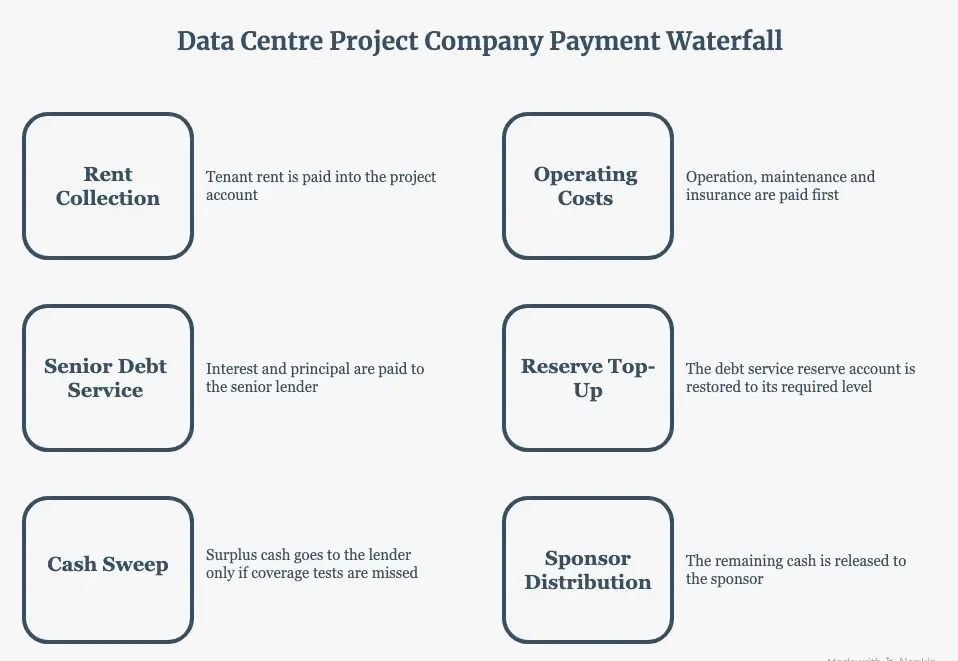
That waterfall is where much of the negotiation value sits. The level at which cash is locked up, and whether a sweep is permanent or reverses once coverage recovers, determines how much of the project’s cash the sponsor actually sees over the life of the loan.
Construction Risk Before the Rent Starts
Rent does not flow until the tenant accepts the facility, so the lender has to be comfortable with the build before it is comfortable with the lease. Construction risk is managed through engineering, procurement and construction agreements designed to deliver cost and schedule certainty, backed by contractor guarantees, milestone testing and lender controls over each drawdown.
The draw mechanics, retainage and contingency sizing follow the same principles covered in Construction Loans in Commercial Real Estate.
What is specific to a data centre is the hinge between the two phases: tenant acceptance testing. Power, cooling and resilience systems are tested under load before the tenant signs off, and that sign-off is usually the moment rent starts, construction guarantees fall away and the loan moves from construction debt to an operating facility.
A sponsor who negotiates clear, objective acceptance criteria in the lease is negotiating the release of their own guarantee.
Where the Capital Comes From
Below the billion dollar line, the senior debt in a structure like this comes from banks with project finance desks, infrastructure debt funds and private credit, often in combination. The subordinated layers and joint venture equity come from a wider pool.
Once the facility is operating and the lease has run for a period, the construction phase debt is usually replaced with long-term debt on better terms, a stage we will cover separately.
The equity cheque is often where the most interesting structuring happens. Many sponsors in digital infrastructure are founders or investors with significant listed technology holdings, and increasingly digital assets.
Rather than selling a core position to fund an equity commitment of £137 million or more, some raise it against that position through a stock loan for concentrated shareholders or crypto-backed lending.
Senior lenders will ask where the equity is coming from, so a facility of this kind at sponsor level should be disclosed and presented as part of the funding plan from the outset.
What to Have Ready Before Approaching Lenders
The executed lease or a heads of terms with the key economic and termination provisions agreed, together with the tenant’s credit profile.
A signed or near final construction contract with price, programme and liquidated damages, and a contractor with a data centre completion record.
An accepted grid connection offer with a date, and a clear plan for how any connection security will be provided.
A financial model that shows coverage on the lender’s assumptions, not the sponsor’s, including a downside in which rent starts late.
A defined equity plan, including where each part of the sponsor equity comes from.
Conclusion
Data centres project finance rewards sponsors who understand how much of the loan is written against the lease.
Tenant credit, termination rights, service levels and the rent commencement date shape the leverage before a lender has looked in detail at the construction budget.
The security package and the cash waterfall then decide how much of the project’s cash the sponsor actually keeps. Sponsors who negotiate the lease with the lender’s reading of it in mind, and who arrive with the grid security and the equity plan already solved, make the transaction easier to underwrite and keep more of their financing options open.
If you are structuring the debt on a new data centre facility and want the terms built around your lease and your tenant’s credit, we welcome a discreet conversation. Contact us to discuss the position.
For a more structured breakdown of how these strategies are applied in practice, see the Commercial Real Estate Finance Playbook.