
Construction Loans Commercial Real Estate: What Sponsors Need to Know Before the First Draw
A stabilised asset loan is priced against income that already exists. A construction loan is priced against income that does not exist yet, secured by a building that is not yet complete, and monitored month by month against a budget that is considerably easier to blow than to hold.
That difference in kind, not just in tenor, is why construction loans in commercial real estate are underwritten, structured and administered differently from every other instrument in the capital stack.
What US practice generally calls a construction loan, UK and European sponsors are just as likely to encounter as development finance, and the transitional facility that follows it is often described locally as a bridging loan rather than a mini-perm. The mechanics below apply across all three labels.
Why Commercial Real Estate Construction Loans Are Underwritten Differently
A senior lender against a stabilised asset is underwriting a lease roll and a rent line that already exist. A construction lender is underwriting a plan: a guaranteed maximum price contract, a general contractor’s development experience, a completion timetable, and a sponsor’s capacity to cover cost overruns before the asset produces a single pound of income.
There is no debt yield to test and no cap rate to apply until the building is finished and let. Every protection in the loan documentation exists because the lender is financing an outcome that has not yet happened, across office, retail, multi-family and warehouse developments alike. For offices, logistics and certain retail developments, lenders may also underwrite the quality and timing of pre-leasing, since committed occupiers materially reduce leasing risk after completion.
Who Actually Provides Commercial Construction Loans
The lender pool for construction loans commercial real estate sponsors can access is narrower than for stabilised debt, and the differences between providers matter more than the headline rate. Banks with dedicated construction desks are typically fastest for sponsors with an existing relationship and a proven track record, but they tend to hold out for full or near-full recourse and construction loan terms of twelve to twenty four months.
Debt funds fill the gap for higher-risk projects or for borrowers without a longstanding bank relationship, pricing at a premium to bank debt but usually offering more flexible draw administration and faster closing timelines.
Insurance companies rarely fund during the construction period itself, but many will forward commit to the permanent take out loan before the first draw is made, which is itself a structuring tool: locking the exit financing before the shovel goes into the ground removes one of the largest sources of timing risk in the project, a point worth raising with any lender relationship covered in Senior Debt in Commercial Real Estate.
Where Construction Debt Sits in the Capital Stack
Construction loans are typically sized against loan-to-cost rather than loan-to-value, commonly in the 55 to 65 percent range of total project cost, with the balance funded through sponsor equity financing and, where the gap warrants it, mezzanine or preferred equity behind the construction senior.
The structuring principles for that subordinate layer are the same ones covered in Mezzanine Financing: the intercreditor agreement, not the headline rate, determines what happens if the deal goes wrong. This loan-to-cost basis is also temporary.
Once the asset is complete and let, the lending metric shifts to loan-to-value, the basis used throughout the permanent debt market, which is one reason the construction to permanent transition is a genuine underwriting event and not a formality.
The Draw Schedule: How Construction Loan Funds Are Released
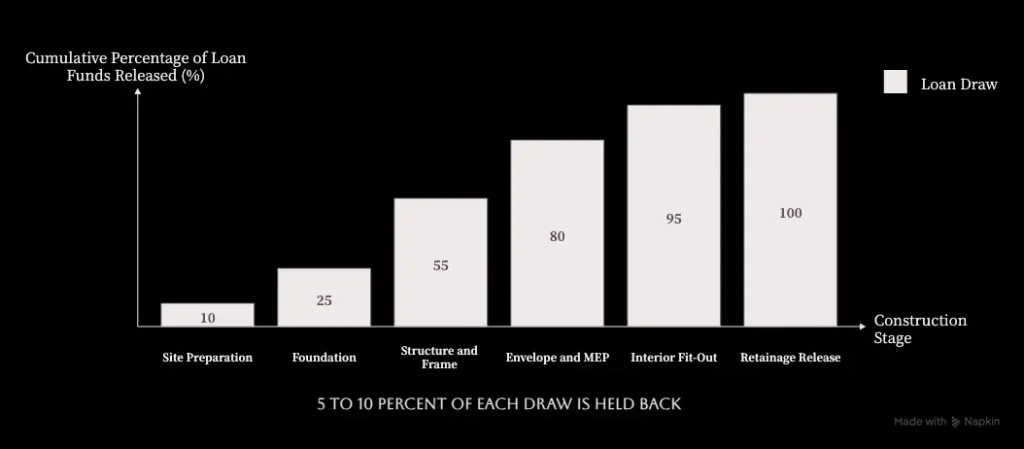
Unlike a term loan funded in a single advance, a construction loan is released in stages against verified progress. Each draw request is tied to a specific construction milestone, confirmed by an independent inspecting architect, engineer or, in UK practice, an independent quantity surveyor, rather than taken on the contractor’s word, and accompanied by lien waivers from every subcontractor paid in the prior draw. Lenders typically hold back five to ten percent of each draw as retainage, released only at substantial completion, which gives the lender continuing leverage over the contractor through to the end of the project rather than only at the start.
Draw frequency is typically monthly, timed to the contractor’s payment application cycle. In UK and European transactions this is usually formalised through an independent certifier’s interim certificate rather than a single standardised national form, so international sponsors should confirm which certification convention a lender expects before the facility is documented, not after the first draw is submitted.
Cost-to-complete verification runs alongside every draw: the lender is not just confirming what has been spent, but recalculating whether the remaining percentage of the total project cost still fits the budget. A budget that looked adequate at closing can fail this test halfway through the project if costs have moved, which is precisely the scenario sponsors need to plan for before it happens rather than during it.
Risk Mitigants Lenders Require Before Funding
Before a construction facility is funded, lenders generally require a guaranteed maximum price contract with a contractor whose development experience and bonding capacity have been independently verified, payment and performance bonds sized to the contract value, and an interest reserve sized to cover the full construction period plus a realistic delay buffer rather than the sponsor’s base-case timeline.
Most facilities also carry a completion guarantee from the sponsor, a recourse carve-out that survives even where the underlying loan is otherwise structured on a non-recourse basis, a distinction worth understanding in the context of Recourse vs Non-Recourse Loans in Commercial Real Estate.
The facility is rarely non-recourse in practice during construction itself: the completion guarantee typically operates as full recourse until the project reaches an agreed stabilisation or performance test, at which point it burns off, a distinction sponsors who assume non-recourse means no personal exposure throughout the project often miss.
A hard cost contingency line, typically five to ten percent of construction costs, sits behind all of this as the first line of defence against overruns before the completion guarantee is ever called on.
Institutional facilities typically separate this into a hard cost contingency for construction overruns and a smaller soft cost contingency for non construction items such as design fees, permits and extended interest during a delay, and sponsors should confirm both are sized independently rather than assuming one covers the other.
Illustrative Scenario: When the Budget and the Calendar Diverge
Consider a sponsor developing a mid-sized logistics facility under a guaranteed maximum price contract, with an interest reserve sized for an eighteen month build.
Six months in, a structural steel delay pushes the schedule out, and rising input costs consume most of the hard cost contingency before the building is topped out.
Under the loan agreement, the lender is entitled to require a sponsor equity injection under the completion guarantee before releasing the next draw. The sponsor is left choosing between funding the gap personally or accepting a delay that pushes completion into a different leasing market than the one underwritten at closing.
This is not an unusual outcome. It is the scenario every construction loan is documented to anticipate, and the sponsors who negotiate contingency sizing and completion guarantee scope properly at closing are the ones with real options when it happens, rather than a single expensive one.
The cost backdrop makes this more pressing in 2026 than it was two years ago. Mortenson’s Q1 2026 Construction Cost Index recorded nonresidential construction costs up 1.7 percent quarter on quarter and 6.8 percent year on year, with materials specifically up 7.0 percent annually. A contingency line sized against a 2024 or 2025 cost base is materially thinner in real terms before the first draw is even funded.
Commercial Real Estate Lending Conditions in 2026
Credit for construction and land development lending has not tightened sharply this year, but it has not loosened either.
The Federal Reserve’s July 2026 Senior Loan Officer Opinion Survey reported that standards for construction and land development loans remained basically unchanged on net in the second quarter, while a moderate net share of banks reported weaker borrower demand for these facilities.
Read together, capital is available for well-structured deals, but lenders are not competing aggressively for higher-risk projects the way they might for stabilised income-producing assets, and due diligence on the contractor, the contingency and the completion guarantee carries more underwriting weight than it did in a looser cycle.
Moving From Construction Loans to Permanent Debt
Few construction facilities are designed to be held to term. Sponsors generally plan for one of three outcomes at completion: a construction to permanent facility that converts automatically once stabilisation covenants are met, a mini-perm bridge while the asset leases up, similar in structure to the instrument covered in Bridge Loan Commercial Real Estate, or a full refinance into permanent debt once the asset has an operating history, following the process, and the loan-to-value, debt service coverage and debt yield benchmarks, set out in Commercial Real Estate Refinance.
The risk sponsors most often underweight is timing: the rate and terms available at delivery can differ materially from the environment at closing, which is why negotiating a forward rate commitment or a clearly defined take out strategy before breaking ground is worth more than a marginally better construction rate at signing.
What to Consider Before Signing a Commercial Construction Loan
Size the contingency against current cost inflation, not the figures used when the budget was first drawn up, since input costs have moved materially over the past year.
Verify the contractor’s development experience and actual completion history rather than relying on reputation alone. Confirm the precise triggers for retainage release and make sure they are documented, not assumed.
Read the completion guarantee carve-out closely, since its scope is often broader than the sponsor expects going in.
Size the interest reserve against a realistic delayed timeline rather than the contractor’s best-case schedule, compare rates and terms across the narrower pool of active construction lenders rather than defaulting to the first relationship bank approached, and agree a take-out financing strategy in principle before the first draw is funded, not for the first time as completion approaches.
Conclusion
Construction lending rewards preparation more than any other instrument in the commercial real estate capital stack, precisely because so much of what it finances has not happened yet.
With material costs still rising faster than headline inflation and lenders holding standards steady rather than easing, the sponsors who allocate completion risk correctly before the first draw is funded are the ones who reach permanent financing on schedule. The ones who do not are the ones renegotiating in month fourteen.
Construction lending is less about financing concrete and steel than financing execution. The strongest projects rarely succeed because nothing goes wrong; they succeed because the capital structure anticipates what eventually does.
If you are structuring construction financing for a commercial development and want completion risk allocated correctly before the first draw goes out, we welcome a discreet conversation. Contact us today.