
Senior Debt in Commercial Real Estate: How Lenders Differ

Most commercial real estate transactions are financed primarily by senior debt. Where it sits in the capital stack, ahead of mezzanine and preferred equity, is set out in Capital Stack Structuring 2026. What gets less attention, and what actually determines the terms a borrower receives, is which lender provides that senior debt and how materially their requirements differ from one another.
Banks, insurance companies, CMBS conduits and debt funds all originate senior debt against commercial property, but they are not interchangeable. Each prices risk differently, structures security differently, and imposes a different covenant package. A borrower who approaches the wrong lender type for their asset and timeline does not get a worse deal, they often get no deal at all.
How Senior Debt Lenders Differ in Practice
Banks
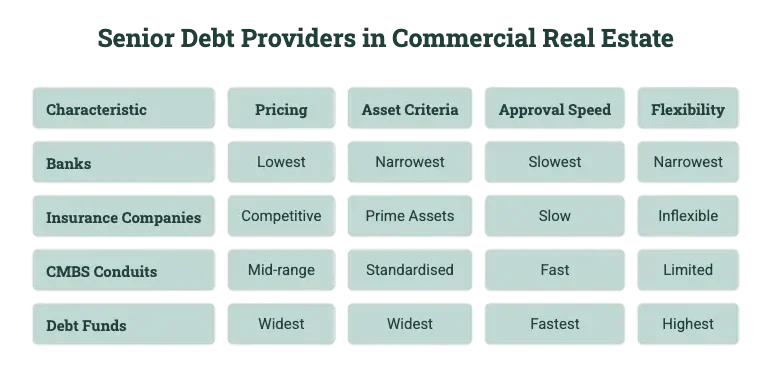
Banks remain the most conservative source of senior debt for commercial property, and usually the most price competitive when a transaction fits their book. That conservatism shows up most clearly in the credit committee process itself, multiple approval layers, extensive documentation requirements and a slower path to signed terms than any other lender type covered here.
Bank senior debt is typically the cheapest in the market, but borrowers should expect the longest and most heavily scrutinised approval process of any senior lender. For which transaction types actually fit a bank’s book in the first place, see CRE Financing Guide: Choosing the Right Capital Source.
Insurance Companies
Insurance companies lend against commercial property to match long dated liabilities, which makes them a natural source for borrowers seeking ten to twenty five year terms rather than the five to seven year terms more typical of bank facilities.
Pricing on prime, well let assets can undercut bank pricing, but insurers are highly selective on sponsor track record and asset quality, and largely inflexible once terms are agreed. An insurer is not a lender a borrower can renegotiate with mid term in the way a relationship bank sometimes will, the trade off for competitive long dated pricing is reduced flexibility for the life of the loan.
CMBS Conduits
Commercial mortgage backed securities (CMBS) lending originates senior debt with a view to pooling and selling it into a trust, not holding it on balance sheet. Underwriting is more standardised and less relationship driven than bank or insurance lending, which can mean faster initial execution, but materially less flexibility after closing.
Once a loan is securitised, amendments, waivers and extensions are handled by a servicer acting on behalf of bondholders rather than a single decision maker with discretion. Borrowers who anticipate needing flexibility during the loan term, a lease renegotiation, a partial release, an early repayment on favourable terms, should weigh that constraint carefully before choosing a conduit lender.
Debt Funds
Private credit and debt fund lenders sit at the most flexible end of the senior debt market. They move faster through credit approval than banks or insurers because they are not subject to the same regulatory capital constraints, and that speed and flexibility is priced. Debt fund senior debt typically carries a wider margin than bank or insurance pricing, and is more often structured on a floating rate basis.
Some debt funds also offer senior stretch facilities, combining senior and mezzanine proceeds into a single tranche to simplify execution and reduce the number of counterparties. That structure changes the risk and intercreditor position materially and is a distinct product from a conventional senior loan, worth raising explicitly with any debt fund lender quoting a stretch structure.
The Security and Covenant Package
Whichever lender type is involved, a senior commercial property facility is built around a consistent security package. The lender takes a first ranking legal charge over the property itself, an assignment of leases and rents so it can collect rental income directly if the borrower defaults, and in most facilities, control over a designated account through which rental income and reserves flow. Reserve accounts for interest, capital expenditure and leasing costs are standard on income producing assets, and the lender’s consent is typically required before reserve funds are released.
Financial covenants are tested on an ongoing basis, not only at closing. The Debt Service Coverage Ratio and loan to value tests set out in Real Estate Finance Basics and Commercial Real Estate Financing: 9 Steps to Close apply directly to senior facilities. A breach of either, even without a missed payment, typically triggers cash sweep provisions or restricts distributions to the sponsor well before it becomes a formal event of default. Negative covenants restricting additional borrowing, change of control and disposal of the asset without consent complete the package, and are negotiated harder by debt funds, who price flexibility, than by banks, who price conformity.
Where Senior Debt Sits Once Other Capital Joins the Stack
If mezzanine debt or preferred equity is layered behind the senior facility, see Preferred Equity in Real Estate for how that layer is structured, an intercreditor agreement governs how the senior and subordinate lenders interact, including standstill periods and enforcement rights. The mechanics of that agreement are covered in Intercreditor Agreement 2026.
Borrowers structuring a layered capital stack should treat the intercreditor negotiation as a parallel workstream to the senior loan documentation, not an afterthought once senior terms are agreed, since the senior lender will typically insist on approving the subordinate lender’s rights before closing.
It is also worth noting that seniority is not always as straightforward as the label suggests, particularly where borrowing sits across multiple entities in a group structure. Structural Subordination 2026 sets out why a lender’s senior position at one level of a structure does not guarantee priority access to the underlying asset, a distinction that matters most to borrowers operating through holding company structures rather than a single asset owning entity.
Maturity and Refinance Risk
Senior commercial property debt is rarely amortised to zero over its term. Most facilities carry a substantial bullet repayment at maturity, which means refinancing risk sits with the senior lender as much as the borrower.
Refinancing Risk 2026 sets out how a compressed execution window can force a borrower into worse terms regardless of asset quality, a dynamic senior lenders price for by tightening covenants and reducing leverage as a facility approaches its maturity date, well before any formal default occurs. Borrowers should expect a senior lender to start asking refinancing questions twelve to eighteen months ahead of maturity, and to treat the answers as a live input into how the existing facility is managed in the meantime.
What This Means for Borrowers Approaching the Market
Choosing a senior lender is a structuring decision, not a procurement exercise. Two lenders quoting senior debt against the same property at similar headline pricing can differ enormously in covenant flexibility, post closing responsiveness and how easily terms can be renegotiated if circumstances change.
For the upstream question of which type of capital, senior debt, mezzanine, preferred equity or bridge, actually fits a given transaction, see CRE Financing Guide: Choosing the Right Capital Source. Once senior debt is the right instrument, the lender type choice covered here is what determines whether the facility that closes still works for the borrower three years into the term.
Conclusion
This post is part of the Forbes Le Brock Commercial Real Estate Finance Playbook, which sets out how senior, mezzanine and preferred capital are sourced and structured across UK, European and Asia-Pacific transactions.
If you are structuring a senior debt facility and want to confirm which lender type fits your asset and timeline, we welcome a discreet conversation. Contact us today