
Debt Yield in Commercial Real Estate: How Lenders Size the Loan

Most borrowers preparing a commercial real estate financing know their target loan-to-value. Fewer have stress-tested their deal against debt yield in commercial real estate lending, and it is often the metric that determines the actual proceeds a lender will advance, regardless of the LTV quoted on the term sheet.
Commercial Real Estate Financing: 9 Steps to Close introduces debt yield as one of four factors lenders assess before issuing terms. This post goes further: how lenders set thresholds by property type, how a loan actually gets resized when the calculation falls short, and why debt yield, LTV and DSCR do not all bind at the same point in a rate cycle. For the LTV, DSCR and NOI fundamentals this post builds on, see Real Estate Finance Basics.
Debt yield in commercial real estate is calculated as annual net operating income divided by the loan amount, expressed as a percentage. Unlike LTV, it takes no view on valuation. Unlike DSCR, it takes no view on interest rate or amortisation structure. It answers one question only: if the lender had to foreclose today, what return would the in-place income generate on the capital advanced.
Why Debt Yield in Commercial Real Estate Acts as a Floor, Not a Guideline
LTV and DSCR are both sensitive to inputs a lender does not fully control. Valuations move with cap rate assumptions that shift through a cycle. DSCR moves with interest rates and amortisation terms that can be structured around.
Debt yield in commercial real estate strips both variables out. It is a direct ratio of income to loan proceeds, which makes it the metric most private credit lenders and institutional debt funds use as a hard underwriting floor rather than a target to be negotiated toward.
That is the practical distinction borrowers miss. A sponsor can often negotiate LTV upward on a strong asset, or structure interest-only periods to improve DSCR. Debt yield resists both tactics. If the income does not support the requested loan amount at the lender’s minimum, the loan gets sized down until it does, irrespective of how favourable the LTV or DSCR calculation looks.
How Lenders Actually Resize the Loan
This is the mechanic most borrowers have not seen modelled. When a proposed loan amount produces a debt yield below the lender’s threshold, the lender does not decline the deal outright. They solve backward from the minimum acceptable ratio to establish the maximum loan proceeds the income will support.
A property generating £900,000 of annual NOI, facing a lender minimum debt yield of 9 per cent, supports a maximum loan of £10 million, regardless of what LTV that figure represents against the appraised value. If the sponsor requested £12 million based on a 60 per cent LTV calculation, the ratio caps proceeds £2 million short of that request. The borrower is left funding the gap through additional equity, mezzanine or preferred equity, not renegotiating the senior facility.
This is why debt yield in commercial real estate underwriting is best understood as a proceeds constraint rather than a risk score. It does not tell a lender whether to approve a deal. It tells them the ceiling on what they can advance once they have decided to.
Property-Type Variance in Minimum Thresholds
Debt yield in commercial real estate is not applied as a single floor across all property types. Perceived income durability and asset liquidity under stress both feed into where the threshold sits.
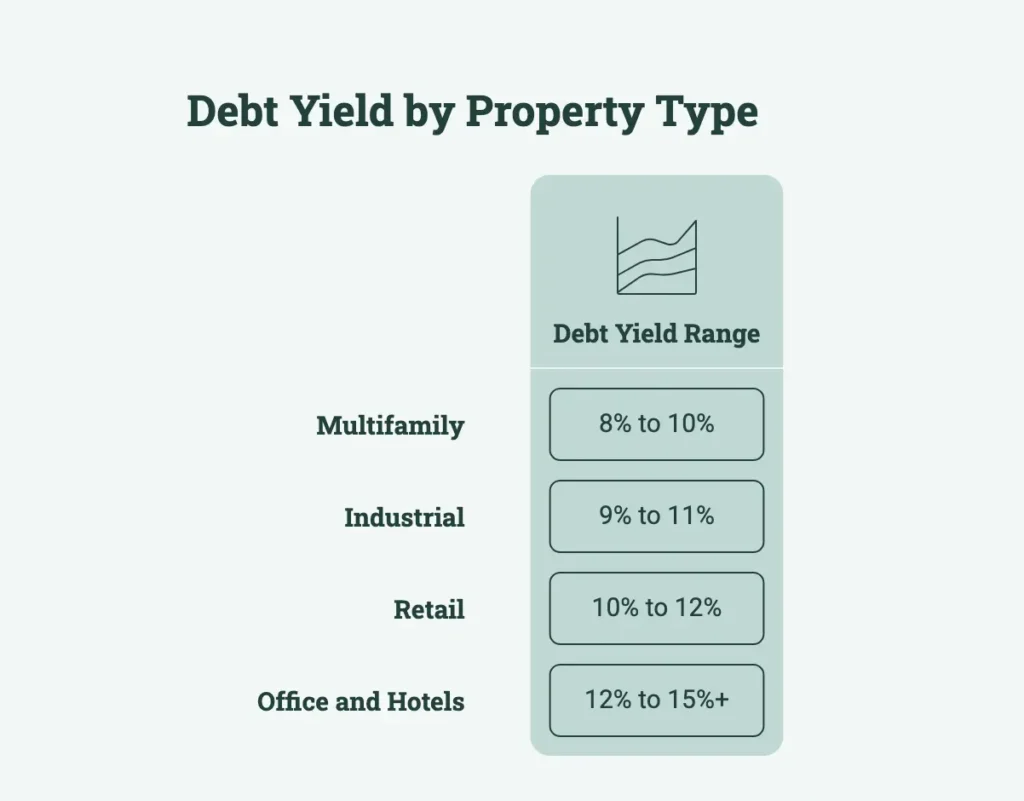
Multifamily assets typically clear at the lowest thresholds, often in the 8 to 10 per cent range, reflecting granular income across many units and comparatively deep secondary market liquidity. Industrial assets sit close behind, generally 9 to 11 per cent, supported by long lease terms and strong occupier demand across UK, European and Asia-Pacific logistics corridors.
Retail requires a higher floor, typically 10 to 12 per cent, reflecting tenant concentration risk and slower repositioning options if income falters. Office and hospitality assets attract the most conservative thresholds, frequently 12 to 15 per cent or higher, a direct response to structural demand uncertainty in office and the operational income volatility inherent in hospitality.
A sponsor targeting an office acquisition should stress-test proceeds against a floor materially higher than the multifamily assumptions that dominate general market commentary. Running the wrong property-type threshold produces a proceeds expectation that will not survive underwriting.
Thresholds also shift by market: minimums in UK and European institutional lending tend to sit toward the conservative end of these ranges relative to some Asia-Pacific markets, reflecting differences in market liquidity, lender appetite and regulatory capital treatment.
For the broader UK lending market context these thresholds sit within, Bayes Business School’s UK Commercial Real Estate Lending Report tracks underwriting terms across lender type and property sector twice yearly.
Which Metric Actually Binds
The more useful question for a sponsor structuring a transaction is not what debt yield in commercial real estate requires in isolation, but which of the three core metrics will actually constrain proceeds on this specific deal.
In a low interest rate environment, DSCR is easy to clear because debt service costs are low relative to income. LTV is often generous when valuations are supported by compressed cap rates. In that setting, debt yield frequently becomes the binding constraint, since it is immune to both the low rates that ease DSCR and the low cap rates that inflate value and support LTV.
When rates rise, the dynamic reverses. DSCR tightens first as debt service costs climb against a fixed income base, and it is often DSCR, not debt yield, that caps proceeds in a high-rate environment. The ratio remains relevant as a floor, but it stops being the metric doing the constraining work once debt service coverage becomes the tighter test.
Sponsors who model only LTV, or only DSCR, without checking debt yield against the lender’s property-type threshold, are the ones surprised at term sheet stage by proceeds materially below what their headline leverage target implied.
Modelling LTV, DSCR and Debt Yield Together.
A sponsor targeting a stabilised logistics asset at 65 per cent LTV may find that LTV alone supports a £20 million loan against the appraised value. DSCR, tested against the lender’s minimum 1.30x coverage, supports £18.8 million. Debt yield, tested against a 9.5 per cent property-type threshold, supports only £17.6 million.
In practice, the lowest of the three figures governs. The senior facility is sized to £17.6 million, not the £20 million the headline LTV implied, and the £2.4 million gap has to be closed through additional equity, mezzanine or preferred equity before the transaction can close. Running all three tests before term sheet stage, rather than discovering the shortfall after, is what separates a structured raise from a scramble.
Debt Yield at Refinancing
The ratio does not disappear once a loan closes. It resurfaces at every refinancing, tested against the lender’s then-current threshold rather than the one in place at origination. A facility that cleared comfortably three or five years earlier can fail the test at refinance if rates have risen, income has softened, or the incoming lender applies a more conservative property-type threshold than the outgoing one did. Sponsors approaching a maturity should model debt yield against current market thresholds well before the refinancing conversation starts, not assume the ratio that worked at origination still clears.
How Lenders Assess Debt Yield in Commercial Real Estate Deals
Debt yield underwriting does not happen in isolation from the rest of the credit file, and how a lender treats a marginal calculation depends heavily on the surrounding context of the deal.
Lenders scrutinise the NOI figure feeding the calculation before accepting it at face value. A pro forma NOI built on projected rent increases, near-term lease-up, or optimistic vacancy assumptions gets stress-tested down to in-place, trailing income before the test is applied. A borrower presenting forward-looking NOI without flagging the underlying assumptions invites a lender to apply a more conservative haircut than the sponsor’s own model.
Sponsor track record shifts how strictly the threshold is applied. A lender working with a sponsor who has successfully executed comparable transitional or repositioning strategies may accept a debt yield closer to the low end of the property-type range, on the basis that execution risk is better mitigated than the raw metric alone suggests. An unproven sponsor on the same asset will typically see the threshold applied at the conservative end, with limited room to negotiate.
Transitional and value-add assets are underwritten against a different expectation than stabilised income-producing property, and lenders will often apply the threshold on a projected stabilised basis with day-one proceeds capped more conservatively until the business plan delivers. This is also where bridge lending diverges most sharply from stabilised senior debt: bridge lenders typically underwrite to stabilised NOI rather than in-place income precisely because the asset has not reached stabilisation at the point of funding, a distinction covered in Bridge Loan Commercial Real Estate.
This is where the CRE Financing Guide’s distinction between capital sources becomes relevant: debt funds and private credit lenders are typically more comfortable underwriting to a stabilised ratio with a clear execution plan than banks or insurance companies, whose senior debt appetite still concentrates on assets already clearing the threshold on in-place income.
Lender type also shapes how rigidly the floor is enforced once a deal is marginal. Senior Debt in Commercial Real Estate sets out how banks, insurers, CMBS conduits and debt funds differ on pricing and covenant flexibility, and that same variance extends here: banks and insurers tend to hold the threshold as close to non-negotiable, while debt funds are more likely to flex proceeds against a wider structuring package, at a corresponding cost.
What to Consider Before you Approach Lenders
- Run all three metrics, not just LTV. The lowest figure governs, and it is rarely the one you would guess without running the numbers.
- Use the correct property-type threshold. A multifamily benchmark applied to an office acquisition will overstate achievable proceeds materially.
- Stress-test your own NOI before a lender does it for you. Present the in-place figure alongside any forward-looking assumptions.
- Match lender type to your asset’s stabilisation status. Debt funds and private credit lenders are typically more willing to underwrite to a projected stabilised debt yield than banks or insurers.
- Revisit the threshold at every refinancing. Do not assume the ratio that cleared at origination will clear again.
- Size the equity gap early, not at term sheet stage. Identify the mezzanine or preferred equity needed to close any shortfall before entering lender conversations.
Conclusion
Debt yield in commercial real estate does not replace LTV or DSCR in a lender’s credit process, and it is rarely the headline number quoted on a term sheet. It functions as the constraint that catches what the other two metrics can miss, particularly in low-rate environments where valuation and debt service assumptions can both look more favourable than the underlying income actually supports.
Sponsors who model debt yield against the correct property-type threshold before approaching lenders, rather than discovering the constraint at term sheet stage, protect their negotiating position and avoid the funding gap that comes from proceeds sized down after the fact. Sponsors who focus only on leverage targets often negotiate against the wrong constraint; understanding which metric actually governs proceeds before the first lender conversation leads to fewer surprises at credit approval.
If you are structuring a commercial real estate transaction and want proceeds modelled correctly against debt yield, LTV and DSCR before you approach lenders, we welcome a discreet conversation. Contact us today.
For a more structured breakdown of how these strategies are applied in practice, see the Commercial Real Estate Playbook.