
Bridge Loan Commercial Real Estate: Structuring the Gap Between Acquisition and Permanent Capital

A commercial real estate transaction rarely closes with a single, neat piece of financing. Between acquisition and stabilisation, or between a refinancing deadline and a sale, there is often a gap that conventional senior lenders are not positioned to fill on the timeline required. A bridge loan exists precisely for that gap. How it is structured determines whether a transaction completes smoothly or stalls under pressure.
For the fundamentals of what a bridge loan is and how it compares to other financing options, see Real Estate Finance Basics. This post goes further: how bridge financing is structured and priced in private credit markets, what lenders scrutinise before committing capital, and where the real risk in a bridge transaction sits.
Why Bridge Financing Exists in the Capital Stack
A commercial real estate bridge loan is not a product category in the way senior debt or mezzanine capital is. It is a function. Short-term, interest-only capital deployed to cover a defined period until permanent financing, sale proceeds, or stabilisation income becomes available. Its role in the capital stack is temporal, not positional, sitting senior, occupying the full stack on an acquisition, or layered alongside mezzanine financing depending on the transaction.
Terms typically run 6 to 24 months. Loan-to-value generally sits in the 60% to 75% range, more conservative than stabilised senior debt, reflecting the absence of established income to support the position. Pricing reflects execution risk over that fixed window, not a blanket premium for speed.
When a Bridge Loan is the Right Instrument
Three scenarios consistently drive demand for this kind of capital.
1. Acquisition timing mismatches. A buyer needs to close quickly, often to meet auction completion deadlines or secure a competitive position, before a permanent lender can complete full underwriting. The facility closes that gap, with the borrower refinancing onto a conventional loan once the asset’s income profile is established.
2. Stabilisation periods. The asset is acquired with below-market occupancy or needs repositioning. The borrower funds acquisition and capital improvements with short-term debt, leases up the asset, and only then qualifies for senior pricing that reflects stabilised income. Senior lenders price off in-place cash flow. Bridge lenders price off the credibility of the plan to get there.
3. Refinancing gaps. An existing loan matures before a sale or replacement financing is ready, often during rate volatility or tightened credit conditions.
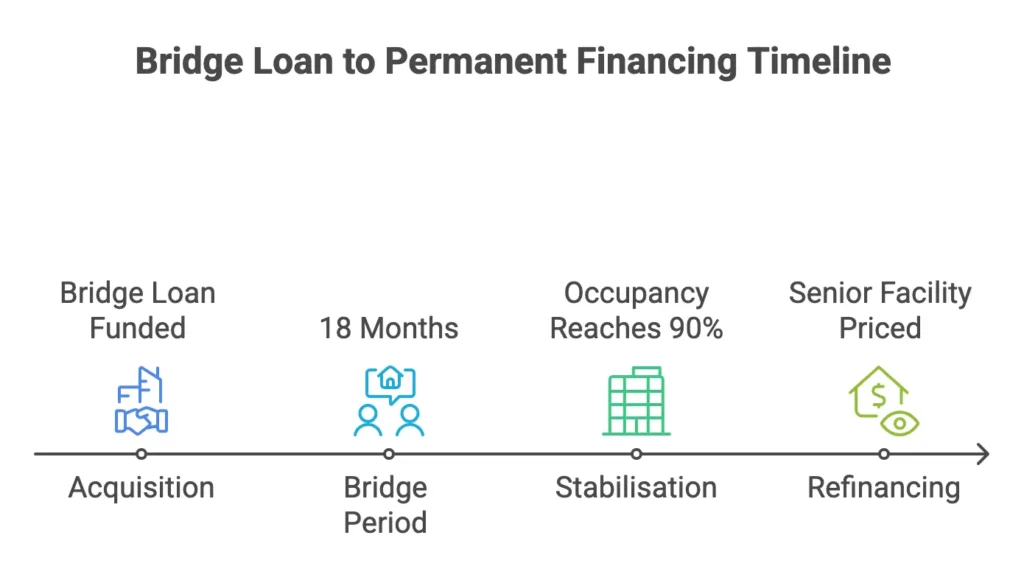
Illustrative example: A sponsor acquires a £10 million office asset at 60% occupancy, below the threshold most senior lenders require for stabilised pricing. A bridge lender funds the acquisition and a capital improvement budget at 65% LTV, interest rolled up rather than serviced monthly, over an 18-month term. The sponsor executes a leasing programme, brings occupancy to 90%, and refinances onto a senior facility priced off the now-stabilised income. This example is illustrative only and not based on any specific transaction.
How Lenders Structure and Price the Loan
One question dominates underwriting: what is the exit, and how credible is it. Everything else follows from the answer.
Interest is generally interest-only, serviced monthly or rolled up and capitalised into the balance, deferring cash payments until exit. Roll-up suits borrowers prioritising liquidity during repositioning, at the cost of a larger balance at maturity. Extensions are usually available at a fee and a rate step-up rather than open-ended, a contingency if the timeline slips without restructuring the whole facility.
Two borrowers acquiring comparable assets can land on materially different terms. One arrives with a signed refinancing term sheet or an agreed sale. The other arrives with an intention. For how lenders weigh this more broadly, see private credit underwriting.
A More Sophisticated View of Bridge Underwriting
Institutional lenders look past headline LTV. As-complete value is weighed against as-is value, to gauge how much of the return depends on the plan working. Debt yield sits alongside LTV because it doesn’t move with cap rate assumptions, a cleaner read if the realisation timeline extends. DSCR has limited use during the term itself, the asset isn’t generating stabilised income yet, which is exactly why exit credibility and sponsor strength carry more weight than current cash flow.
Sponsor strength is underwritten almost as heavily as the asset. A marginal deal often gets done, or doesn’t, on the strength of that track record alone.
Lender Typology: Who Is Actually Active in This Market
Appetite varies sharply by lender type, often more decisively than rate.
Debt funds and private credit balance-sheet lenders dominate the value-add segment, where pricing follows the credibility of a business plan rather than in-place income. Banks stay closer to lower-leverage transactions, near stabilisation already, where the gap is administrative rather than operational. Insurance balance sheets and larger institutional lenders tend to arrive at the refinancing end, taking out the bridge once stabilisation lands, which is why a lender’s view of who provides that take-out is itself part of underwriting the exit.
Lender Insight: Why the Exit Strategy is the Real Decision
Bridge lending is not priced for speed. It is priced for uncertainty of realisation.
Borrowers focus on speed and leverage. Lenders focus almost entirely on the exit. That gap in emphasis is where deals succeed or stall. Treating the exit as a formality to satisfy at application, rather than the central pillar of the decision, is the single most common reason a transaction gets worse terms than the asset itself would justify. The exit needs to be specific, evidenced, and realistic on the loan’s actual timeline. Vague intentions get priced like vague intentions.
Structuring Considerations Beyond Rate
Rate is what borrowers anchor on. Structure is usually what decides the outcome.
Extension flexibility determines what happens if the take-out is delayed. No extension option means a forced refinancing or sale at a fixed deadline, regardless of market conditions. Prepayment terms matter if the refinance path arrives early, particularly on a sale that closes ahead of schedule, since minimum interest periods or exit fees can erode that benefit. Recourse and guarantee requirements vary significantly by lender and deserve scrutiny alongside pricing, not after it. See recourse vs non-recourse real estate loans for the broader structural distinction.
When the Plan Doesn’t Hold
A bridge loan is underwritten to a plan. The risk sits in what happens when the plan runs behind schedule.
Cap rate expansion between underwriting and exit can erode refinancing proceeds even where the operating plan itself succeeds. An asset that hits its occupancy target can still face a funding gap at exit if cap rates have moved against the sponsor in the interim. That’s a market risk the business plan can’t fix, no matter how well it’s executed.
Leasing underperformance against the stabilisation plan is the most common reason a facility runs past its intended term. Most lenders build occupancy or NOI covenants into the structure, and a material miss typically triggers a lender review well before maturity.
Extension economics harden with each request. The first is usually a fee and a rate step-up, consistent with the original terms. The second tells the lender something has gone wrong with the plan, and pricing, fees, and appetite to continue all tend to deteriorate from there.
A valuation haircut at refinancing compounds both risks at once. A senior lender refinancing the bridge will apply its own conservatism to the as-complete value, often more conservative than the bridge lender’s own assumption at origination. The gap between what the sponsor expected the refinance proceeds to cover and what the senior lender is actually willing to advance is where forced equity injections, or a forced sale, originate.
Placing the Transaction
Bridge financing is a fragmented market. Appetite varies by asset type, geography, loan size, and the specific risk profile of the exit, and the lenders most aggressive on one type of deal are often the most conservative on another.
This is where an intermediary’s market knowledge adds direct value: identifying which lenders are actively deploying capital against a specific exit profile, structuring the presentation to address underwriting concerns before they become objections, and negotiating extension and recourse terms that protect the borrower if circumstances shift.
Conclusion
A bridge loan in commercial real estate fills a defined, temporal gap in the capital stack, priced around the credibility of the exit above almost everything else. Borrowers who present a specific, evidenced path to refinancing, sale, or stabilisation, backed by realistic as-complete valuations and a sponsor track record that supports the plan, secure materially better terms than those who treat bridge capital as generic, fast money.
If you are structuring a bridge transaction and want to ensure the terms reflect the strength of your exit strategy, we welcome a discreet conversation. Get in touch.
For a structured overview of how commercial real estate financing is sequenced from acquisition through to permanent capital, see Commercial Real Estate Financing: 9 Steps to Close