
Intercreditor Agreement: The Clauses That Decide Who Controls a Default

When a senior facility breaches, the lender who moves first is rarely the one that lent the most. It is the one the intercreditor agreement allows to move.
That is the part of multi lender finance that term sheets rarely show. Pricing, leverage and collateral are negotiated with the borrower. The rules on who can enforce, who is paid and who must wait are negotiated between the lenders, often alongside or after the commercial terms are agreed, and they are tested only when something goes wrong.
This post assumes you already know why layered structures rank the way they do. If not, Structural Subordination in 2026 explains how corporate structure creates priority before any contract does.
What follows covers the contractual layer: five clauses that decide how an intercreditor agreement behaves under stress, a worked case showing what they are worth in pounds, and what lenders and borrowers should check before signing.
The case is illustrative. Every figure in it is an assumption.
Intercreditor Agreement or Agreement Among Lenders: Which Document Applies
An intercreditor agreement governs separate facilities held by different lenders, each with its own security position, typically a senior facility alongside a second-lien or mezzanine facility.
An agreement among lenders (AAL) serves a different structure. In a unitranche, the borrower sees one loan and the lenders divide senior and junior risk privately between themselves.
A subordination agreement is narrower than either: one creditor agrees to rank behind another, without the full rules on enforcement, voting and collateral that an intercreditor agreement carries.
The distinction matters because the clauses below exist only in the first. In a unitranche, the borrower may never see them.
In Europe, the Loan Market Association publishes recommended forms. A Hogan Lovells analysis of the 2018 super senior and senior form expected it to become the standard starting position for deals built on that structure. A form is where negotiation starts, not where it ends.
The real estate version of this document, including how a mezzanine lender enforces through a share charge, is covered separately in Mezzanine Financing in Real Estate.
This post deals with the mechanics that apply across asset classes.
Five Intercreditor Agreement Clauses That Decide Who Controls a Default
These five clauses do most of the work. Each one moves control between the senior lender, the junior lender and, indirectly, the borrower.
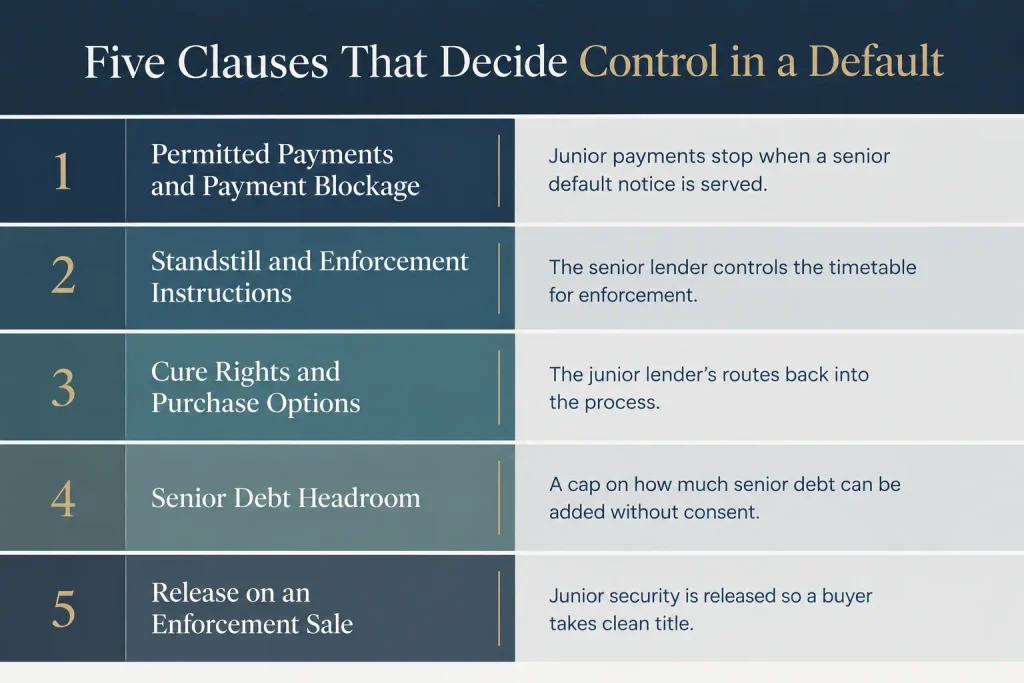
1. Permitted Payments and Payment Blockage
Permitted payments define what the junior lender may receive while the facility performs, usually scheduled cash interest and little else. Payment blockage is the switch.
Once a senior default notice is served, junior payments stop and the amounts accrue. The junior claim keeps growing but its cash does not.
Senior lenders typically seek to block principal and rolled-up interest as well as cash interest. A 2019 analysis of mezzanine intercreditor terms by MJ Hudson notes that junior lenders usually try to keep access to legal fees, so they can protect their own position while payments are blocked.
For the borrower, blockage relieves cash flow and increases the liability. Both effects arrive at the same moment.
2. Standstill and Enforcement Instructions
The standstill is a fixed period after a junior default during which the junior lender may not enforce its security, while the senior lender keeps the right to instruct the security agent. It is the price of subordination, and juniors accept it in exchange for other protections.
This is a lender-to-lender restriction. It is not the borrower facing pause covered in Standstill Agreement 2026, where lenders agree to hold back against a borrower. Here the question is which lender controls the timetable.
Two details decide how much the standstill is worth: how long it runs, and who can instruct the security agent.
A simple majority of senior lenders can often bind the group. The same voting thresholds can be used to change the terms themselves, which is the territory of Liability Management Exercises 2026.
3. Cure Rights and Purchase Options
A cure right lets the junior lender, or the sponsor, remedy a senior default, usually by injecting cash, so that the senior default notice falls away.
The borrower’s own cure of a breach is a different matter and is covered in Covenant Breach in 2026. The question here is whether the junior lender may cure at all, how often, and whether curing restores its right to be paid.
MJ Hudson notes that senior lenders may resist cure rights where a cure allows junior payments to resume afterwards.
A purchase option lets the junior lender buy the senior debt, usually at par plus accrued interest, once an enforcement trigger occurs.
It gives control, but it needs a very large cheque. The same analysis observes that mezzanine lenders rarely exercise these options in practice. Their value lies in negotiation, not exercise.
4. Senior Debt Headroom
Headroom caps how much senior debt can be added or refinanced without junior consent. Without a cap, the senior lender can lend more and push the junior position further back in the recovery order.
MJ Hudson notes that junior lenders typically press to limit supplemental senior debt to roughly 10 per cent of the original senior facilities.
For the borrower, this is the clause that decides whether an upsized or refinanced senior facility needs a second lender’s consent. It belongs in any refinancing plan from the first day, not the last.
5. Release on an Enforcement Sale
When senior lenders sell the business or its shares, the junior security must be released so the buyer takes clean title. After release, the junior lender holds a claim against the borrower, not security over its assets.
That makes release one of the points where a junior position is most exposed. Junior lenders typically look for an independent valuation, cash consideration and information on how the price was reached.
MJ Hudson notes a trend towards requiring independent valuations and cash consideration for pre packaged sales.
Intercreditor Agreement Worked Example: A £20 Million Junior Facility Behind a £60 Million Senior Loan
The following scenario is illustrative only. It does not describe an actual transaction or client.
A family owned UK engineering group raises £80 million. A bank provides a £60 million senior term loan at 8 per cent. A private credit fund provides a £20 million junior facility on second-ranking security, with cash interest of 8 per cent.
The two lenders sign an intercreditor agreement. EBITDA at closing is £16 million, so senior leverage is 3.75 times and total leverage 5.0 times. The senior covenant requires EBITDA of at least 2.5 times senior interest of £4.8 million a year, so EBITDA must stay above £12.0 million.
In year two, EBITDA falls to £10.5 million. Interest cover is 2.19 times and the covenant is breached. The senior lender serves a default notice, and the intercreditor agreement’s payment blockage clause stops the junior cash interest of £1.6 million a year.
Over six months £0.8 million accrues, taking the junior claim to £20.8 million. From here, the intercreditor agreement decides what happens next.
Version A: an intercreditor agreement with no cure right and no valuation safeguard. The standstill runs for 120 days, during which the junior fund cannot enforce.
The senior lender then uses its enforcement instructions to sell the group at the trough, at 5.0 times EBITDA, or £52.5 million. The senior lender takes all of it and a £7.5 million shortfall. The release clause discharges the junior security automatically.
The junior fund recovers nothing against a £20.8 million claim.
Version B: an intercreditor agreement with a limited cure right. The facility and intercreditor agreements allow the junior lender to cure up to twice, and provide that a cash injection counts as deemed EBITDA for covenant purposes.
Without that wording, cash does not lift a covenant measured on EBITDA. With it, restoring 2.5 times cover needs EBITDA of £12.0 million, so a £1.5 million injection added to £10.5 million is enough.
The junior fund injects £1.5 million, the default notice is withdrawn and the sale does not proceed.
If the business recovers to £12.0 million of EBITDA and is valued at 6.0 times, it is worth £72.0 million. Assuming no other debt, enforcement costs or priority claims, the senior lender is repaid in full at £60.0 million and the remaining £12.0 million goes to the junior fund.
Its total exposure is £22.3 million, which counts the £1.5 million cure only on the assumption that the cure creates an additional claim. On that basis the recovery is about 54 per cent, compared with nothing in Version A.
The same facilities, the same covenant breach and the same borrower produced two different outcomes.
The only difference was the wording of the intercreditor agreement. In Version B, £1.5 million of new money moved the junior outcome from zero to £12.0 million.
The senior lender is better off as well, repaid at par instead of taking a £7.5 million loss, which is why cure rights are negotiable. The senior lender’s concern is the opposite scenario: the cure delays a sale and recovery fails.
The purchase option in the intercreditor agreement looks attractive on paper and works poorly in practice.
Buying out the senior loan costs £60.0 million plus one quarter of accrued interest, £1.2 million, a total of £61.2 million. Added to the £20.0 million already lent, the junior fund would have £81.2 million deployed against a £72.0 million recovery value.
The option gives control of the timetable. It does not repair the arithmetic. That is consistent with the observation that these options are rarely exercised.
How Lenders Negotiate an Intercreditor Agreement
To negotiate a intercreditor agreement, senior lenders usually trade on control, not price. They accept a junior lender in the structure, but expect to hold the enforcement instructions and the standstill. Clauses that could slow a sale, such as a long standstill or a wide veto, tend to meet the most resistance.
Cure rights are negotiated on their consequences. The objection recorded by MJ Hudson is not that a cure exists but that payments might restart once it is used.
One workable compromise is to limit how many times a cure can be used and to keep junior payments blocked after each one. That is a structuring suggestion, not a statement of market practice.
Junior lenders price headroom. A senior facility that can grow without consent changes the risk of the junior position after it has been priced. The roughly 10 per cent limit noted by MJ Hudson is a negotiating position, not a fixed standard, and the right figure depends on how much the senior facility is expected to flex.
Information and valuation matter most at the point of sale. A junior lender that cannot see how a price was reached, or that is released against non-cash consideration, has little recourse afterwards. Independent valuation and cash consideration are the usual protections sought.
A credit committee reads the intercreditor agreement as a recovery input. A junior facility with weak protections is typically priced as though recovery in distress will be low. That is an inference from how recovery is modelled, and it explains why lenders on both sides ask for the draft early.
How three or more capital providers are sequenced around one document is covered in Capital Stack Structuring.
What Borrowers Should Check Before Signing an Intercreditor Agreement
The borrower is often not the main negotiator of the intercreditor agreement, but it lives under it. Four checks are worth making, alongside the wider diligence in the Borrower Trust & Due Diligence Playbook:
- Permitted payments: do they match the cash flow the business can actually generate?
- Headroom: does the senior cap leave room for a planned refinancing or upsizing?
- Enforcement timetable: who can instruct the security agent, and after how long?
- Obligations: what the borrower is asked to acknowledge or accept in the document.
Ask for the draft at term sheet stage, not at documentation. By then the commercial terms are agreed and the borrower has the least leverage.
Conclusion
As private credit funds lend alongside banks more often, more financings will carry two or more lenders with different incentives. In those structures the real terms of the deal are not only the margin and the covenants but also the clauses that say what happens when the numbers move.
They are agreed when nothing is wrong, and they decide the outcome when something is. The practical discipline is to read the intercreditor agreement as a recovery document. Test each clause against a slow case, a trough valuation and a delayed refinancing, and find out who controls the timetable in each.
Where the answer is not the party you expected, the time to change it is before the facility funds.
If you are evaluating a multi-lender structure and want the intercreditor terms to reflect your position, we welcome a discreet conversation. Contact us today.