
Data Center Financing: What Lenders Actually Fund Below $1 Billion

Meta’s joint venture with Blue Owl Capital to build the Hyperion data centre campus in Louisiana runs to $27 billion.
The construction loan behind the first Stargate data centre in Texas, a 1.2 gigawatt facility arranged by Newmark and led by JPMorgan, closed at $7.1 billion. Numbers at that scale dominate the coverage, and they create a false impression: that data centre financing is a market for sovereign funds and hyperscalers only.
It is not. Morgan Stanley puts total global data centre capital expenditure at roughly $2.9 trillion through 2028, and estimates that $1.5 trillion of that has to come from external capital rather than hyperscaler balance sheets.
Most of that gap is being filled, but the way it is being filled draws a line through the market, and that line sits close to $1 billion.
Below it is where private credit, regional banks and intermediaries actually operate, and where most of the coverage never looks.
The $1.5 Trillion Gap, and Who is Actually Filling it
Morgan Stanley’s own breakdown of that $1.5 trillion external data center financing need runs roughly as follows: private credit and asset-based finance account for about $800 billion, the largest single channel; investment grade corporate bonds around $200 billion; securitised credit, including data centre ABS and CMBS, roughly $150 billion; and a further $350 billion spread across other financing mechanisms.
The firm is explicit that the model has shifted: capital expenditure has so far been largely self-funded by hyperscalers, but that will not continue to be the case as spending accelerates.
Private credit carrying the largest share of a $1.5 trillion data center financing gap is the headline. The detail that matters for anyone outside the hyperscale tier is where that private credit actually goes.
Where the Institutional Machine Stops
PeerSense, a marketplace that connects developers to institutional data center financing, states its own operating range plainly: $1 billion to $30 billion or more.
Its own guidance on what does not fit that range is just as direct: files below $1 billion, unleased speculative developments, and deals already shopped through multiple brokers are, in its words, not the right conversation.
That is one specific institutional platform stating, in its own words, that sub-$1 billion files are not the right conversation, and its capital stack shows why.
Senior construction debt at that top tier prices around SOFR plus 350 to 550 basis points at 65 to 75 percent loan-to-cost, but only against a signed or guaranteed hyperscaler lease; mezzanine debt runs 11 to 15 percent current pay plus payment inkind; joint venture or preferred equity sits at 12 to 18 percent.
Every layer assumes an investment grade counterparty and a deal large enough to justify the underwriting effort.
Below roughly $1 billion, that specific combination becomes harder to find, and the financing universe changes materially, away from single source institutional platforms and toward the regional banks, balance-sheet lenders and private credit that make up the next two tiers.
The Tiers That Actually Serve the Mid-Market
Below that line, a different and less publicised set of lenders competes for the business. Broker guidance on data center financing maps it into three reasonably distinct tiers.
| Financing tier | Typical deal size | Who actually lends | Underwriting focus |
| Institutional / hyperscale | Above roughly $1 billion | Global banks, ABS and CMBS shelves, infrastructure mega-funds | Signed or guaranteed hyperscaler lease, investment-grade counterparty |
| Mid-market | $50 million to $300 million | Money-centre banks, life insurance companies, CMBS, debt funds | Secured power capacity, contracted tenant cash flow, sponsor track record |
| Regional | Under $50 million | Regional banks, balance-sheet lenders, private credit | Local interconnection position, colocation lease-up, sponsor experience |
The middle and lower tiers are where most independent developers, colocation operators and regional infrastructure sponsors actually sit, and where an intermediary placing capital against private credit and asset-based lenders has a genuine role to play. It is also, not coincidentally, close to the range PeerSense’s own guidance rules out.
Power, Not Property, is the Underwriting Constraint
Data center financing has moved away from the traditional commercial real estate lens of location, square footage and exit cap rate.
The underwriting question now starts earlier: whether the site has megawatts, where it sits in the utility interconnection queue, what the equipment lead times look like, and how much power density the intended tenant actually needs. A real estate model is not considered credible until those questions are answered.
The numbers behind that shift are stark. Grid interconnection timelines currently run from twelve months to more than three years depending on region and available headroom, and equipment lead times for the transformers, breakers and conductors needed for a network upgrade run 90 to 130 weeks. Virginia, Texas, and parts of the Southeast and Midwest are named as the tightest markets, where spare transmission capacity is already short of incoming demand and upgrades are the rule rather than the exception.
The practical consequence is that interconnection, not construction, is usually the binding constraint on when a facility can actually go live, and financing models that treat these two clocks as sequential rather than concurrent risk running well past their stated timelines.
This applies at every deal size. A 1.2 gigawatt hyperscale campus and a 15 megawatt regional facility both live or die on the same interconnection queue logic, the difference is that the larger deal has a syndicate of banks working the power question full time, and the smaller one usually does not.
Structuring the Debt: Construction to Stabilised Exit
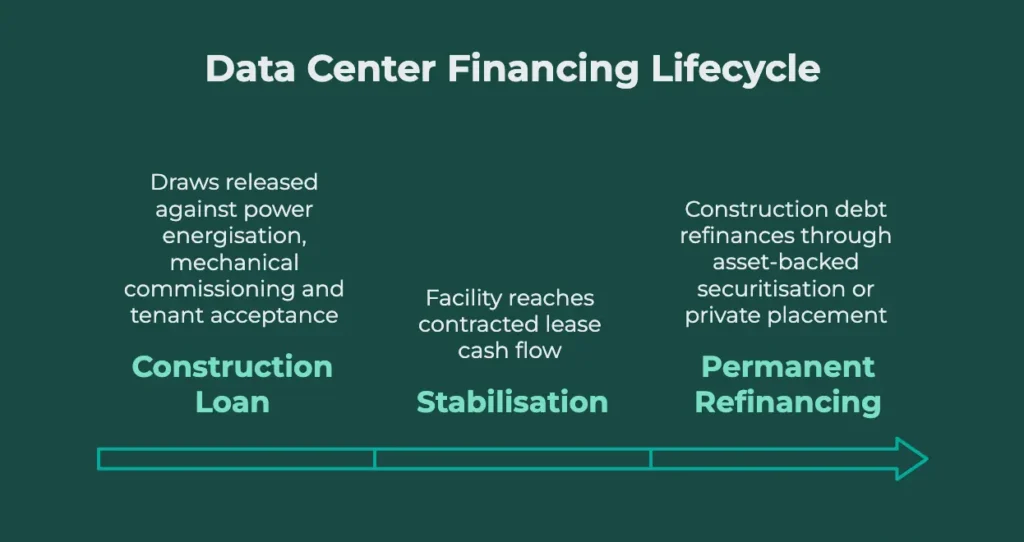
The instrument most commonly used in the mid-market and regional tiers is a mini-perm construction loan, commonly sized around 60 to 70 percent loan-to-cost, with draws released against specific milestones, power energisation, mechanical commissioning and tenant acceptance, rather than simple physical progress.
The actual structure varies with the tenant, the sponsor, the jurisdiction and whether capacity is contracted or speculative, but where a facility reaches stabilisation on contracted lease cash flow, that construction debt commonly refinances into permanent debt in the 55 to 70 percent loan-to-value range, often through asset backed securitisation or private placement.
Two levers are worth building into that structure from the outset. Power usage effectiveness is increasingly treated as a pricing input in its own right, a facility that qualifies for green loan terms on its efficiency metrics can secure a lower margin than an otherwise identical asset that does not.
And the definition of collateral itself is widening. CoreWeave’s $8.5 billion facility, the first investment grade, rated GPU backed financing, secured against compute infrastructure and enterprise customer contracts rather than the building alone, shows that hardware and its revenue streams are now bankable in their own right. That deal sits well above the range this piece is concerned with, but the mechanism it establishes, compute as collateral, is starting to filter down, and is the subject of the next piece in this series.
The Overlap Worth Noticing
There is a second reason this market deserves attention beyond commercial real estate. The investors and developers active in data center financing and AI infrastructure financing are frequently the same individuals who hold concentrated positions in listed technology equity and, increasingly, in crypto assets, the client profile at the core of our securities-based lending practice.
A developer or fund principal raising debt against a data center asset is often, separately, sitting on a stock position that could be structured into liquidity without a sale.
The two conversations are related more often than the category labels suggest.
Where This Leaves Regional Developers and Lenders
The headline deals will keep the market’s attention. The actual activity, for anything under roughly $1 billion, runs through regional banks, balance-sheet lenders and private credit, priced and structured around power position and contracted cash flow rather than counterparty credit rating alone.
That is a market private banking and asset-based lending are built for, and one the institutional platforms have said, in their own words, is not their conversation.
If you are structuring data center financing for a development below the billion dollar threshold and want the terms built around your project’s actual power position and lease economics rather than a generic institutional template, we welcome a discreet conversation. Speak to Forbes Le Brock