
Commercial Real Estate Refinance: How the Loan Gets Re-Underwritten
A commercial real estate refinance is often treated as an administrative step: the existing loan matures, a new one replaces it, the rate moves up or down, and the borrower carries on. That framing misses what actually happens on the lender’s side of the table.
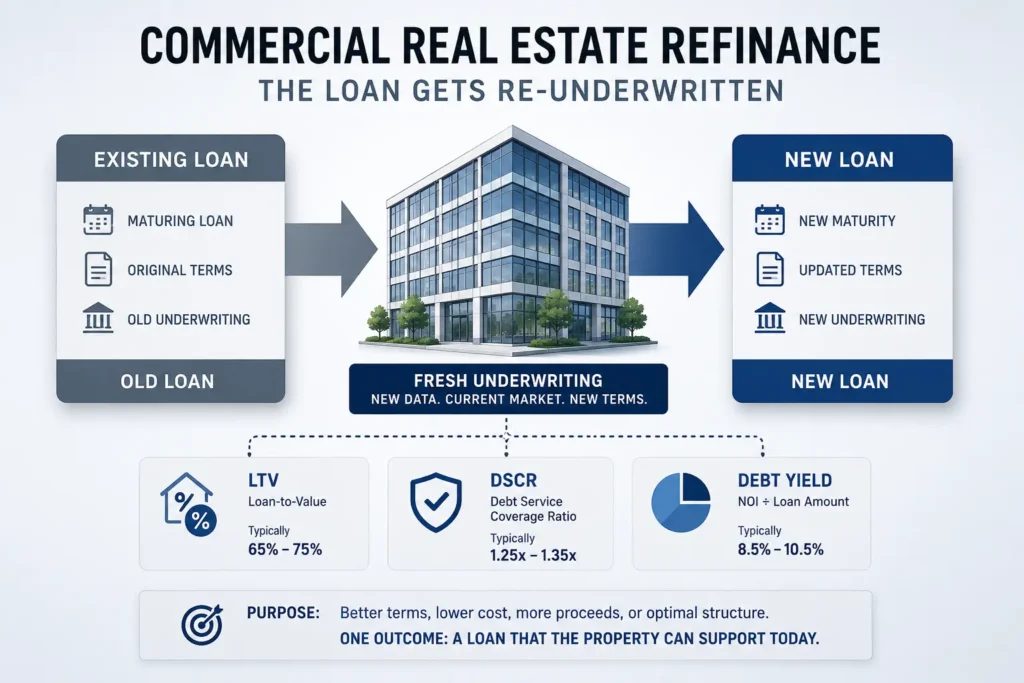
At refinance, the loan is not extended or rolled over. It is re-underwritten in full, against current income, current valuation, and current market conditions, regardless of how the asset has performed since origination.
For the underlying metrics this process draws on, LTV, DSCR and NOI, see Real Estate Finance Basics. This post covers what happens when those metrics are retested years after origination, and what determines whether the new loan looks better or worse than the one it replaces.
Why a Commercial Real Estate Refinance Starts From Zero
The terms on your existing facility are irrelevant to the lender pricing your refinance. What matters is what the asset can support today.
That means every commercial real estate refinance opens with a fresh underwriting exercise, not a renewal. Income is reassessed against current leases and occupancy. Valuation is reassessed against current cap rates, which may have moved materially since the property was acquired or last financed.
Loan sizing is reassessed against whichever of loan-to-value, debt service coverage, or debt yield binds tightest at that moment in the cycle. A property that easily supported its original loan can find its refinance proceeds capped well below the existing balance if any one of these has moved against it.
The Three Metrics Every Commercial Real Estate Refinance Is Tested Against
Loan-to-Value
Lenders typically size new proceeds against 65 to 75 per cent of current appraised market value, not the value at original purchase. If cap rates have widened since acquisition, the reappraised value can fall even where net operating income has held steady, which directly compresses what a commercial real estate refinance can deliver. For how cap rate movement drives valuation independently of income, see Cap Rate in Commercial Real Estate.
Debt Service Coverage Ratio
Most lenders require net operating income to cover annual debt service at 1.25 to 1.35 times, tested against the new loan’s rate and amortisation, not the old one’s. This is where refinancing at a materially higher rate than the maturing loan bites hardest: the same income that comfortably serviced the original debt may fail to clear the coverage threshold on the replacement loan, forcing a smaller facility or additional equity into the deal.
Debt Yield
Institutional lenders and debt funds increasingly apply debt yield, current net operating income divided by proposed loan amount, as a hard floor rather than a target, typically in the 8.5 to 10.5 per cent range depending on property type. Unlike LTV, debt yield takes no view on valuation, which makes it resistant to the same cap rate assumptions that can be pushed favourably elsewhere in the analysis. For how lenders apply this threshold by asset type and resize a loan when it isn’t met, see Debt Yield in Commercial Real Estate.
Applying the Three Tests: A Worked Example
Take a property valued at £10 million, generating £750,000 in net operating income, with an existing loan balance of £6.5 million maturing at refinance.
On loan-to-value, a lender capping proceeds at 70 per cent of current value would support a loan of up to £7 million, comfortably above the existing balance.
On debt service coverage, assume the new loan is priced to produce annual debt service of £550,000. That gives a DSCR of 1.36 times, £750,000 divided by £550,000, which clears a 1.25 to 1.35 times threshold, though only just at the tighter end of that range.
On debt yield, £750,000 of NOI against a £7 million loan produces a debt yield of 10.7 per cent, comfortably above a typical 8.5 to 10.5 per cent floor.
In this scenario, all three tests pass, and LTV is the least binding constraint. Change one variable, a softer cap rate that reduces appraised value to £8.5 million, for instance, and LTV becomes the binding test instead, capping proceeds at £5.95 million, below the existing loan balance.
That is how a property with unchanged income can still see refinance proceeds fall: the constraint that binds shifts with market conditions, not with the asset’s own performance.
Types of Commercial Real Estate Refinance
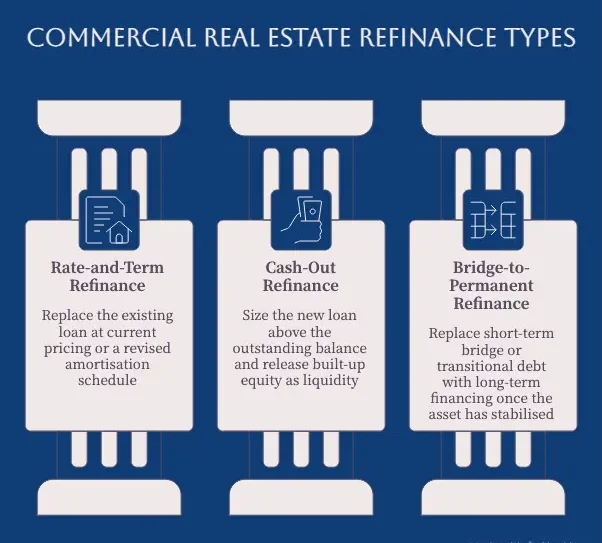
Not every refinance is solving the same problem, and the structure should follow the objective.
Rate-and-term refinance replaces the existing loan with a new one at current pricing or a revised amortisation schedule, without changing the loan amount materially. This is the most straightforward form, used when the goal is simply to reprice debt or extend maturity.
Cash-out refinance sizes the new loan above the outstanding balance, releasing the difference as liquidity against the property’s built-up equity. This depends entirely on the LTV, DSCR and debt yield tests above allowing for a larger facility than currently outstanding, which is why cash-out proceeds are the first casualty when valuations or coverage have tightened since acquisition.
Bridge-to-permanent refinance replaces short-term bridge or transitional debt with long-term financing once a property has stabilised, typically once occupancy and income have reached a level that supports conventional underwriting. This is the exit side of a bridge facility; for how the originating bridge loan itself is structured, see Bridge Financing in Commercial Real Estate.
Lender Selection in Commercial Real Estate Refinance
The lender who originated the loan is not automatically the right lender to refinance it. Banks, insurers, CMBS conduits and debt funds price and structure senior debt differently, and a property that suited one lender type at acquisition may fit a different one better at refinance, particularly if the asset has stabilised, the hold period has shifted, or pricing conditions have moved. For how these lender types differ in practice, see Senior Debt in Commercial Real Estate.
Recourse and Guarantee Terms Rarely Carry Over Unchanged
Personal guarantee terms agreed at origination, including any burn-off triggers tied to performance milestones, do not automatically transfer to a refinance. A new lender re-underwrites the guarantee position independently, and a sponsor who negotiated favourable recourse burn-off on the original loan should not assume the replacement facility will mirror it. For how lenders structure and price recourse exposure in commercial real estate, see Recourse vs Non Recourse Loans in Commercial Real Estate.
What a Commercial Real Estate Refinance Costs
Beyond the new loan’s rate, three costs routinely erode the expected benefit of refinancing:
Prepayment penalties on the existing loan can outweigh the savings of a lower rate, particularly on fixed-rate facilities with yield maintenance or defeasance provisions. These need to be quantified before a refinance is pursued, not after terms are agreed on the new loan.
Transaction costs, including independent appraisal, legal due diligence, title work and origination fees, typically run into the tens of thousands of pounds on an institutional-scale facility and should be weighed against the refinance’s actual proceeds or rate benefit.
Timing cost is less visible but real: a refinance that takes longer to execute than expected extends the period during which the borrower is carrying two sets of assumptions, the maturing loan’s terms and the anticipated replacement terms, without certainty on either.
How Long a Commercial Real Estate Refinance Takes
Timelines vary meaningfully by lender type, and this is worth factoring into any refinance planned around a maturity date rather than opportunistically.
Bank lenders typically move fastest where the relationship and property type are straightforward, often six to ten weeks from application to close, but can extend well beyond that where credit committee approval or updated valuations introduce delay.
Insurance company and debt fund lenders generally require more extensive underwriting and documentation, commonly running eight to fourteen weeks, reflecting the more detailed re-underwriting these lenders apply to income and asset quality.
CMBS conduit refinancing tends to be the slowest and least flexible on timing, since execution depends on loan pooling and securitisation schedules rather than a single lender’s internal process, and can extend past sixteen weeks depending on market conditions.
Against the 18 to 24 month engagement window referenced for refinancing risk generally, these timelines make clear why early engagement matters: a lender-side process that takes three to four months leaves little room for correction if it starts close to loan maturity.
What to Have Ready Before Approaching a Lender
A commercial real estate refinance moves faster when the underwriting inputs are assembled before the first lender conversation, not during it: current rent roll and trailing twelve-month operating statements, a recent appraisal or a clear view of current market cap rates for the asset type, the existing loan’s payoff amount and any prepayment penalty schedule, and a defined objective, whether that is rate reduction, term extension, cash-out, or exit from bridge financing.
Conclusion
A commercial real estate refinance is a full re-underwriting event, not a continuation of the existing loan on updated terms. LTV, DSCR and debt yield are all retested against present conditions, lender type is worth reconsidering rather than assuming, and guarantee terms are renegotiated from scratch.
Approaching a refinance with that in mind, rather than treating it as a formality, is what determines whether the new facility improves on the old one or simply replaces it.
For a confidential discussion about refinancing a commercial real estate asset, structuring proceeds, or selecting the right lender for the next stage of a hold, we invite you to contact us. Discreet conversations are welcome.