
Capital Stack Structuring: What Gets Funded in 2026
Capital stack structuring in 2026 is less about knowing the components of a stack, senior debt, mezzanine, preferred equity, common equity, and more about coordinating three or four capital providers into one closing, on one timetable, under one agreed framework, Chart breaking down the components of a multi-tranche capital raise for the capital stack structuring 2026 post
without any single provider walking away because another has not yet committed.
That coordination problem, not the layer definitions, is what capital stack structuring actually tests in 2026.
Capital Stack Structuring: The Layers, in Brief
If you need the mechanics of each layer, they are covered in depth elsewhere: Senior Debt, Mezzanine Financing, Preferred Equity and Recourse vs Non-Recourse each have a dedicated breakdown of pricing, security and repayment priority. This post assumes that grounding and focuses on what happens once a transaction needs two or more of those layers to close together.
How Lenders Read a Multi-Tranche Raise
In multi-tranche transactions, a lender can become reluctant to proceed even where the collateral is acceptable, if the rest of the capital stack structure is incomplete or dependent on another tranche that has not yet committed. A letter of intent from a mezzanine provider carries little weight if it is conditional on senior terms that have not yet been fixed.
A coordinated, sequenced raise can give lenders greater confidence in execution and reduce the risk of one tranche disrupting the others.
Parallel vs Sequential Negotiation
Running senior, mezzanine and preferred equity negotiations in parallel is faster, but it means each provider is asked to commit before seeing the others’ final terms. If one provider walks away late, the whole stack can collapse and the process restarts from a weaker position, since the remaining providers now know a deal has already failed once.
Negotiating sequentially, locking senior debt terms first and then shopping mezzanine or preferred equity against an agreed senior position, reduces that walk away risk. The cost is time, and a structural disadvantage: once senior terms are fixed, the sponsor has materially less leverage to negotiate subordination terms with the junior tranche, which must accept whatever standstill and cure provisions the senior lender has already dictated.
There is no universally correct sequencing. The right choice depends on how much of the stack’s total value the senior tranche represents, and how replaceable each provider is if talks stall.
One Framework, Three or More Parties
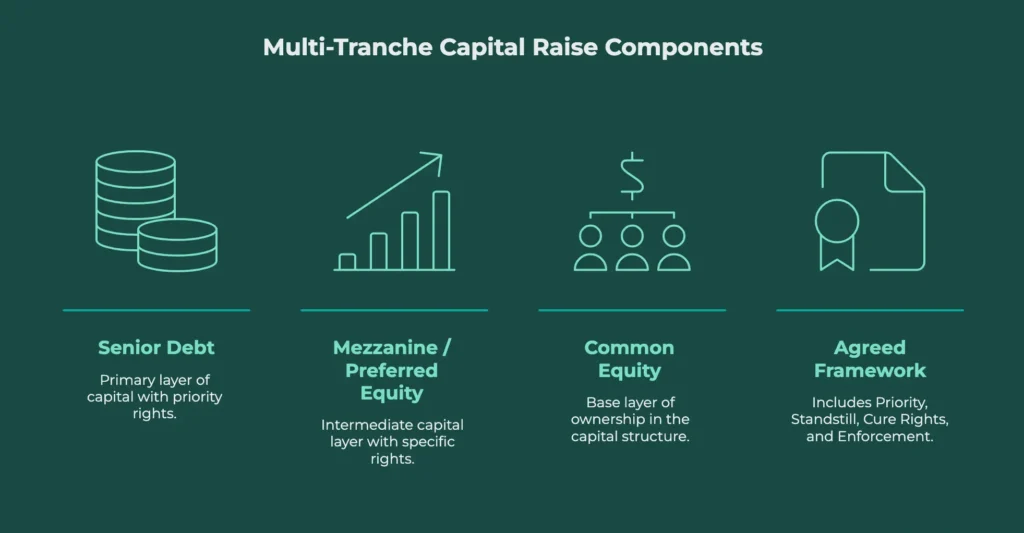
A two-party arrangement, senior debt and one junior layer, is a known negotiation. Once a third capital provider enters, whether that is a second debt tranche, preferred equity or another subordinated capital provider, the intercreditor or subordination arrangements have to reconcile priority, standstill periods, cure rights and enforcement triggers across all three simultaneously, not pairwise.
Where all providers are lenders, this typically sits in a single intercreditor agreement; where preferred equity is involved, its rights are usually documented separately but still need to be consistent with the debt-side arrangements.
This is where multi-tranche raises most commonly stall. Each provider negotiates its own position on the assumption the other two are fixed, and if all three are negotiating concurrently, the documentation can circle for weeks without a stable draft.
Sponsors who fix the coordination framework early, even in outline, before finalising commercial terms with each provider, avoid this loop.
Quantifying the WACC Trade-off
The case for adding a middle layer is not simply that it is available. It has to lower the blended cost of capital enough to justify the added negotiation complexity.
Take a hypothetical £40m transaction, illustrative only. An all senior plus equity structure at 60% loan-to-value prices £24m of senior debt at 6.5% and £16m of common equity at a 14% target return: an illustrative blended capital cost of 9.5%, using the common equity’s 14% target return as its cost assumption.
Introduce £8m of mezzanine debt at 11% between the senior tranche and equity, and the common equity requirement falls to £8m: the blended cost drops to roughly 8.9%.
That 60 basis point saving is real, but it only holds if the mezzanine and senior lenders agree standstill and cure provisions that do not conflict. A stack that saves 60 basis points on paper but adds six weeks of coordination, and a real risk of the process failing altogether, is not obviously the better structure.
Capital Stack Structuring In Practice
A developer capping ground-up finance at 50% senior debt, and unwilling to fund the remaining half as pure equity, brings in a mezzanine provider for a further 15% of the stack.
The resulting structure, 50% senior, 15% mezzanine, 35% equity, boosts the sponsor’s return on its equity stake, provided the senior and mezzanine lenders are negotiated and documented as one coordinated raise rather than two sequential deals with inconsistent standstill terms.
The mechanics of the underlying facility are covered in Construction Loans. For a stack built to absorb an asset already in distress, rather than to pre-empt it, see Distressed CRE Loans Workout.
What to Consider Before Structuring a Multi-Tranche Raise
- Decide parallel versus sequential negotiation before approaching any provider, based on how replaceable each layer is.
- Fix the coordination framework in outline before finalising commercial terms with each individual provider.
- Quantify the WACC saving of each additional layer against the time and execution risk it adds, not just its headline rate.
- Confirm which provider’s counsel drafts the intercreditor or subordination documentation, and get all parties’ comments in the same draft cycle, not sequential redlines.
- Match layer term length to strategy: short-dated mezzanine against a long hold creates its own refinancing cliff inside the stack.
Conclusion
Capital stack structuring in 2026 is a coordination discipline, not a definitions exercise. The sponsors who close fastest are not the ones with the cheapest blended rate on paper. They are the ones who have sequenced their negotiations deliberately, fixed the coordination framework early, and can show every capital provider in the stack that the others are genuinely committed, not merely interested.
If you are structuring a multi-tranche capital raise and want the sequencing handled with the coordination it requires, we welcome a discreet conversation.
For a fuller view of how each layer fits together, see the Borrower Trust & Due Diligence Playbook.
Forbes Le Brock structures and places asset-based lending transactions for UHNW individuals, family offices and institutional investors across the UK, Europe and Asia-Pacific.