
Data Center Development Financing: Who Funds the Project Before the Lease Exists
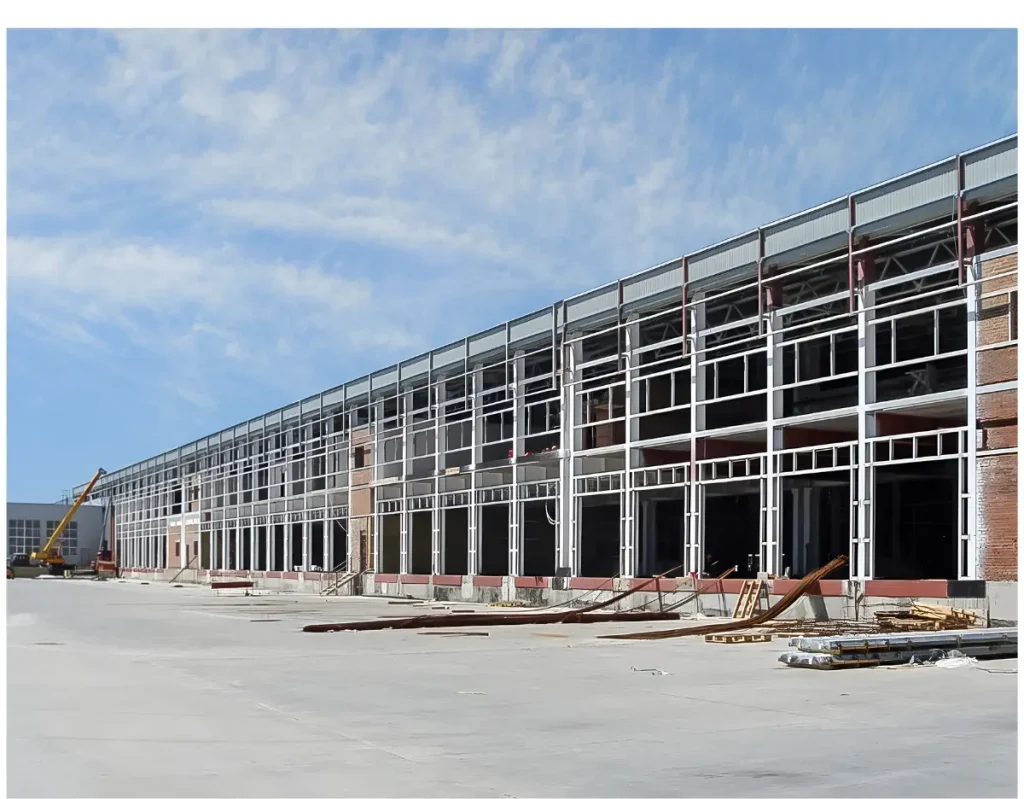
Data center development financing runs into a timing problem. Most senior lenders want a signed lease before they commit substantial construction capital. Hyperscale tenants, in turn, want permits, power and funding in place before they sign.
Both positions are reasonable, and together they leave a gap that someone has to fund.
That gap is where data center development financing sits. It covers the land, the planning work, the grid application and the long-lead equipment that a developer pays for before a tenant exists.
Our guide to data centres project finance shows how debt is structured once a lease is signed. This post covers the stage before that, when the only collateral is a site and the only revenue is a prospect.
The mechanics apply across the UK and Europe, where power rather than land is usually the first constraint. The case worked through below is illustrative. The project, the budget and every figure are assumptions constructed to show the decision points, not drawn from a live transaction.
Why Data Center Development Financing Starts With a Gap, Not a Loan
In data center development financing, financiers typically require a signed customer contract before committing capital, because the contract provides revenue certainty. Customers pull the other way. In the same analysis, Norton Rose Fulbright notes that a customer will want certain permits secured and funding in place before it commits.
A&O Shearman describes the same standoff: infrastructure lenders require signed customer contracts, so developers have to bridge the gap with equity or, increasingly, private credit.
The practical result is that equity carries the project until both sides can commit. The sponsor’s capital unlocks the debt, not the other way round.
Until a lease exists, a lender is underwriting the site and the sponsor, not the contract.
That is why this stage looks like real estate lending rather than infrastructure finance. A&O Shearman notes that lenders have traditionally approached data center development financing from a real estate perspective, underwriting the value of the land and property.
Norton Rose Fulbright places the same approach where no customer contracts are in place.
Four Costs That Fall Before the Lease
- Land. Land is the pre-lease cost most readily supported by conventional asset-based lending, because the lender has identifiable property security. That is why land cost financing is usually the first debt in the structure.
- Planning and design. Permits, surveys, design work and early works are spent before there is any revenue. They are also what a tenant checks before it will talk seriously.
- Power and grid. This is increasingly the largest uncertainty. In Great Britain, proposed reforms to demand connections would require applicants to show planning permission or financial backing, and the consultation floated refundable and non refundable deposits and a progression fee at application or offer acceptance. The reform programme is still evolving, so deposit levels and timing should be confirmed at the point of application. Whatever the outcome, the principle is the same: grid position has to be paid for before it is certain.
- Long-lead equipment. BCLP notes that mezzanine debt can be particularly valuable for funding pre-construction activities, such as land acquisition or securing long-lead procurement items, before the conditions for drawing the senior facility have been met.
None of these four costs is secured by a lease. That is what makes them expensive to finance.
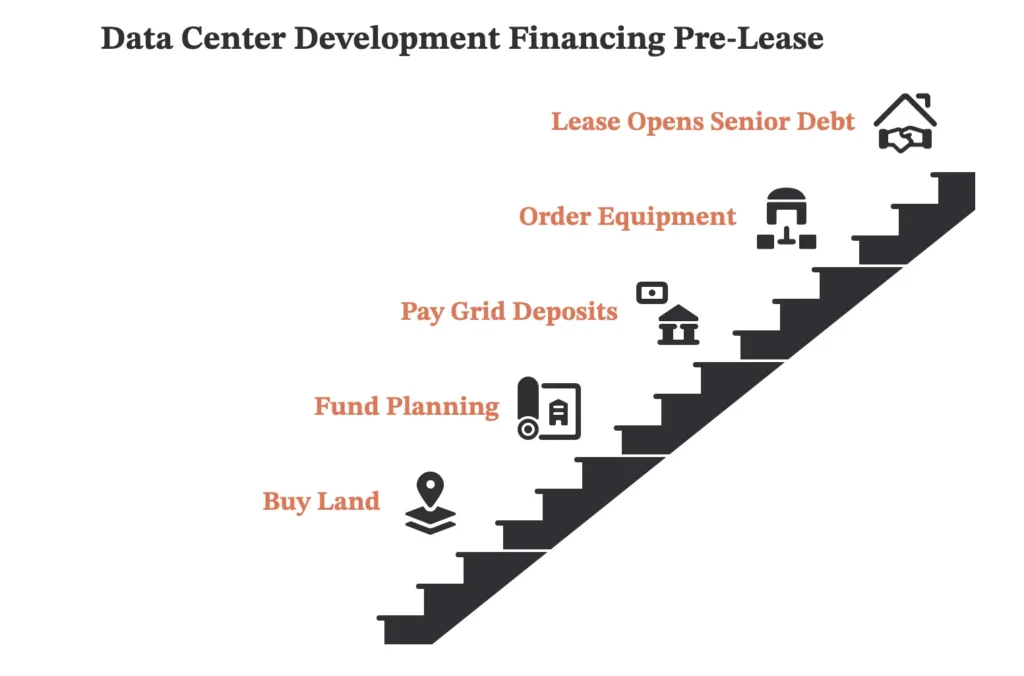
Who Funds the Gap in Data Center Development Financing
Real estate lenders fund the land. The facility is sized against land value, and the sponsor carries everything else.
Infrastructure funds and banks with a greenfield mandate can fund through a development company structure. Norton Rose Fulbright notes that these structures may rely on mezzanine debt or construction loans at higher margins.
Mezzanine and private credit fill the space between the sponsor’s equity and what a land lender will provide. It is the most flexible money in the structure and the most expensive. Our guide to mezzanine financing covers the instrument itself.
Equity partners take part of the project in exchange for capital. BCLP notes that developers typically bring in an equity partner through a joint venture, with a negotiated distribution waterfall and governance provisions that decide control. A preferred equity structure is the alternative where the sponsor wants to keep control.
Where no lease exists, lenders price the risk and size the data center development financing accordingly. BCLP notes that speculative or partly pre let developments often face tighter equity requirements and phased drawdowns linked to leasing milestones.
Some structures then convert. Norton Rose Fulbright describes deals that move to an infrastructure style regime once a contract with an eligible customer is signed, with sponsor guarantees falling away at that point. From there, draws, retainage and completion guarantees work as set out in Construction Loans in Commercial Real Estate, and our overview of data center financing below the billion-dollar threshold maps who lends at each size.
The Illustrative Case: £45 Million at Risk Before the Lease
Assume a developer is building a 40 MW campus in a European market, with a total project cost of £380 million. Before any tenant signs, four costs are incurred:
Land: £15 million.
Planning, design and early works: £8 million.
Grid application deposits and securities: £10 million.
Long-lead equipment deposits: £12 million.
That is £45 million, about 12 per cent of project cost, and none of it is secured by a lease. The senior construction facility does not open until a tenant signs.
Assume the sponsor has £20 million of its own equity committed. That leaves a £25 million gap. Assume it is closed three ways:
A land secured loan of £7.5 million, which is 50 per cent of the land cost.
A £10 million mezzanine or gap facility, secured against the project structure and sponsor equity position rather than lease income, and priced to reflect that.
£7.5 million of sponsor-level liquidity, raised against listed holdings without a sale.
£20 million plus £25 million funds the £45 million. The project then waits for a tenant.
The Cost of Waiting for the Lease
Assume the mezzanine is priced at 14 per cent and rolled up rather than paid currently. Left until the lease is signed, £10 million becomes £11.8 million if the lease is signed in month 15 and £13.0 million if it takes until month 24. The cost of the facility is £1.8 million in the first case and £3.0 million in the second.
That £1.2 million difference is on one tranche only. It excludes interest on the land loan, the cost of the sponsor-level facility and the cost of holding the grid position.
Every month of lease negotiation is a financing cost, so the pre-lease funding plan has to be sized for the slow case.
In Europe, the slow case can be long. Colliers’ EMEA data center report for the first half of 2026, as reported by Data Center Dynamics, puts average grid connection timelines for data centres in the UK past eight years.
Where Europe Changes the Sequence
In most of Europe, the first question is not whether the land is available. It is whether the power is. The same Colliers report describes power availability as the defining constraint in EMEA, with Ireland, Germany and the UK facing acute grid constraints, and describes developers shifting capital towards markets such as Madrid, Milan, Lisbon and the Nordics.
Policy then changes what has to be funded early. In Ireland, the energy regulator’s final policy on data centre connections requires larger data centers to bring new on-site or proximate generation or storage, and requires 80 per cent of annual electricity demand to be met by additional renewable generation in the Republic within six years of energisation.
For a developer, that moves generation capacity and power purchase commitments into the pre-lease budget.
The effect on data center development financing is direct. In a power constrained market, more of the pre-lease spend is power-related and less of it is land.
A lender comparing two sites will look at which has the more credible route to a connection date, because that decides whether a tenant will engage at all. Data center financing in Europe is, at this stage, a power underwriting exercise.
Raising the Equity Without Selling the Core Position
Pre-lease costs are the ones a sponsor feels first. Land options, grid deposits and equipment deposits fall due on a fixed timetable, before any institutional capital has drawn. For a sponsor whose wealth sits in listed technology holdings or digital assets, selling to meet those calls can mean crystallising a gain at the wrong moment.
A stock loan for concentrated shareholders or crypto-backed lending facility can fund those calls while the position is retained. The facility should be sized and dated against the slow case in the previous section, not the base case. A sponsor level loan that matures before the lease is signed creates a second problem on top of the first.
What Lenders Need to See Before Funding
Evidence of site control: freehold title or option terms, and the current planning status.
A pre-lease budget with each cost phased by month, and a clear line between spend that is refundable and spend that is not.
The grid position: application status, queue position and any security already posted.
The status of tenant discussions, from a heads of terms to a letter of intent.
An equity plan showing where every pound of the funding gap comes from, including any facility at sponsor level.
Conclusion
Data center development financing is the part of the capital stack that sits before any lender can rely on a lease. Land, planning, power and long-lead equipment have to be paid for while the revenue is still a prospect, and equity carries the project until the contract exists. Sponsors who size the funding for a slow lease, rather than a quick one, keep their options open when the timeline moves.
If you are funding the development stage of a data center and want the structure built around your site, your power position and your equity plan, we welcome a discreet conversation. Contact us to discuss the position.
For a more structured breakdown of how these strategies are applied in practice, see the Commercial Real Estate Finance Playbook.