
How to Check If a Lender Is Legitimate Before You Sign

Every serious lender checks the borrower before it lends. Far fewer borrowers check the lender back. Yet knowing how to check if a lender is legitimate matters most in exactly the transactions where borrowers have the most to lose: stock loans, Lombard facilities and asset-backed private credit, where fees are often paid and collateral moved before a single pound is advanced.
Legitimacy here means more than a real company with a website. It means a lender that is who it says it is, has the capital it says it has, and will still be standing when the facility funds. Get that wrong and the cost is not a worse rate. It is a lost position.
What a lender expects to find in your file is covered in Data Room for Lending: What Lenders Expect. This post covers the other side of the table: how to verify the lender before anything of value changes hands.
Why Legitimacy Starts With the Source of Capital
Term sheets look alike. The capital behind them does not. A term sheet can come from a lender committing its own balance sheet, from a fund lending investor capital under a defined mandate, or from a party with no capital of its own that intends to find it after you sign.
The third is not automatically a problem. Specialists can introduce or arrange capital without being the ultimate lender. The risk arises when the borrower does not know which of the three it is dealing with. Every third party between you and the capital adds delay, adds fees and adds another party holding information about your position. Each one is a counterparty you have not checked.
The question that cuts through this is simple: whose balance sheet funds the drawdown, and which legal entity signs the facility agreement? Real lenders answer with a named company, not a brand.
Brand recognition is not verification either. A familiar name brings its own constraints, which we cover in Alternative Financing: Reputation Bias and the Brand Trap. An unfamiliar name needs to be verified. They are different problems, and this post deals with the second.
How to Check If a Lender Is Legitimate: Five Checks Before You Sign
Five checks establish whether a lender is legitimate, properly structured and capable of progressing to completion. None needs specialist tools. All of them need to be finished before a fee is paid or collateral is transferred.
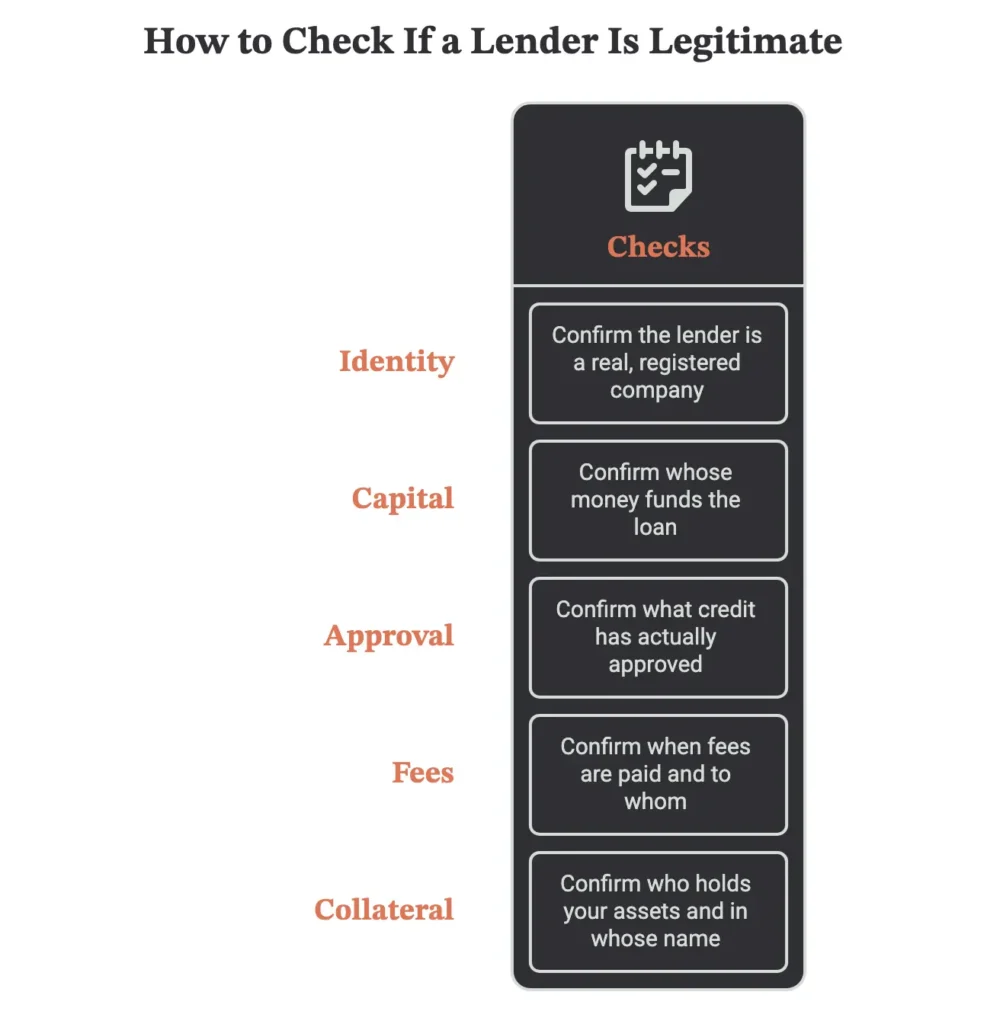
1. Identity: Verify the Company, Not the Website
Establish the lender’s legal name, registration number, registered business address, date of incorporation, directors and beneficial owners. For a UK company, Companies House shows the incorporation date, officers and filing history in minutes. A loan company incorporated a few months ago with no filed accounts is not disqualified on that alone, but it needs a credible explanation.
Then confirm that the entity named on the term sheet is the same one that will sign the facility agreement and send the funds. A mismatch between names, or contact details that differ from those on the official website, should be resolved before anything else moves.
Where the lender claims regulatory status, check it at source. In the UK, the FCA warns that clone firms copy the name, address and Firm Reference Number of authorised companies, and advises using only the contact details shown on the FCA Register, not those the firm supplies. Someone claiming to represent an authorised firm from a lookalike email domain is a known pattern.
Not every private lender needs authorisation for every transaction, so an unregistered lender is not automatically illegitimate. Many high-value and business-purpose facilities also sit outside consumer protection rules, which puts more of the checking on the borrower. What matters is that the regulatory position the lender describes can be verified independently and fits what it is actually doing.
2. Capital: Ask How the Drawdown Is Funded
Ask whether the capital is committed or whether the term sheet is “subject to funding” or “subject to syndication”. A proof of funds letter is weak evidence. It is easy to produce and says little about whether capital is available for your transaction on your timetable.
Stronger evidence is transaction-specific: confirmation of the funding entity, how the drawdown will be funded, evidence of comparable transactions that actually closed, and where appropriate a reference from a borrower whose facility funded. Reputable lenders can usually provide this without difficulty.
3. Approval: Know What Credit Has Actually Approved
A genuine lending process involves assessment before commitment: identity checks, financial information and, in asset-backed lending, the collateral itself. In some structures that includes a credit check and a review of credit history. In non-recourse stock loans the focus falls on the shares. Either way, an offer of guaranteed approval before that work has been done is a red flag.
An indicative term sheet and a credit-approved term sheet are different documents. Ask whether the terms have been through credit, who approved them and which conditions remain open. Even a genuine approval is usually conditional, as set out in Credit Committee Approval Process.
4. Fees: When They Move and Where They Go
Where fees are payable, establish exactly what they cover, when they are due and who receives them. Arrangement and origination fees are a normal part of asset-backed lending. How they sit within a securities-based facility, including how they are deducted from the loan amount, is covered in Securities Based Lending Rates: Pricing Reality Check.
The pattern to guard against is the advance fee: a significant upfront payment demanded before credit approval, often described as a due diligence, insurance or legal fee, with disbursement always one step away. Ask what the payment buys and whether it is refundable if the lender declines.
Payment to an account that does not match the lending entity should stop the process until the discrepancy is explained and independently verified. Where a genuine upfront payment is needed, such as a deposit towards legal costs, it should go to a solicitor’s client account, not to the lender or a third party.
5. Collateral: Who Receives the Transfer, and in Whose Name
Before any shares or assets are transferred, name the custodian. Confirm whether it is independent of the lender, whether the account sits in your name or the lender’s, and whether you can verify the account directly with the custodian rather than through the lender.
Whether legal title passes to the lender, and what that means if the lender fails, is set out in Borrow Pledge vs Repo: SBL Structures Compared. Where the facility is marketed as non-recourse, check the carve-outs using Non Recourse Loan: Structural Differences That Matter.
The Case That Shows Why the Collateral Check Matters
In March 2012, the US Securities and Exchange Commission charged Argyll Investments and its principals over a stock loan scheme that targeted corporate officers and directors. According to the SEC, borrowers were told their shares would not be sold unless they defaulted. Instead, the shares were sold before or shortly after the loans funded, and the sale proceeds were used to fund the loans themselves. The SEC put the scheme at $8 million.
The loans funded. The paperwork looked ordinary. The failure was in where the shares went and who controlled them. That is exactly the ground the identity and collateral checks cover, and it is why both need to be finished before the shares move, not after.
Lender Insight: Red Flags and How a Legitimate Lender Responds
From the lender’s side of the table, being checked is expected. Lenders run identity and KYC checks on every borrower and understand that sophisticated counterparties check them in return. A legitimate lender answers in writing, from a named individual, with a legal entity that matches the documents.
The red flags are consistent:
- Pressure to sign before counsel has reviewed the agreement.
- Reluctance to name the custodian until after execution.
- Fee requests ahead of credit approval.
- An entity name that changes between the term sheet and the facility agreement.
- Terms that look too good to be true for the collateral offered.
Slow answers are not in themselves a warning. Institutional lenders move through committees and legal review, and that takes time. Process is not the same as evasion.
There is also a commercial upside. A borrower who asks precise questions signals that it understands the market, and lenders tend to prioritise counterparties who will close cleanly. This is one of the advantages of specialist placement: the source of capital and the lending entity can be established before a term sheet reaches the borrower.
Illustrative Scenario: Two Term Sheets for the Same Position
A UK-based founder holds a listed position worth £12 million and needs £5 million for a property acquisition. Two term sheets arrive in the same week. The figures below are illustrative.
Term sheet A offers 50% loan to value on a non-recourse basis at a headline rate well below the market. The lender was incorporated offshore eleven months earlier. It asks for a £60,000 “due diligence fee” before credit review, payable to a company with a different name. The shares are to be transferred to an account in the lender’s name at a custodian it will introduce after signing.
Term sheet B offers a lower loan to value at a higher rate from a specialist lender with a named custodian. The shares sit in a segregated account in the founder’s name. Fees are deducted at closing, and credit approval is confirmed in writing with the remaining conditions listed.
On paper, A releases more capital at a lower cost. Under the five checks, it fails on identity, fees and collateral before rate is even considered. B passes all five. The founder takes B, accepts lower proceeds and funds the balance of the acquisition from other sources. The capital is known, the shares stay identifiable as the founder’s, and the facility closes.
A Checklist to Verify the Lender
A practical checklist for the lender is short:
- Certificate of incorporation, registered business address, directors and beneficial owners
- Regulatory status, and how to verify it independently
- Confirmation of the funding entity and how the drawdown will be funded
- Written confirmation of credit approval status and the conditions outstanding
- A fee schedule showing amounts, timing and the receiving account
- The custodian’s name, the account structure and a direct contact for verification
- A draft facility agreement before any fee is paid
- References from closed transactions, where available
A legitimate lender will usually provide most of this without difficulty. Gaps are not always disqualifying, but each one should be explained before you proceed.
Conclusion
Knowing how to check if a lender is legitimate takes days, not weeks. It moves the question from whether a deal looks attractive to whether the lender behind it is real, funded and able to close. The borrowers who get hurt in this market are rarely the ones who negotiated a slightly higher rate. They are the ones who paid a fee or moved collateral before the lender was verified.
If you are weighing a term sheet and want the lender behind it verified before fees are paid or collateral is transferred, we welcome a discreet conversation. Contact us.
For a more structured breakdown of how these checks fit into the wider credit process, see the Borrower Trust & Due Diligence Playbook.