
Data Center Refinancing: What Lenders Test Once the Facility Is Operating

Data center refinancing is the replacement of an operating facility’s existing debt, usually the construction or bridge loan that funded the build, with longer dated capital priced on the strength of the tenant and the lease. The lender is no longer underwriting a build programme. It is underwriting how long the rent will keep arriving.
This article covers only that operating stage test. For the sequence from construction to stabilisation, see our guide to how data center financing moves through the project lifecycle and the mechanics of construction loan take-outs.
Data Center Refinancing Begins With the Lease Tail
The first question in any data center refinancing is not about the building. It is the gap between how long the debt runs and how long the rent is contracted.
A&O Shearman notes that private placements often carry tenors of 20 years or more, while hyperscaler customer contracts are typically around ten years. That mismatch creates renewal risk, and it limits what a single-asset structure can support.
Freshfields records pre-lets signed 24 to 36 months before delivery with lease terms of 10 to 20 years, so the length of the contracted income varies widely from one facility to the next.
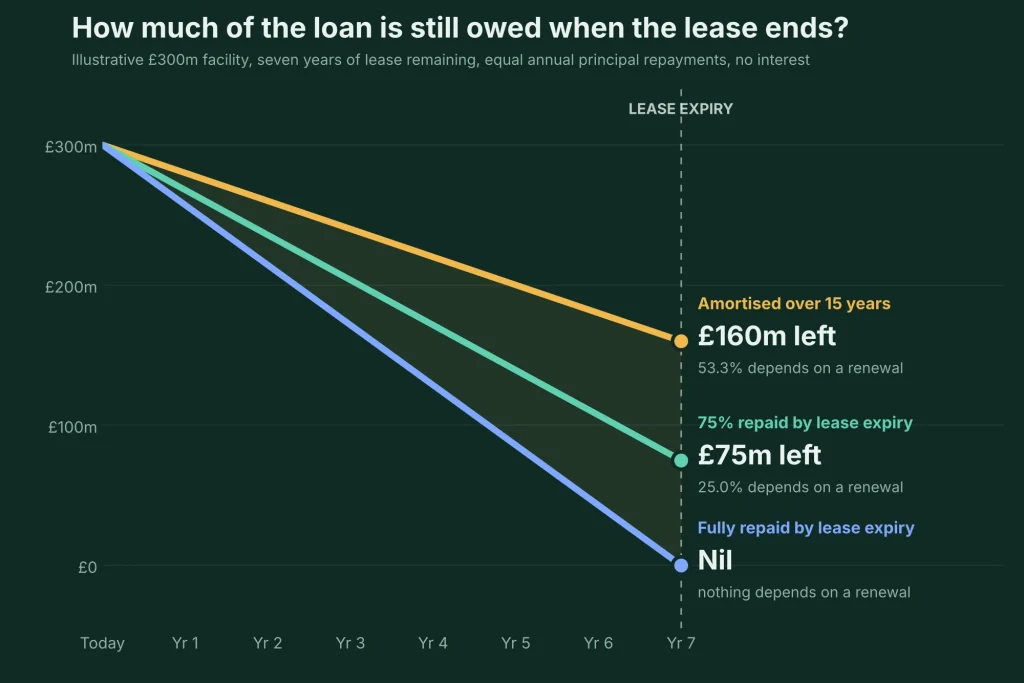
The arithmetic shows why the gap matters. The case below is illustrative only. It assumes a £300m facility, seven years of lease remaining at the date of refinancing, equal annual principal repayments and no interest. The comparison isolates principal repayment. It is not a debt service forecast, and interest would sit on top of every figure shown.
| Repayment profile | Principal repaid each year | Balance at lease expiry |
| Amortised over 15 years | £20.0m (6.7% of the loan) | £160m (53.3%) |
| 75% repaid by lease expiry | £32.1m (10.7%) | £75m (25.0%) |
| Fully repaid by lease expiry | £42.9m (14.3%) | Nil |
Under the first profile, more than half the loan depends on a renewal or re-letting that has not yet been signed.
The second profile reduces that exposure to a quarter, at the cost of £12.1m a year more in principal. The 25% figure is chosen only to show the arithmetic. It is not a market norm.
Full repayment within the lease needs 2.14 times the annual principal of the 15-year profile, which is why the tail and the payment profile have to be solved together. A facility whose cash flow cannot carry faster repayment has to carry the renewal risk instead.
Renewal Risk: Who Carries It and What Reduces It
A&O Shearman sets out when investors may be willing to accept renewal risk: where tenant credit is strong, extension options are embedded in the lease, and the assets sit in established FLAPD markets, namely Frankfurt, London, Amsterdam, Paris and Dublin.
Larger portfolio financings also offer staggered maturities, which spread the exposure across several expiry dates.
Read as a credit analyst would, those conditions are separate tests:
- Tenant. Will this tenant want to stay once the term ends, and does its credit justify the assumption?
- Extension rights. Is the right to remain contractual, and who holds it?
- Location. If the tenant leaves, is there a realistic replacement in that market?
A colocation facility with several tenants spreads its expiries and makes the exposure less binary than a single hyperscaler lease, although the rent roll then has to be read tenant by tenant.
What Refresh Capex Does to the Credit
Refresh capex is the cost of keeping the asset lettable to the next tenant. Shell condition, power density and cooling equipment are the usual pressure points, and capex that the first tenant never required can surface at re-letting.
A lender assessing the asset will ask who funds that spend and whether cash flow can carry it alongside debt service. That places the capex plan inside the refinancing case rather than after it. The pace of AI hardware replacement is a separate question that we will address in a later article.
The Anticipated Repayment Date and the Hedge Problem
Not every structure has a conventional maturity. A&O Shearman reports that data centre securitisations typically have a five year expected maturity, or anticipated repayment date (ARD), with debate about extending it to seven or ten years.
Failure to repay at the ARD is disincentivised through step-up coupons and accelerated amortisation, and that makes hedging floating-rate instruments difficult and expensive.
Two consequences follow. The first is that an ARD turns the borrower’s refinancing into a scheduled event, not a contingency. The second is easier to miss: the exit at the ARD is itself a refinancing, underwritten against whatever lease term then remains.
On an illustrative ten year lease and a five year ARD, the next lender sees five years of contracted rent, not ten. Actual terms vary by transaction, but the lease tail shortens every year while the ARD does not move.
Matching the Instrument to the Tenor
The lease profile sets the risk horizon. How much debt the operating cash flow and valuation can support is a separate sizing test, which we cover in our commercial property refinance guide.
Skadden observes that construction debt typically runs for a three to five year term, and that take-out options include broadly syndicated term loans, private placements and asset-backed securities (ABS).
Those options are usually available on better terms and at lower cost than construction loans, and pricing follows the creditworthiness of the tenant. The tenor each option can support is where the lease tail decides the choice:
Term loan. Suited to a defined, shorter horizon, with senior bank or private credit lenders and a maturity that can sit inside the contracted lease.
Private placement. Long dated, which is exactly why the 20 year plus tenor collides with ten year leases. It tends to work best where the lease is long, extension options are strong or the portfolio is large enough to stagger maturities.
ABS. Senior notes appeal to insurance and infrastructure investors, with mezzanine tranches for higher-yielding capital, according to Freshfields. The first EMEA data centre ABS closed in May 2024, and A&O Shearman describes the European and UK market as more recent. Freshfields also notes that ABS and CMBS may diverge in Europe.
A&O Shearman adds that rating agency methodology requires an insolvency remote financing entity, which can be commercially undesirable and may involve transfer tax and national security regimes. That is worth testing before the structure is chosen, not afterwards.
Where the original build was part-funded with a subordinated layer, our article on mezzanine financing explains how that capital is priced.
What Data Center Refinancing Releases
Skadden notes that a takeout can unlock equity trapped in the facility, and that release is what a data center refinancing delivers when it succeeds.
How much is released depends on how the new debt is sized against what it repays, and on the lease: a longer, stronger tail supports more debt against the same asset. The lease work above is therefore also the equity release work in any data center refinancing.
Questions to Settle Before Approaching the Market
Before approaching the market for a data center refinancing, settle these five points.
Lease tail. How many years of contracted rent remain, compared with the tenor of the debt being proposed?
Renewal dependence. What share of the balance at lease expiry depends on renewal or re-letting?
Extension rights. What extension options exist, and who controls them?
Refresh capital. What capital does the asset need to stay lettable to the next tenant, and who funds it?
Exit date. If the structure has an ARD, what is the plan, and the cost, if the exit slips?
If you are planning a data center refinancing and want the structure to reflect the lease profile of the asset, we welcome a discreet conversation.
Related reading: the Commercial Real Estate Playbook sets out where this article sits in the wider financing sequence.