
Private Credit Trends 2026: Institutionalisation, Secondaries and Bank Partnerships

A €200 million private credit facility used to be a relationship between one borrower and one manager. In 2026, that same facility is increasingly likely to sit inside a bank originated portfolio, sold down through a secondaries market that barely existed three years ago, structured against balance sheet assets rather than pure cash flow.
The real story behind private credit trends 2026 is not that lenders have become more cautious. It is that the plumbing of the asset class has changed.
That caution story has already been told. For the mechanics of how underwriting, leverage and documentation have tightened this year, see Credit Market 2026: The Reset, which covers the shift to disciplined, selective capital in full. This post assumes that foundation, along with the standard of preparation set out in what a lender expects to see in a data room, and looks instead at what sits underneath the shift: the structural changes turning private credit trends 2026 from a growth story into permanent portfolio infrastructure.
Private Credit Trends 2026: A $1.5 Trillion Structural Reality
Private credit has crossed $1.5 trillion in assets under management globally, and the figure understates its significance. The asset class has moved from a tactical allocation to a structural replacement for parts of the high-yield bond and syndicated loan markets that institutional investors used to rely on for income.
That scale has produced what practitioners increasingly call a bifurcation in manager quality. Platforms with genuine underwriting infrastructure, workout experience and sector depth are pulling ahead of managers who raised capital during the growth years but have never had to restructure a position. For borrowers and family offices selecting a lending partner, this is now the more relevant filter than headline pricing.
Credit Secondaries: A New Liquidity Layer
The clearest evidence that private credit has institutionalised is the emergence of a functioning secondaries market for LP interests in private credit funds. Until recently, an investor committed to a ten-year direct lending vehicle had no practical way to exit early short of a negotiated, heavily discounted transfer.
That is changing. Secondaries volumes in private credit are growing from a low base but growing fast, driven by institutional LPs rebalancing exposure and by GPs using continuation vehicles to hold high-performing assets longer than a fund’s original life allows. For allocators, this adds a liquidity layer that simply did not exist when direct lending first scaled, and it changes how duration risk should be priced into a private credit allocation.
Asset-Based Finance: Lending Against the Balance Sheet
A second structural shift is the growth of asset-based finance within private credit, where managers lend against equipment, inventory, intellectual property and receivables rather than relying purely on enterprise cash flow. This is a different underwriting discipline to the cash-flow lending that built the direct lending market, and it provides a different form of downside protection.
The parallel with securities-based lending is direct. Just as a securities-based lending facility is structured against the liquidity and volatility profile of a specific portfolio rather than the borrower’s income statement, asset-based private credit prices the realisable value of a specific balance sheet asset. Readers who understand the logic of one will recognise the logic of the other.
Semi-Liquid Structures and the Private Wealth Channel
Private wealth access to private credit has historically been constrained by structures built for institutional capital: long lock-ups, capital calls and limited redemption windows. Semi-liquid vehicles, including ELTIF 2.0 structures in Europe and Long-Term Asset Funds in the UK, are designed to close that gap with monthly or quarterly liquidity windows layered on top of genuinely illiquid underlying loans.
The design challenge for managers running these vehicles is real. A fund offering periodic redemptions still holds loans with multi-year maturities, and the ELTIF 2.0 framework sets out the regulatory guardrails managers must work within to reconcile the two. Family offices evaluating semi-liquid private credit allocations should treat the redemption terms, not the headline yield, as the first diligence question.
Banks and Private Credit: From Competition to Partnership
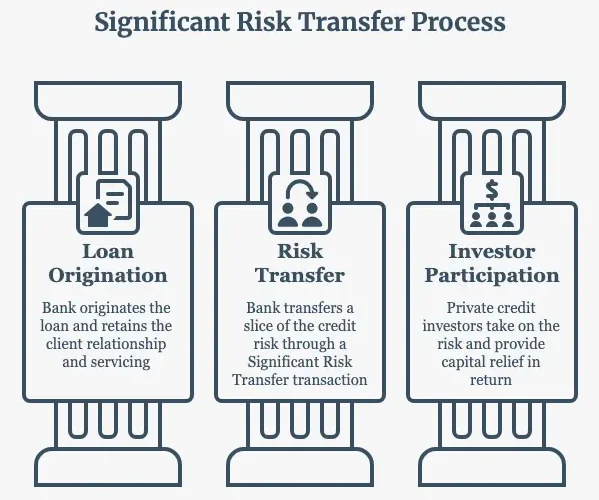
The most consequential structural development in 2026 is not competition between banks and private credit managers, it is their convergence. A growing share of new private credit deployment now originates on a bank’s balance sheet before risk is transferred to private credit investors, most commonly through Significant Risk Transfer transactions.
In an SRT structure, a bank retains the client relationship and often the servicing of a loan portfolio, while transferring a slice of the credit risk to private credit investors in exchange for a return. This allows banks to meet capital requirements without exiting relationships they value, and it gives private credit managers access to origination volume and underwriting data they could not replicate independently. The Grant Thornton explainer on synthetic securitisation sets out the mechanics in detail.
For borrowers, the practical effect is that the counterparty taking the credit decision may no longer be the institution the borrower originally approached. A facility can be originated by a bank relationship manager and ultimately priced and monitored by a private credit fund with its own reporting requirements. Understanding who actually holds the risk on a facility is now a legitimate diligence question for any borrower relying on a bank-originated private credit line.
Lender Insight: How Institutional Capital Assesses These Structures
Private credit managers evaluating a bank-originated SRT tranche scrutinise the originating bank’s historical loss and recovery data on comparable portfolios before committing capital, not just the headline coupon on offer. A bank with a strong servicing track record on a portfolio commands a materially tighter spread than one where workout history is thin or undocumented.
In asset-based finance, lenders build their own view of realisable value for the specific collateral class rather than accepting a borrower’s carrying value. Equipment and inventory are typically discounted against third-party liquidation appraisals, while receivables are assessed on concentration risk and historical dilution rates, not simply on the ledger balance.
For secondaries transactions, pricing discipline centres on vintage and remaining duration. A 2021-vintage direct lending position with several years of documented performance trades on very different terms to an undrawn 2026 commitment, and managers buying into continuation vehicles look closely at why the GP wants to hold the asset longer rather than exit through a sale.
Semi-liquid fund managers stress-test redemption scenarios against the actual liquidity of the underlying loan book, not against modelled investor behaviour alone. A fund that assumes orderly redemptions in a stressed market is the structure most likely to face a gate, and sophisticated allocators now ask to see that stress testing before committing capital.
What This Means for Allocators and Borrowers
None of this changes the diligence discipline set out in Credit Market 2026: The Reset or in the standards covered in Private Credit Underwriting 2026: A Lender’s Perspective. It does change where allocators should be looking for genuine differentiation between managers and between structures.
For family offices and institutional allocators, the structural questions now matter as much as the credit questions: is the manager equipped to run asset-based underwriting or only cash-flow lending, does a semi liquid vehicle’s redemption profile match the actual liquidity of its loan book, and on a bank-originated facility, who is actually holding the risk once the ink is dry. A lender or manager who cannot answer these clearly has not yet caught up with where the asset class has moved.
Private Credit Trends 2026: The Bottom Line
Private credit’s next phase is not defined by whether capital is available, that question was settled years ago. It is defined by how that capital moves: through secondaries markets that did not exist at scale in 2023, through asset-based structures borrowed from securities-based lending logic, and through bank partnerships that blur the line between traditional and private credit.
Borrowers and allocators who understand this plumbing will be better placed to negotiate structures that reflect where the risk, and the value, actually sits.
If you are evaluating a private credit facility and want clarity on how the underlying structure and risk transfer actually work, we welcome a discreet conversation. Contact us today.
For a more structured breakdown of how these strategies are applied in practice, see the Borrower Trust & Due Diligence Playbook.