
Private Credit Due Diligence: How AI is Transforming Borrower Intelligence in 2025

Private credit markets are growing fast and so is private credit due diligence. And with that growth comes increased scrutiny, higher expectations, and greater competition for funding. Borrowers are now expected to show up with more than just a slick pitch deck and some projected numbers — they need institutional-grade data, bulletproof structures, and the ability to speak the language of technical due diligence.
The balance of power is shifting. Private credit due diligence used to be something done to borrowers. Today, the smartest borrowers are flipping the script. They’re using AI to run borrower due diligence on their lenders. They’re showing up armed with insights and real-time intelligence. They’re turning data rooms into living, breathing assets. And increasingly, they’re taking control of the process — because the cost of not doing so is losing out to someone who will.
This post explores how AI is helping borrowers in private credit risk, level up their due diligence, manage complexity, and negotiate with leverage.
The New Private Credit Due Diligence Landscape
In the old world of private lending, private credit due diligence was one-sided. The lender asked questions, the borrower answered. The lender ran background checks, legal reviews, risk analysis, and valuation studies — the borrower waited. But the private credit market isn’t what it used to be. As it matures and institutionalises, borrowers are being asked to bring the same level of transparency and discipline that lenders do.
More than that, borrowers are under pressure to:
- Present data that can stand up to institutional-grade scrutiny
- Prepare for technical and financial questions they may not have anticipated
- Identify and mitigate risks before the lender flags them
- Avoid reputational or structural pitfalls that may block the deal later
So how do you do that? AI is becoming one of the most powerful tools on the table.
How AI is Rewriting Private Credit Due Diligence for Borrowers
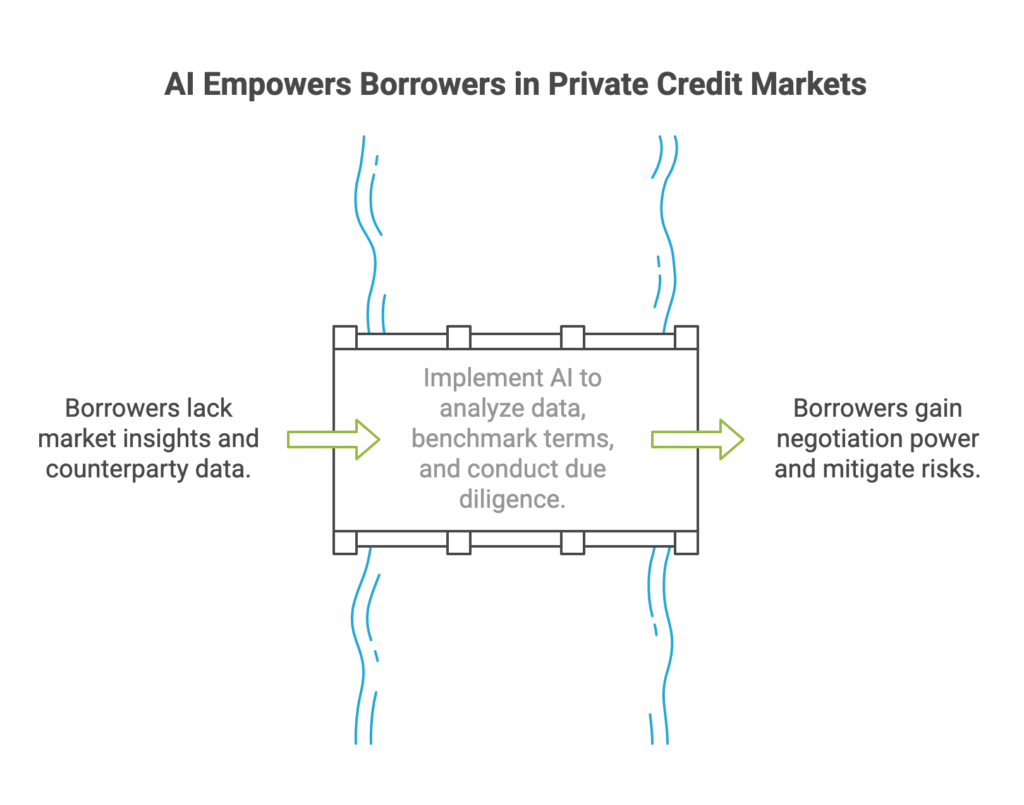
Here’s how AI is giving borrowers the edge in private credit due diligence:
1. Faster, Smarter Document Analysis
Borrowers have to review everything from loan agreements and term sheets to covenants, compliance clauses, and valuation assumptions. AI-driven platforms like Kira Systems, Evisort, and Luminance can scan thousands of pages, flag risky terms, and compare language against market norms in minutes.
That means borrowers can:
- Identify unfair or hidden clauses early
- Spot precedent from previous deals
- Negotiate with data-backed confidence
2. Real-Time Market Intelligence
What’s the going rate for art finance or crypto based loans? What covenants are normal in aviation finance? How are lenders treating equity kickers in development projects?
AI-enabled platforms like Preqin, PitchBook, and AlphaSense can benchmark terms across thousands of transactions. This arms borrowers with:
- Pricing intelligence to avoid overpaying for capital
- Structuring guidance based on peer deals
- A clear understanding of what lenders are seeing across the market
This isn’t just useful — it’s critical. In opaque markets, having visibility into deal terms separates the serious players from the rest.
3. Counterparty Due Diligence
Borrowers need to vet their lenders too. Not all private credit providers are created equal. Some have hidden reputational baggage, litigious histories, or may be shopping your deal around without your consent.
AI tools like SignalX, RepRisk, and DueDil help borrowers:
- Screen for lawsuits, regulatory actions, or ESG red flags
- Identify shell companies or offshore structures
- Flag past controversies involving key individuals
It’s the same level of scrutiny that lenders apply — just flipped. And with good reason: a bad lending partner can kill your deal, tie up your assets, or damage your credibility with other investors.
For non-institutional borrowers — especially in stock loan transactions — the use of AI may be more limited to basic company checks or background screening. But even here, a quick reputational check can prevent major headaches later.
If you’re preparing for a raise and want help building your private credit due diligence stack, let’s talk.
4. Unstructured Data Mining
Private credit deals are complex, and often involve partners — like private equity sponsors, syndicate lenders, or insurers — whose influence isn’t obvious at first glance.
AI can mine unstructured data like:
- Analyst reports
- Fund manager letters
- Media coverage
- Regulator filings
This data can reveal hidden relationships, changes in portfolio strategy, or even subtle shifts in lending appetite. Tools like Quid or AlphaSense allow borrowers to build a 360-degree view of their counterparties.
Borrower vs Lender AI Use: A Comparative Snapshot
| Function | Traditional Lender AI Use | Modern Borrower AI Use |
| Document Review | Detect borrower risk, legal compliance | Spot unfair clauses, negotiate stronger terms |
| Market Benchmarking | Evaluate pricing vs peers | Avoid overpaying, align with market standards |
| Counterparty Risk Screening | Background checks on borrower and affiliates | Vet lenders, avoid reputational landmines |
| Deal Structuring Insights | Adjust covenants, manage downside risk | Understand common deal terms, enhance positioning |
| Data Room Analytics | Monitor borrower responsiveness and transparency | Detect lender interest, streamline communication |
AI is Powering Next-Gen Data Rooms
Here’s the truth: many borrowers think of data rooms as static — a folder of PDFs dumped into a Dropbox. But in today’s market, lenders expect dynamic, real-time data rooms that are structured, searchable, and constantly updated.
AI-enabled platforms can:
- Automatically tag and organize documents by topic
- Detect missing items in a standard due diligence checklist
- Track document views and flag areas of interest to lenders
- Push alerts when data becomes outdated (e.g. financials, valuations, forecasts)
Borrowers using tools like DealRoom, DocSend, and Ansarada are delivering smoother processes, faster cycles, and more transparent relationships.
From Passive to Proactive: Borrowers Doing Their Own Private Credit Due Diligence
Beyond tools, AI is encouraging a mindset shift: good borrowers no longer wait to be asked for things. They:
- Pre-screen their lenders
- Prepare data rooms proactively
- Benchmark terms with real-time comps
- Flag their own risks — and show how they’re managing them
Some are even hiring third-party platforms to run internal due diligence reports on themselves before they go to market. This builds credibility, reduces back-and-forth, and shows lenders they’re serious.
Think of it as “institutional readiness.” The best borrowers don’t just look investable — they are.
Example: Using AI in Asset-Based Lending
Let’s take a real-world scenario: a borrower wants to raise $10M against a portfolio of listed equities and two fractional shares in a private jet. Here’s how AI can help:
- Use Plaid or Canoe to pull up-to-date portfolio data, including liquidity analysis
- Use Kira Systems to review any co-ownership or lien documents on the jet
- Use PitchBook to find historical comps for similar loan structures
- Use SignalX to check the reputational background of the lender and its principals
- Create a virtual data room with DealRoom that flags asset valuation gaps or missing compliance documents
Instead of spending 3 weeks going back and forth, the borrower can compress diligence timelines and negotiate from strength — because they’ve already done most of the work.
AI Doesn’t Replace Judgment — It Elevates it
A word of caution: AI is powerful, but it’s not magic. It can surface insights, detect patterns, and speed up process — but it can’t replace experience. Human judgment still matters. AI might tell you a lender has a clean record, but only experience will tell you whether their term sheet is likely to shift at the eleventh hour.
Borrowers should use AI to enhance their judgment — not outsource it.
The Borrower’s Edge
Private credit is no longer a free-for-all. It’s selective, competitive, and increasingly professionalized. The borrowers who win are those who carry out private credit due diligence:
- Understand what institutional lenders expect
- Take control of the diligence process
- Use AI to move faster, see deeper, and negotiate smarter
You don’t need to become a data scientist. But you do need to treat private credit due diligence as a strategic function — not a compliance chore.
Because in 2025, capital doesn’t just flow to the best projects. It flows to the best-prepared borrowers.
AI-Driven Borrower Intelligence Recap
- Build institutional-grade data rooms
- Run real-time lender & market due diligence
- Close faster by front-loading credibility
Next Step: Let’s Talk About Private Credit Due Diligence
We work with borrowers… to structure AI-powered diligence strategies… book an AI Readiness & Strategy Session today!
🎧 Want a breakdown of Private Credit Due Diligence: How AI Is Transforming Borrower Intelligence in 2025 ? Listen to this Deep Dive where experts dive into its key points. 🎙️Listen here