
Alternative Financing 2026: The Smart Borrowers Choice
In private wealth and institutional capital markets, reputation has long been mistaken for resilience.
For decades, ultra-high-net-worth investors, family offices, and senior executives have defaulted to Tier-1 private banks and global prime brokers for one simple reason: the brand feels safe.
In 2026, that assumption deserves scrutiny.
Sophisticated borrowers are increasingly recognising that prestige does not guarantee flexibility. In many cases, the most recognisable institutions are also the most structurally constrained. Regulatory capital rules, internal exposure limits, and policy-driven credit frameworks have made traditional private bank liquidity more rigid than borrowers often appreciate.
Alternative financing is no longer a fallback for those excluded from traditional credit. It is becoming a deliberate strategic choice for borrowers who prioritise control.
Reputation Bias and the Brand Trap
Reputation bias is subtle. It is not ignorance of terms, nor a lack of sophistication. It is the assumption that a long-standing institutional relationship will adapt in times of stress.
Brand comfort creates behavioural inertia. The borrower believes flexibility will exist when needed.
Yet modern private bank and prime brokerage lending is frequently pro-cyclical. When markets are stable, leverage is available. When volatility rises, margin requirements tighten, concentration caps are enforced, and discretionary clauses are activated.
The borrower discovers that the relationship is secondary to the mandate.
This is the Brand Trap. Trust in the name obscures scrutiny of the structure.
What Alternative Financing Means in 2026
At the institutional and UHNW level, alternative financing refers to specialist capital providers operating outside traditional private banking constraints.
This is not retail crowdfunding. It is structured, asset-backed, often non-bank capital designed for complex portfolios.
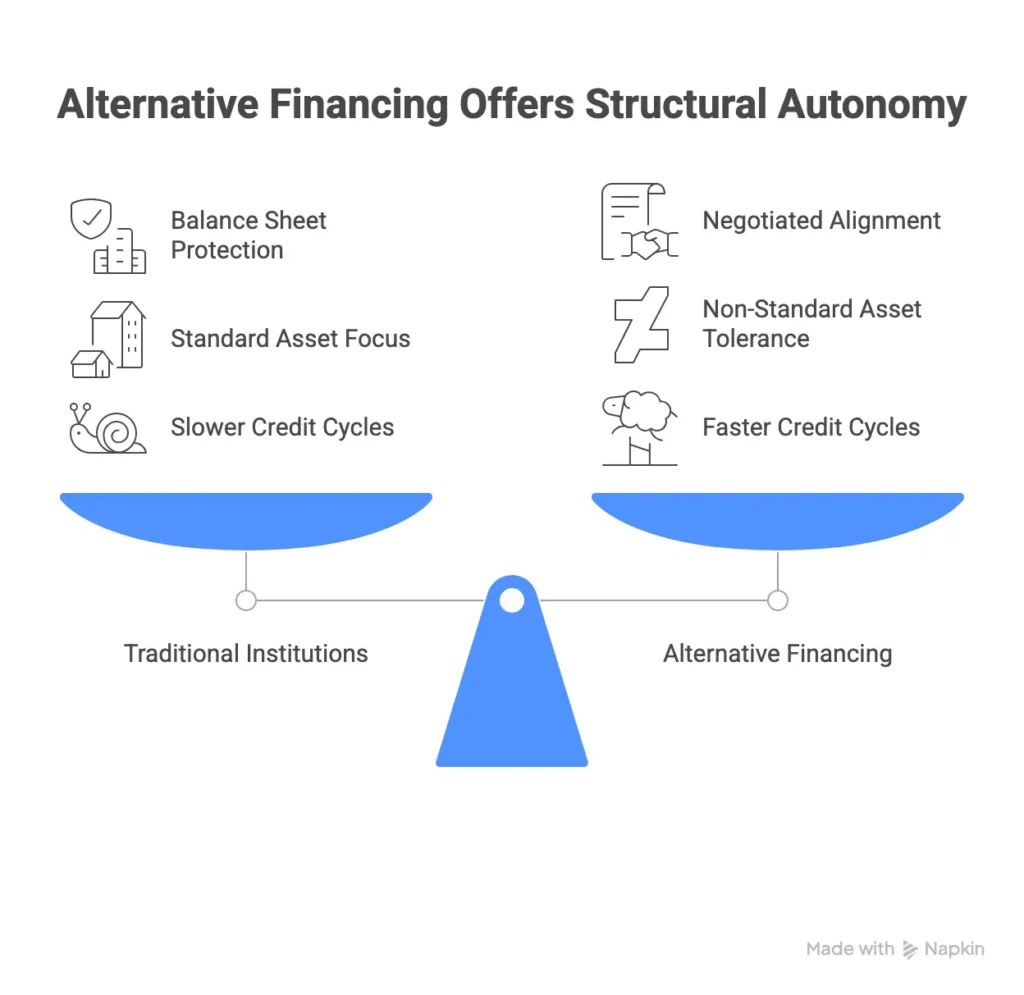
Alternative financing typically offers:
- Bespoke structuring aligned to the risk profile of the asset
- Non-recourse or limited-recourse frameworks that isolate exposure
- Faster credit decision cycles
- Greater tolerance for concentrated or non-standard assets
The defining distinction is structural autonomy.
Where traditional institutions prioritise balance sheet protection, alternative financing prioritises negotiated alignment.
Where Traditional Structures Restrict Borrowers
Sophisticated borrowers are not moving because banks are incompetent. They are moving because structure matters.
1. Recourse Across the Estate
Most private bank facilities for individuals remain full recourse. A single underperforming asset can create claims against unrelated holdings.
Non-recourse alternative financing isolates risk to the pledged collateral, preserving the wider estate.
2. Concentration Limits and Internal Policy Shifts
Prime brokers and private banks routinely impose sector and position limits. These limits may change due to internal risk recalibration rather than asset fundamentals.
Borrowers can be forced to reduce exposure at strategically disadvantageous moments.
3. Cross-Collateralisation
Bundling assets into a unified collateral pool simplifies risk management for the lender, not the borrower.
A decline in one asset class can trigger margin consequences across unrelated holdings.
4. Discretionary Margin Adjustments
Valuation haircuts and margin requirements often sit within institutional discretion. During stress, that discretion becomes active.
Control shifts quietly but decisively.
Alternative financing structures typically define clearer parameters in advance, reducing unexpected control transfer.
Reality in Practice
The Concentrated Shareholder
A senior executive holds a significant listed position and seeks liquidity without triggering tax consequences or signalling to the market.
A private bank offers a Lombard facility, 50 percent LTV, full recourse, approval in three weeks.
An alternative financing provider structures a comparable facility, non-recourse, ring-fenced to the shares, execution inside five days.
The interest rate is similar. The structural control is not.
The Time-Sensitive Acquisition
An investment group identifies a distressed commercial real estate asset requiring a 48-hour completion.
Their established banking partner cannot move within internal compliance timelines.
A specialist bridge lender evaluates asset value and exit strategy, deploying capital inside the window.
The marginal cost of capital is negligible relative to the strategic gain.
In both cases, the distinction is flexibility under time and stress.
Why Alternative Financing Is Expanding
The expansion of alternative financing in 2026 reflects structural evolution:
- Regulatory capital frameworks reduce traditional bank flexibility
- Internal credit conservatism prioritises balance sheet protection
- Volatility reinforces pro-cyclical margin behaviour
- Investors increasingly value capital agility over marginal rate savings
Borrowers are recalibrating. They are optimising for autonomy.
The Autonomy Audit
Before committing to any facility, borrowers should evaluate structure over brand:
- Does this facility restrict portfolio growth?
- Is recourse broader than necessary?
- Are discretionary adjustments embedded in the agreement?
- Can the structure adapt in volatility?
- In a worst-case scenario, who controls the outcome?
Alternative financing becomes compelling when flexibility and estate protection take precedence over institutional prestige.
From Reputation to Resilience
The most capable borrowers in 2026 are not abandoning private banks. They are rebalancing dependence.
Reputation has value. Structural control has greater value.
Alternative financing enables risk isolation, speed of execution, and strategic independence. In volatile markets, those attributes often outweigh incremental pricing differences.
The shift from brand-based lending to structure-based capital is not ideological. It is pragmatic.
Those who recognise the Brand Trap early gain flexibility when it matters most.
Discreet Engagement
If your current financing structure prioritises institutional comfort over strategic flexibility, it may be time to reassess.
We advise sophisticated borrowers on non-recourse and structured capital solutions designed to preserve autonomy and control.
Confidential discussion is available on request.