
Stock Loan Underwriting: How Lenders Decide Before Approving

Many shareholders assume that if the stock is listed and freely tradeable, the loan will follow. What they discover in practice is that approval depends on a set of assessment criteria that have nothing to do with income, balance sheet or credit history. The lender underwrites the security, not the shareholder. Understanding what drives that assessment, and where it results in declined applications or lower-than-expected advance rates, is essential before any structured borrowing conversation begins.
What Stock Loan Underwriting Actually Assesses
Stock loan underwriting is the process by which a lender evaluates a pledged or transferred security to determine whether it qualifies as collateral, and on what terms. The underwriting process is asset-led. The starting question is not whether the borrower can service debt, but whether the lender can manage and exit the position if required. That distinction separates stock lending from virtually every other form of secured finance.
In traditional investment bank underwriting of equity and debt securities, the institution assesses the issuer’s ability to raise capital and prices the offering accordingly.
Bank loans and private credit facilities assess the borrower’s earnings, cash flow, leverage and repayment capacity. As covered in Private Credit Underwriting 2026, that process involves credit committees, data rooms and financial modelling built around the borrower. Stock loan underwriting inverts this logic entirely. The borrower’s financial profile is not the approval driver.
KYC and AML checks are always required, as is source-of-shares verification. These are compliance gates, not credit filters. Passing them does not generate an approval. Only the stock can do that.
Factors That Determine Whether a Stock Qualifies
Lenders approach each stock loan underwriting on a case-by-case basis. There is no standard formula, and the same position presented to different lenders will produce different outcomes. The assessment consistently centres on four areas.
Tradability, Average Daily Volume and Listing Venue
Liquidity is the primary screen in stock loan underwriting. Before a lender considers pricing or structure, it assesses whether the position can be managed if circumstances require it. Average daily volume (ADV) is the core metric. A position representing two or three days of ADV is manageable. One representing twenty days of ADV presents a liquidity and price problem that most lenders will not accept at standard terms, if at all.
The lender is not simply asking whether the stock trades. It is asking whether it can manage the buying and selling of those shares at scale without moving the market against itself.
Listing venue and settlement infrastructure also influence lender appetite, and are assessed alongside ADV rather than separately. Securities listed on the LSE Main Market, Euronext, the Hong Kong Stock Exchange or the ASX generally attract broader participation from specialist lenders than those listed on AIM, junior or frontier market exchanges, or quoted on OTC markets. The exchange determines the regulatory standards, settlement certainty and liquidity depth the lender can rely on when managing the collateral. A stock that meets the ADV threshold but trades on a market with limited settlement infrastructure or weaker regulatory oversight will attract a more conservative advance rate, or may not qualify at all.
Free Float and Concentration
Position size relative to free float is assessed separately from ADV, because a stock can have reasonable daily volume and still present a concentration problem. If the applicant holds a significant percentage of the free float, the lender’s ability to manage the collateral without market impact is constrained regardless of headline trading activity.
For concentrated shareholders, this is often the binding constraint. As discussed in Stock Loans for Concentrated Shareholders, large positions in listed companies require specific structuring considerations. In a stock loan underwriting context, concentration is typically addressed through lower LTVs, limits on the proportion of the position eligible for lending, or both.
Volatility and Risk Profile
Once tradability is established, the underwriter assesses the stock’s historical and implied volatility. Both 30-day and 90-day readings are reviewed. The risk profile of the security determines the financial risk the lender carries over the loan term and directly influences the advance rate applied.
A low-volatility, large cap stock on a major exchange will typically attract an LTV in the range of 50 to 60 percent. A mid cap with elevated volatility or limited liquidity will attract a lower advance rate, sometimes materially so. Market volatility at the time of application also matters. A stock that qualifies at 55 percent LTV in a stable market may be reassessed downward during a period of broader market stress, reflecting the overall risk to the lender’s collateral position rather than any change in the borrower’s circumstances.
Regulatory and Transfer Restrictions
This is the assessment factor that most frequently causes applications to stall. A stock may be listed, liquid and low-volatility, but if the shares are subject to a lock-up period, carry a restricted legend or are held by an insider or affiliate of the issuer, they are not free-trading. No lender operating in the single listed stock loan underwriting market will advance against securities that are not free to trade. The shares must be capable of being transferred without restriction for the collateral to function.
Source-of-shares due diligence is conducted as part of this screen. The stock loan underwriting needs to verify that the applicant holds clear, unrestricted legal title and that no third-party interest, pledge or restriction encumbers the position. Cases where restrictions were not disclosed at the outset have resulted in declined drawdowns after indicative terms were agreed, creating complications for borrowers that proper preparation would have avoided.
How Assessment Translates into Terms
Once a security passes the initial screens, the stock loan underwriting output is a proposed term sheet rather than a binary approval. The loan underwriting process does not produce a fixed answer. It produces a range: an LTV, a pricing indication, a proposed term and, where applicable, margin trigger levels.
The LTV is the primary output of the risk assessment. It reflects the lender’s view of the overall risk associated with the collateral: its liquidity, its riskiness under stress, its structure and its position relative to the broader market. Whether the collateral is a stock or bond, the lender is asking the same structural question: can this asset be relied upon to protect the facility if conditions change? For single listed equities, that question is answered through the screens above. The Securities Based Lending 2026 guide provides the structural context within which the stock loan underwriting decision sits, and How Do Securities-Backed Loans Work? covers the mechanics of how a qualifying loan is then constructed.
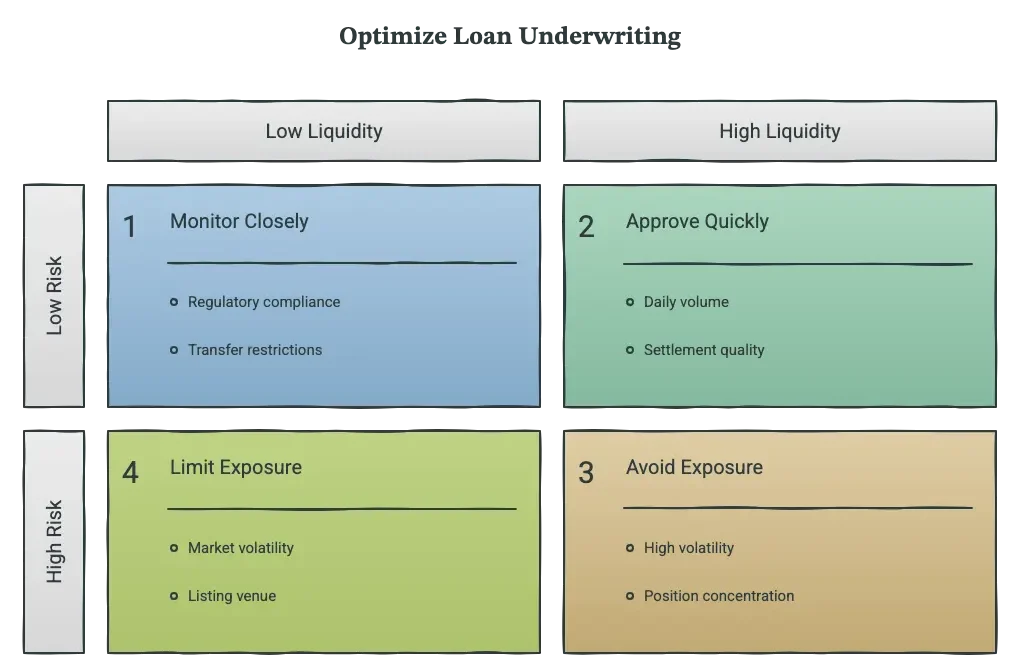
Lender Insight: How Underwriters Assess Stock Loan Applications
The liquidity screen is not a threshold, it is a scale. A stock that comfortably passes the ADV test can still attract conservative terms if the underwriter identifies execution risk in the wider market context. They are assessing how the collateral will behave over the loan term, including under conditions of market volatility. Liquidity and price stability are assessed together, not independently. A stock that trades actively in normal conditions but tends to gap significantly on news events will carry a higher discount than its headline ADV suggests.
Concentration relative to free float is the variable that surprises borrowers most frequently. An applicant with a large listed position will often have a market price in mind and a loan quantum in mind. What they have not calculated is their position as a percentage of what is actually tradeable in the market. When the stock loan underwriting process identifies that a full advance against the declared position would represent a significant fraction of the available float, the advance rate falls, the eligible portion of the position is capped, or both. This is not a variable that lenders negotiate around. It reflects a structural limit on the collateral’s utility, not a pricing preference.
Legal title and restriction checks are conducted before pricing is confirmed. It is common for applicants to understand intellectually that shares must be free-trading, while holding positions that are technically restricted due to a recent corporate transaction, a lock-up tied to a capital raise or a regulatory designation they were not aware carried borrowing implications. The underwriter identifies these through a combination of regulatory databases, broker confirmation and direct legal title review. A lender will not commit to pricing until title is confirmed clean.
Terms are not fixed outputs of a formula. The same stock presented to three specialist lenders will generate three different structures. One may offer 55 percent LTV at competitive rates with a 12-month term. Another may offer 50 percent with tighter margin triggers and a six-month term. A third may decline entirely based on internal concentration limits that have nothing to do with the quality of the specific position. For borrowers seeking to access capital against a significant listed position, working with an intermediary who understands these differences and can place the transaction with the most appropriate counterparty materially improves the probability of a deal completing on terms that reflect the value of the collateral.
Where Applications Stall: A Practical Example
Consider a FTSE 250 shareholder holding a 4.5 percent stake in a listed company following a secondary placing twelve months earlier. The stock is liquid, well-covered and the borrower holds clear legal title. The application is submitted to three lenders. Two decline without issuing terms. The third issues an indicative term sheet at 45 percent LTV with a six-month term, conditional on drawdown.
The constraint is a lock-up attached to the placing agreement, expiring in two months. The shares are not free-trading until that date. The lender willing to issue conditional terms has assessed the stock quality as qualifying and is prepared to hold the terms pending expiry of the restriction. The two who declined do not advance against restricted securities under any circumstances, even conditionally.
At expiry, the borrower confirms the restriction has lifted, title is clean, and drawdown proceeds at the agreed terms. The outcome depended not on the stock quality, which all three lenders would have assessed similarly, but on which lenders were in the conversation and what their individual policy positions on conditional advances were. The difference was access to the right counterparties at the right stage of the process.
What to Consider Before Requesting Terms
Applicants who understand the underwriting criteria are significantly better positioned before approaching a lender. The key practical considerations are as follows.
Confirm the shares are free-trading. Any lock-up, restricted legend or insider designation needs to be identified and its expiry date established before the application is made. Presenting restricted stock as freely tradeable is the single most avoidable cause of declined applications.
Understand the position in context. Know what percentage of the free float your holding represents and what the average daily trading volume looks like relative to the size you intend to pledge. These two figures will define the LTV range before the lender has reviewed a single document.
Set realistic expectations on advance rates. For qualifying listed equities, an LTV in the range of 50 to 60 percent reflects current market reality for single listed stock loans. Expectations above this range will result in either wasted process time or a misaligned lender.
Be prepared for variation across lenders. What one underwriter declines based on internal concentration limits, another may accept at modified terms. The absence of a single approval is not the end of the process. It is information about which part of the market that particular position fits. The Bank of England’s Guide to Pre-positioning Loan Collateral provides a useful reference for how collateral quality is assessed in institutional contexts, reinforcing the principles that underpin stock loan underwriting in the private market.
Conclusion
The most common assumption borrowers bring to a stock loan conversation is that the value of the shares determines the loan quantum. In practice, lenders focus on whether the position can be managed, transferred and exited under stress. A large position in an illiquid stock and a smaller position in a blue-chip that trades actively can attract the same or lower advance rate for very different reasons. That distinction, the asset’s manageability rather than its market price, explains why two shareholders holding positions of identical value can receive materially different outcomes.
If you are evaluating a stock loan and want to ensure the stock loan underwriting process reflects the quality of your collateral, we welcome a discreet conversation. Arrange a call here.
For a more structured breakdown of how securities-based lending transactions are assessed and placed, see the Securities-Based Lending Playbook.