
Structured Finance in Commercial Real Estate: Structure, Risk and Private Credit Access

Traditional bank debt is no longer sufficient for the full range of commercial real estate transactions being executed today. Rising financing costs, tighter credit committee mandates and more conservative senior lending thresholds have left a structural gap between what conventional lenders will provide and what ambitious projects actually require.
Structured finance in commercial real estate closes that gap. It is not an alternative of last resort; for complex, high-value CRE transactions, it is increasingly the primary approach. This post explains how structured finance works in commercial real estate, why the capital stack matters, and what developers, family offices and institutional investors need to understand before committing to a structure.
For a broader overview of the financing process from initial preparation to drawdown, the Commercial Real Estate Financing: 9 Steps guide is the right starting point.
What Structured Finance Means in a CRE Context
Structured finance refers to financing arrangements that go beyond a single senior loan. Rather than relying on one lender for the full capital requirement, a structured transaction assembles multiple instruments, each carrying a different risk profile, return expectation and priority of repayment. The result is a capital stack tailored to the specific project, borrower and investor base rather than constrained by any single institution’s lending parameters.
In commercial real estate, this typically means combining some or all of the following: a senior secured loan, mezzanine debt, preferred equity and, in larger transactions, securitised instruments or hybrid convertible capital. Each layer serves a different function, attracts a different class of capital, and is governed by its own legal and commercial terms.
The appeal is precision. A well-constructed capital stack can reduce the overall cost of funding compared with relying on expensive junior debt alone, improve execution certainty by matching each tranche to investors who actively seek that risk level, and extend the range of transactions that can be financed.
The Capital Stack: How Layers Work in Structured Finance
The capital stack in a structured CRE transaction is not simply a list of debt and equity. It is a deliberate architecture in which each component has a defined function and a defined position in the repayment waterfall.
Senior debt sits at the base: lowest risk, lowest cost, first to be repaid, and secured against the asset. Institutional lenders, insurance companies and senior credit funds are the typical providers. Senior LTV in current markets commonly runs between 50% and 65% of assessed value, with terms varying by asset class, jurisdiction and income profile.
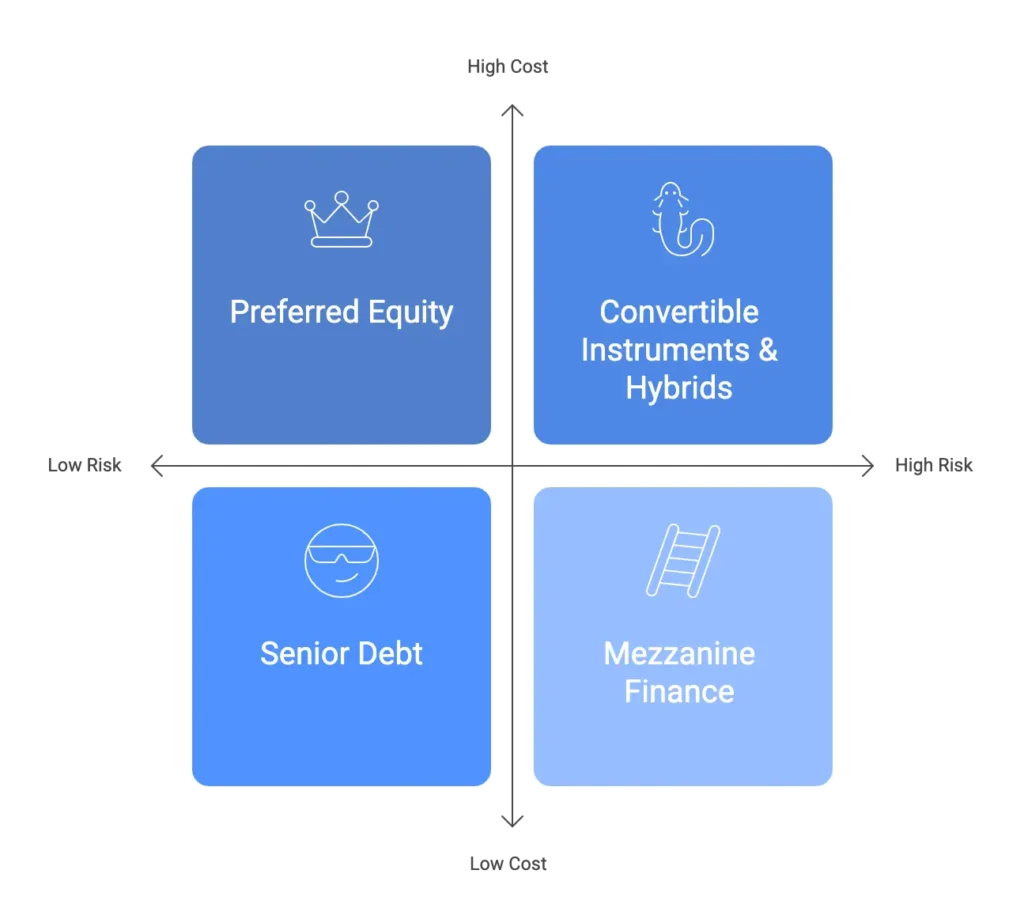
Mezzanine debt fills the gap between senior leverage and the equity contribution. It is subordinated to senior debt, carries higher rates to reflect that subordination, and is typically unsecured at asset level, instead taking a pledge of the borrower’s equity interest in the holding vehicle. For a more detailed treatment of how mezzanine operates in practice, see Mezzanine Financing in Real Estate.
Preferred equity occupies a similar position in the stack but is structured as equity rather than debt. It carries preferred distribution rights, meaning preferred equity investors receive their return before common equity participates in upside. The instrument is particularly relevant where debt limits have been reached or where a mezzanine loan would create intercreditor complications. The Preferred Equity in Real Estate Guide covers the instrument’s mechanics and investor considerations in full.
Common equity sits at the top of the risk hierarchy: last in the waterfall, highest potential return, first to absorb losses. This is typically the developer’s or sponsor’s own capital, or co-investment from a joint venture partner.
Securitisation in CRE: The Mechanism
For larger portfolios and institutional transactions, securitisation provides an additional layer of capital efficiency. The process converts illiquid real estate-backed assets into tradable securities, connecting project cash flows to a broader pool of institutional capital.
The standard mechanism operates as follows. A portfolio of assets, typically income-producing commercial mortgages or receivables, is assembled and transferred to a Special Purpose Vehicle (SPV). The SPV is legally ring-fenced from the originator’s balance sheet, which protects investors in the event of originator distress.
The SPV then issues notes backed by the cash flows of the underlying assets. These notes are tranched: senior notes receive payment first and carry the lowest yield; junior notes absorb losses first and carry the highest yield. Credit enhancements such as overcollateralisation or reserve accounts provide additional comfort to senior investors.
The result is a structure that appeals simultaneously to conservative institutional investors seeking rated, investment-grade exposure and to yield-seeking funds prepared to take first-loss positions in exchange for higher returns.
For family offices and developers seeking liquidity without asset disposal, a private securitisation can be particularly effective. Assets remain in the portfolio in economic terms, but the structure enables capital release against those assets at competitive senior pricing.
Why the Private Credit Market Has Changed the Calculus
The growth of private credit over the past decade has directly expanded what is achievable through structured finance in CRE. As banks have retreated from bespoke, complex or cross-border transactions, specialist credit funds, institutional asset managers and family office capital have filled the space.
Private credit providers are not constrained by the same regulatory capital requirements as banks. They can move faster, tolerate more structural complexity, and hold positions that bank credit committees would not approve. For borrowers, this creates access to a materially larger and more flexible capital pool, particularly for transactions that fall outside vanilla bank criteria: development assets, transitional properties, cross-border structures or portfolios with mixed income profiles.
The trade-off is pricing. Private credit typically sits above bank rates, particularly in subordinated positions. Borrowers must calculate the blended cost of capital across the full stack and satisfy themselves that the project economics support it.
Three Scenarios Where Structured Finance is the Rational Choice
Development with a phased capital requirement. A developer secures senior construction finance for Phase 1 of a mixed-use scheme. The senior lender will not extend to Phase 2 until Phase 1 reaches stabilisation. A mezzanine tranche bridges the gap, funding Phase 2 without requiring the developer to wait, reducing the total development timeline and improving project returns.
Family office liquidity without disposal. A family office holding a diversified CRE portfolio requires liquidity but is unwilling to sell core assets into current market conditions. A private securitisation allows the office to raise capital against the portfolio at senior pricing while retaining ownership and future upside. Junior tranches are retained or placed with aligned investors.
Distressed or transitional asset acquisition. An investor acquires a partially vacant office building requiring significant capital expenditure. Senior lenders decline on current cash flow grounds. A structured deal combines a conservative senior loan with preferred equity funding the repositioning programme. Preferred equity investors receive an enhanced return on exit as a share of value created through the repositioning.
These are not edge cases. They represent a significant portion of the CRE transactions that require intermediary expertise to structure and place effectively.
Risks That Must Be Assessed Before Committing to Structured Finance
Structured finance adds layers of complexity that must be managed, not assumed away.
Documentation and legal costs are material. A structured transaction requires multiple legal agreements: senior facility agreements, intercreditor deeds, mezzanine loan agreements, equity documents and, for securitisations, note trust deeds and ratings processes. These are not trivial costs and must be built into the transaction economics from the outset.
Intercreditor dynamics can create friction in distressed scenarios. Senior and junior lenders have different interests, different standstill rights and different timelines. A poorly negotiated intercreditor agreement can complicate enforcement or restrict the borrower’s options at precisely the moment flexibility is most needed. The Intercreditor Agreement 2026 post addresses these dynamics in detail.
Blended cost of capital must be calculated on realistic assumptions. The weighted average across senior debt, mezzanine and preferred equity may be competitive relative to a standalone junior product, but the calculation must use actual indicative terms rather than market generalisations. Rate ranges vary significantly by lender, transaction profile and current market conditions.
Liquidity risk in structured instruments can increase in market stress. Some tranches, particularly subordinated notes in securitisation structures, may trade at significant discounts or become illiquid during periods of market dislocation, complicating refinancing.
Exit strategy must be considered from the outset. A structured transaction that works on a five-year development timeline requires clarity on the exit mechanism: sale, refinancing into conventional debt, or retention. Lenders in junior positions will have their own views on timing and process.
Working With an Intermediary on Structured Finance for CRE
Structured finance transactions are not self-assembling. The architecture of the capital stack, the sequencing of tranches, the selection of appropriate lenders for each layer, and the negotiation of intercreditor terms all require specialist knowledge that is rarely available in-house.
An intermediary with active relationships across private credit providers, specialist mezzanine funds and preferred equity investors brings market intelligence that most borrowers cannot access independently: which lenders are active in the current cycle, what pricing is genuinely achievable, and where structural complexity is likely to create friction during execution.
Forbes Le Brock works with developers, family offices and institutional investors to structure and place CRE transactions across the UK, Europe and Asia-Pacific. If you are evaluating a capital stack for a complex CRE transaction and want to understand what is achievable in current market conditions, we welcome a discreet conversation.
CRE Finance Playbook
This post is part of the Forbes Le Brock Commercial Real Estate Finance Playbook, a structured guide to CRE financing from foundational metrics through to complex capital stack assembly. Access the full Playbook here.