
Tech Stock Correction: Why Selling Costs More Than Borrowing

A tech stock correction creates a problem many wealthy shareholders underestimate: the moment liquidity is needed most is often the moment selling becomes most damaging. If a large share of your wealth sits in a single listed technology company, a tech stock correction stops being a market story and becomes a live decision.
You hold twenty million in stock, it has fallen thirty-five per cent, you need liquidity, and selling now would crystallise the damage at the worst possible point. The reflex is to sell into the fall. When the underlying investment case is intact, it is often the most expensive choice available.
This is not a guide to rebalancing a diversified book. For that, our portfolio rebalancing guide covers the strategic picture. The question here is narrower and more urgent: during a tech stock correction, what does selling actually cost you, and when does borrowing against the position beat it?
What a Tech Stock Correction Costs You if You Sell
A market correction is conventionally defined as a fall of at least ten per cent, but less than twenty, measured from a recent high. Until you sell, that fall is a paper figure. The moment you sell, three things happen, none of them in your favour.
The loss becomes permanent. A drawdown you could have waited out is converted into a realised loss you cannot recover. You also step out of the rebound that follows most tech stock corrections, and technology recoveries can be sharp and difficult to time, so the holder who sells into weakness frequently buys back higher or misses the move entirely. On top of that, a sale can trigger a tax charge on any embedded gain and, for a founder or insider, can signal weakness to the market at exactly the wrong moment.
Selling is not always wrong. But selling into a tech stock correction is the option people reach for under pressure, and it is the one that turns a temporary problem into a permanent one. Much of that pressure is behavioural rather than financial, a pattern we explore in our note on behavioural biases in investment decision making.
Why a Tech Stock Correction Turns Holders into Forced Sellers
The greater danger is not choosing to sell. It is being made to. In a tech stock correction, a forced sale, driven by a margin call, a covenant breach or an urgent liquidity need, happens on the market’s timing rather than yours, and almost always at the worst price.
A tech stock correction is when forced sales cluster. Leverage arranged in calm conditions comes under strain as values fall, and where a position is held on margin the lender can force the sale of the collateral without your consent to cover a shortfall, selling the very shares you wanted to keep, at the very moment you would least choose to.
Unrelated liquidity needs arrive regardless of where the market is, and all of it can fire at once. The holder who has access to cash that does not depend on selling the fallen asset simply avoids the trap.
Our note on blue chip shares as collateral sets out what lenders assess before lending against a listed holding, and the common thread is always liquidity.
Borrowing Against the Position Instead of Selling it
In a tech stock correction, a securities-based facility against a single listed holding lets you raise cash while keeping the shares. You retain ownership, retain the exposure, and keep any recovery for yourself, then repay from other sources or when conditions improve.
The mechanics of these structures, how the collateral is held, how lenders screen a position for execution, and how a stock loan differs from a margin loan, are covered in our note on stock loans for concentrated shareholders and in how securities-backed loans work.
The essential point in a tech stock correction is simply this: rather than sell into a falling market to fund a liability, an acquisition or a capital call, you borrow against the holding and leave it intact. Facilities of this kind are arranged against free-trading shares on major venues, including the London Stock Exchange, Euronext, Hong Kong Exchanges and the Australian Securities Exchange.
Consider a founder holding twenty-five million in listed technology shares who needs five million to fund an acquisition or a tax obligation during a tech stock correction. Selling a fifth of the position crystallises the loss on that slice and signals an exit at a depressed price. A facility secured against part of the holding can provide the five million while leaving the position, and the recovery, intact.
Why “Sell Now and Buy Back Later” Rarely Works
The obvious counter to all of this is to sell now, sit in cash, and buy back once the correction bottoms. It sounds disciplined. In practice it fails on two points.
The first is timing. Buying back requires calling the bottom, and a tech stock correction does not announce when it is over. The recovery is often fastest in its earliest days, so the holder waiting for confirmation tends to re-enter well above the trough, giving back much of the benefit of having sold. Selling is one decision. Buying back correctly is a second, harder one.
The second is cost. A round trip out of and back into a large listed position carries transaction costs, spread and market impact at size, and where the sale realises a gain, it crystallises a tax charge that the buy-back does not refund. For a concentrated holder in a tech stock correction, the friction of exiting and re-entering a meaningful line is rarely trivial. Borrowing against the position sidesteps both problems, because you never leave, so you never have to time a re-entry.
The Timing Trap: Borrowing Capacity Falls as a Tech Stock Correction Deepens
This is the part most holders miss, and it is where hesitation is expensive.
The amount you can borrow is set by loan-to-value, and LTV is struck off the current price, not the pre-correction peak. On single listed technology positions, facilities are typically structured in the 50 to 60 per cent range. As the correction deepens, the same shares support a progressively smaller facility, because the base value keeps falling. A position that could raise six million early in a drawdown may raise materially less once it has fallen further, on identical terms.
Volatility compounds the effect. Lenders widen their haircuts as realised volatility rises, so the LTV offered on a turbulent technology stock is more conservative precisely when the price is also falling. The borrower is squeezed from both directions at the worst moment. Our loan-to-value in securities based lending guide sets out how these ratios are determined.
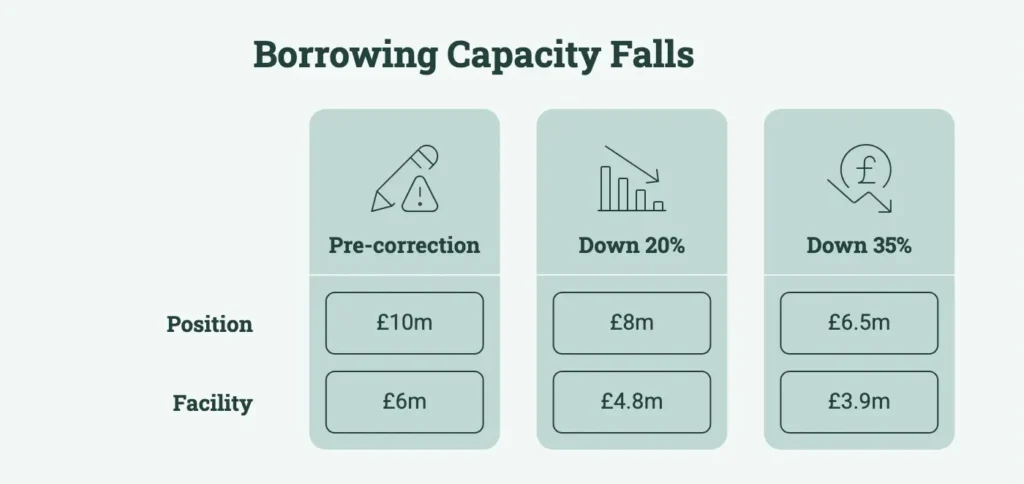
The practical lesson is about sequencing. Terms are best when the position is stable, not when it is in free fall. Holders who scope, or arrange, a facility ahead of or early in a tech stock correction give themselves an option they can exercise on their own timing. Those who wait until the sell-off is under way negotiate from weakness, against a lower base and a wider haircut. Acting early is worth more than acting cheaply.
Tech Stock Correction or Company Impairment: The Distinction That Governs the Decision
Borrowing against a fallen holding is only sound when you have separated a market-wide correction from a company-specific problem.
When the fall is broad, driven by rates, sentiment or a sector-wide repricing, and the underlying business is intact, borrowing to hold is defensible. You are bridging a temporary dislocation you expect to reverse. The signs point that way when the stock is falling roughly in line with its sector or the wider index, when peers are down by similar magnitudes, and when there is no company-specific catalyst behind the move.
When the fall reflects a genuine impairment in the specific company, borrowing is the wrong move. You would be adding leverage to a deteriorating asset with no clear path back, and a facility struck against a falling, impaired stock can quickly come under pressure.
The warning signs are the opposite: the stock falling while peers hold, a specific trigger such as a guidance cut, regulatory action, a lost contract or an accounting concern, or a decline that persists after the broader market has stabilised. The discipline is to strip out the market beta and ask, honestly, whether the company itself has changed. If it has, the answer is not a loan.
When a Tech Stock Correction Fits, and When it Does Not
- It fits when you have a genuine, temporary liquidity need and medium-term conviction in the holding.
- It fits when selling would trigger a disproportionate tax charge or an unwanted signal to the market.
- It does not fit when the fall reflects permanent impairment rather than a market-wide correction.
- It does not fit when there is no realistic repayment path, since a loan defers a decision rather than making one.
The honest downside: if the shares keep falling after you draw, the facility can come under pressure, and additional collateral or partial repayment may be required. Suitability, not availability, should drive the decision.
Being Ready Before the Next Tech Stock Correction
Because terms deteriorate as a correction deepens, the useful work happens before one arrives. That does not mean drawing a facility you do not need. It means knowing, in advance, what your position could realistically support, which lenders would consider it, and how quickly a facility could be arranged if a need appeared. A holder who has scoped this in calm conditions can act in days rather than weeks, and against a higher base value. A holder starting from scratch mid-correction is negotiating terms, liquidity and timing all at once, at the worst possible moment. Arranging finance against a single listed position at size and under time pressure is an execution problem as much as a pricing one, which is precisely why preparation, not availability, tends to decide the outcome.
After the Correction: Rebalance From a Position of Strength
Borrowing to hold is a tactical move. The strategic question, reducing a concentration so that no single holding can dictate your wealth again, is best answered once conditions stabilise and you are not acting under duress. That is a rebalancing decision, covered in our portfolio rebalancing guide and our note on portfolio drift. A facility can bridge the two, giving you room to reduce exposure deliberately rather than dumping shares into a falling market.
Speak to us Before the Next Tech Stock Correction
The strongest financing options in a tech stock correction are usually available before liquidity becomes urgent, while the position is stable and the base value is high. If you hold a significant listed technology position and want to understand your options before market conditions force the decision, we welcome a discreet conversation.
Contact us today to discuss how a facility against your holding could be structured, and how much liquidity it could realistically support.
For the framework behind these transactions, see our Securities-Based Lending Playbook