
Subscription Finance: What Lenders Check Before Funding
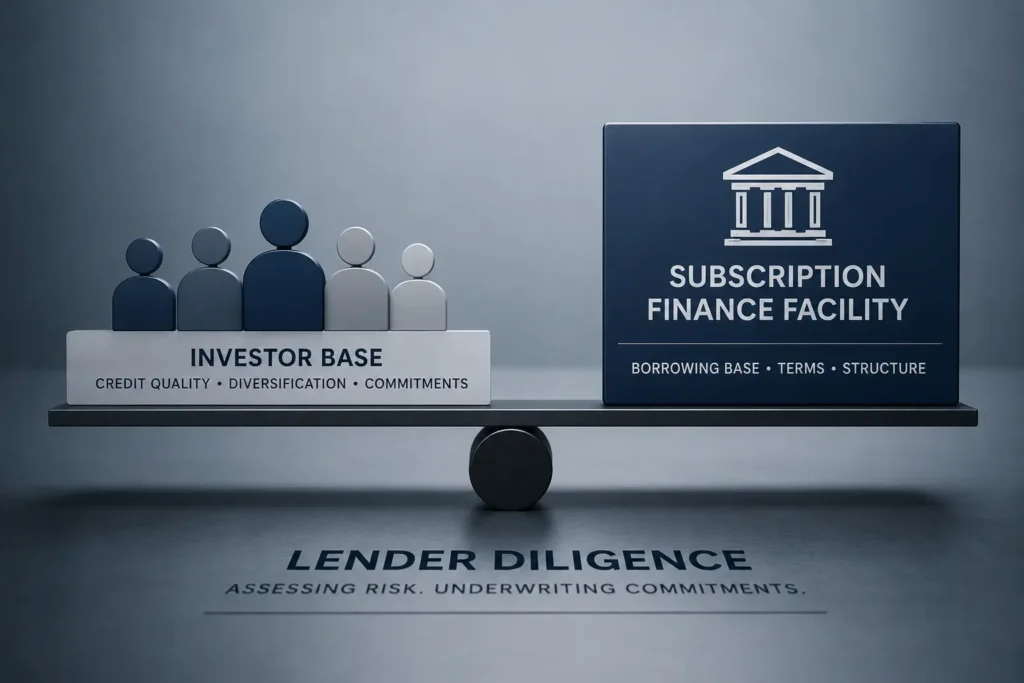
A subscription finance facility is only as good as the collateral behind it, and that collateral isn’t an asset on a balance sheet. It’s a pool of investor promises. Before a lender advances a single pound against uncalled capital, they run a diligence process most GPs never see, and the outcome of that process decides pricing, advance rates and how much of the fund’s commitments can actually be borrowed against.
This article sets out that process: how lenders assess the investor base, what the LPA needs to contain before credit committee will approve a facility, and where the structure changes as a fund matures. For the mechanics of how lender expectations are evolving more broadly, see our Data Room for Lending analysis. For the modelling discipline behind these facilities, our Structured Finance Modelling guide sets out the underlying framework.
What the Subscription Finance Facility Actually Secures
A subscription finance facility, sometimes called a capital call facility or sub line, is a revolving credit facility secured not by fund assets but by the investors’ uncalled capital commitments. When a GP identifies an opportunity or incurs an expense, they draw on the facility rather than issuing an immediate capital call. The lender advances against the pledge of each investor’s obligation to fund when called, typically over a 12 to 36 month tenor, repaid once capital is actually called.
That single distinction, security over a promise to pay rather than an asset, is what drives everything a lender checks before agreeing terms.
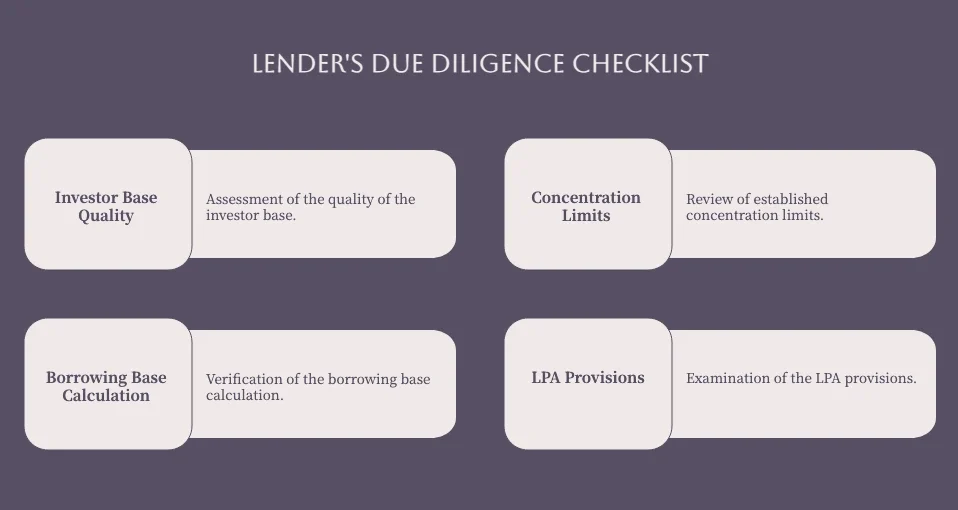
The Lender’s Due Diligence Checklist
Investor Base Quality
Creditworthiness depends on the investor base, not the fund’s strategy or track record.
Concentration Limits
Strict concentration limits apply. If a single investor holds a large share of total commitments, the borrowing base is capped or adjusted against that investor’s rating.
Borrowing Base Calculation
This is where sponsor expectations and lender arithmetic most often diverge. One of the more common surprises in early discussions is that sponsors quote total commitments, while lenders are already working from the eligible borrowing base, uncalled capital from investors who clear the credit threshold, at the applicable advance rate. Those two numbers can differ materially, sometimes by 30% or more, and a facility sized against the wrong one derails term sheet discussions later than it should.
To illustrate: a fund with £400 million in total commitments might have only £260 million from investors who clear the lender’s credit threshold. Applying a 90% advance rate against
that eligible base gives a borrowing base of £234 million, materially less than the £400 million figure the sponsor may have been working from internally.
LPA Provisions
The Limited Partnership Agreement is the document lenders read most carefully, and the one GPs most often assume is already fit for purpose. It must explicitly permit the pledge of capital calls and waive investors’ right to claim set-off defences against the lender. Without clear no-setoff language, credit committees will not approve the facility regardless of investor quality. Funds raised on an older LPA template, drafted before subscription facilities were standard, are the most common source of this gap, and it is worth having counsel confirm the language supports the facility before a term sheet is requested.
Lender Insight
A few things surprise GPs consistently once they’re inside the subscription finance process.
First, timeline: credit committees will not move on investor quality and borrowing base mechanics alone, they want the LPA’s no-setoff and pledge language confirmed in writing, and funds that arrive without this already reviewed typically add two to three weeks to execution.
Second, the borrowing base conversation almost always resets sponsor expectations downward from the headline commitment figure, so it pays to model the eligible base before entering discussions, not during them.
Third, lenders weight investor concentration more heavily than most GPs expect going in, a fund that looks well-diversified on paper can still draw scrutiny if two or three investors dominate the uncalled capital pool.
Common Reasons Credit Committees Reject Subscription Finance Facilities
Most rejections trace back to a small set of recurring issues, rarely to the fund’s underlying strategy or track record:
- Concentrated LP base. A small number of investors holding a disproportionate share of commitments, without the credit quality to support it.
- Weak or absent LPA wording. No explicit pledge or no-setoff language, particularly common in funds using older template agreements.
- Excluded investors. A meaningful portion of the investor base falling below the lender’s credit threshold, shrinking the eligible borrowing base below what the facility needs to be viable.
- Unresolved investor KYC or sanctions screening. Gaps in know-your-customer documentation on individual LPs, distinct from the borrower’s own KYC file, which stalls approval regardless of everything else being in order.
- First close too small. Early-stage funds seeking a facility sized against commitments that haven’t yet reached a durable base, leaving too little margin for the lender.
Addressing these before approaching a lender, rather than discovering them mid-process, is generally what separates a fast close from a stalled one.
Beyond Closing: Ongoing Monitoring
Diligence doesn’t end at funding. Lenders typically require a borrowing base certificate on a periodic basis, confirming the eligible investor pool and current advance rate haven’t shifted materially since close.
Reporting covenants usually cover changes to the investor register, any new defaults or withdrawals, and confirmation that concentration limits remain within the agreed thresholds.
GPs who treat this as a one-off closing exercise rather than a standing obligation are the ones who find themselves in breach conversations later, often over paperwork rather than any real deterioration in the fund’s position.
Real-World Scenarios
Scenario A: The Private Credit Fund
A private credit fund identifies a time-sensitive bridge loan opportunity, with the borrower needing funds within 48 hours. The fund draws on its subscription facility to close, then issues a capital call once the position is syndicated or retained. The lender’s prior diligence on investor quality is what makes same-day drawdown possible; a facility underwritten against a weaker investor base would not support this speed.
Scenario B: The Real Estate Sponsor
A real estate fund needs to cover a deposit and legal fees during due diligence on a commercial property. Rather than calling capital for costs that might be returned if the deal falls through, it draws on the sub line, rolling the cost into the final call if the deal proceeds. Lenders assess these “soft cost” draws differently, and clean down requirements exist precisely to prevent this use becoming permanent leverage.
Scenario C: Bridging the Fundraising Gap
A manager launching a successor fund has a first close with a cornerstone investor but hasn’t reached final close. A subscription facility, sized against that first close commitment, lets them begin investing without missing the current vintage. Lenders will size the borrowing base conservatively here, since the eventual investor base composition isn’t yet known.
Risks Lenders Weigh, and Borrowers Should Too
Default and Cross-Default
If an LP defaults on a capital call, the lender typically has the right to step in, and in severe cases this can trigger cross-default provisions across the facility. The LPA’s pledge language is what determines how this plays out in practice.
Interest Rate Sensitivity
In a higher rate environment, facility cost can erode fund performance if it exceeds the hurdle rate on the underlying investment. Managers need to forecast borrowing cost against expected return before drawing, not after.
Layered Leverage
If a fund uses subscription finance at the fund level while portfolio companies carry their own asset-level debt, total system leverage compounds. Ratings agencies are increasingly scrutinising this layering, and lenders factor it into terms.
Where the Structure Changes: Subscription Finance vs NAV Finance
Subscription facilities are secured by uncalled capital and used earliest in a fund’s life. As capital is called and uncalled commitments shrink, the borrowing base for a traditional sub line contracts with it. Later in the fund’s life, when assets have accrued value and uncalled capital is low, funds typically transition toward NAV lending, secured against the underlying portfolio rather than investor commitments. Some lenders now offer hybrid structures that transition the security package from one to the other across the fund’s lifecycle. The underwriting standards that govern this transition are covered in our Private Credit Underwriting guide.
Broader liquidity and credit cycle trends affecting facility availability are tracked by the Bank for International Settlements. GPs assessing how their own disclosure practices measure up against market standard should also review the ILPA guidance on subscription lines of credit, which sets out LP-facing expectations on concentration limits and reporting.
Conclusion
Subscription finance is often described as a liquidity product. In practice, lenders underwrite it as a credit product secured by investor obligations rather than fund assets, and they assess it accordingly: investor quality first, borrowing base arithmetic second, LPA enforceability third. Managers who understand that this is the sequence lenders actually work through, rather than treating the facility as a formality, generally reach terms faster, avoid unnecessary diligence delays, and negotiate from a stronger position.
FAQ
What is the difference between subscription finance and NAV finance?
Subscription finance is secured by investors’ uncalled capital commitments and used early in a fund’s life. NAV finance is secured by the fund’s underlying assets and is typically used later, once uncalled capital has thinned and asset value has accrued.
What does a lender need to see in the LPA before approving a facility?
Explicit permission to pledge capital calls, and a waiver of investors’ right to claim set-off defences against the lender. Without both, credit committee approval will not proceed regardless of investor quality.
How does subscription finance affect the J-curve?
Delaying capital calls through a credit facility can mitigate the negative early returns typical of a fund’s early years, helping optimise IRR, though sophisticated LPs increasingly look at MOIC alongside IRR to assess whether performance is genuine.
Are these facilities risky for LPs?
Generally low risk, since they’re secured by the LPs’ own commitments. LPs should be aware that in a default scenario they remain obligated to fund their capital contribution to the lender directly.
Take the Next Step
Structuring a subscription finance facility, or preparing a fund for lender diligence on one, requires the LPA and investor base to be diligence-ready before terms are sought. Contact our specialist advisory team for a discreet conversation on positioning your facility ahead of lender review.
For the full framework on lender diligence expectations, see our Borrower Trust & Due Diligence Playbook.