
Data Room for Lending: What Lenders Expect to Find
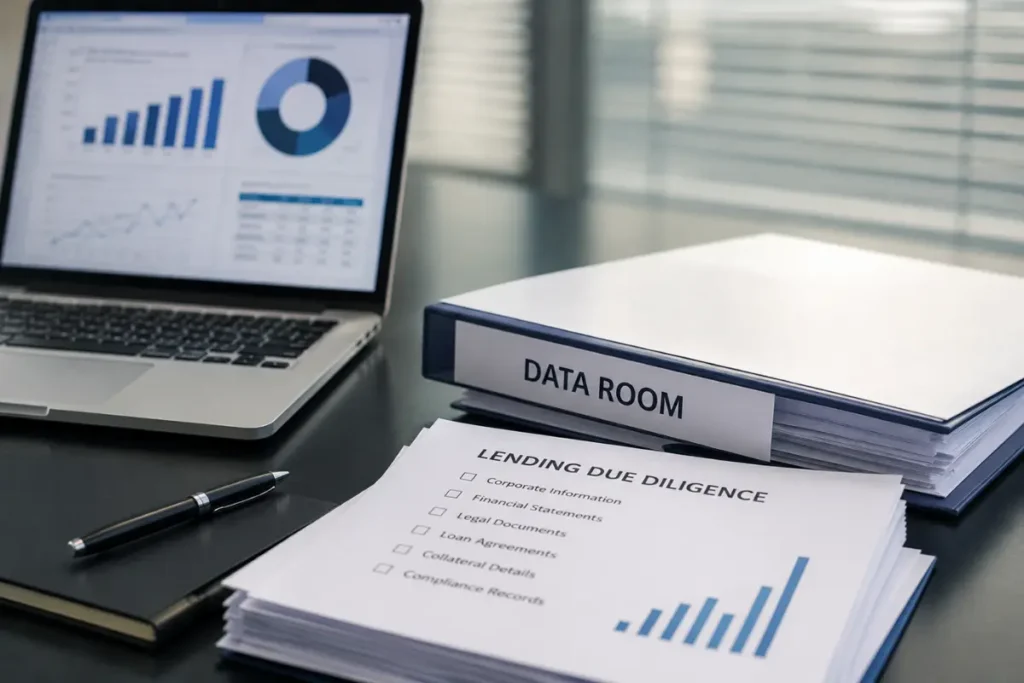
The days of securing an eight-figure facility through a handshake and a chaotic email chain are over. Capital is available, but it now flows through a filter of scrutiny, and the first thing that filter touches is your documentation. For property developers, UHNW borrowers and family offices, the data room for lending has become the infrastructure of the transaction itself: the difference between a file that moves through credit in weeks and one that quietly dies in an analyst’s inbox.
Here is the uncomfortable truth. Lenders rarely decline strong deals because the assets are weak. They decline them because the file is incomplete, inconsistent or stale, and they have twenty cleaner files behind yours. If your data room is chaotic, the lender will not chase you. They will drop you.
This guide sets out what a data room for lending must contain, how it should be structured and sequenced, and why the borrowers who treat it as deal strategy rather than admin consistently secure better terms, faster.
What a Data Room for Lending Is (and What It Is Not)
A data room for lending is a controlled environment where a lender builds the credit case for your transaction. Every document inside it exists to answer a question an underwriter will ask.
- It is not a Dropbox link.
- It is not a WhatsApp dump.
- And it is certainly not 47 PDFs attached to a single email with the subject line “Docs”.
The distinction matters because the data room for lending is the lender’s first evidence of how you run your affairs. A structured, current, internally consistent file signals an institutional-grade borrower. A scattered one signals hidden risk, and lenders price hidden risk by walking away.
The Five Folders Lenders Expect
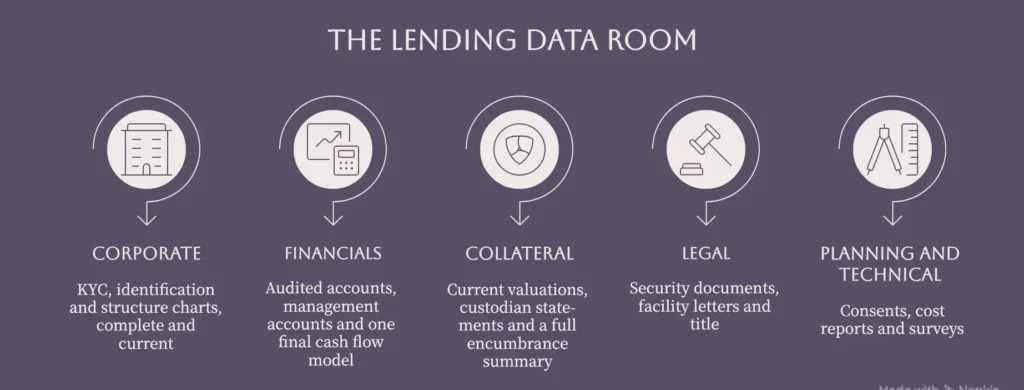
The structure of a data room for lending should mirror the structure of the credit paper the lender must write. When your folders map to their internal template, you are effectively drafting their approval document for them. Every serious file contains five sections.
1. Corporate
KYC documentation, identification, corporate structure charts and registers, complete and current. This folder answers the underwriter’s first question: who exactly am I lending to, and can I evidence it to compliance?
2. Financials
Audited accounts, management accounts and the cash flow model, in a single, final version. The numbers here must reconcile with every other document in the room. Where the transaction involves pooled assets or receivables, the quality of this folder determines whether the lender’s structured finance modelling produces a fundable answer or a list of exceptions.
3. Collateral
The asset evidence: valuations, custodian or bank statements, and a clear summary of existing debt, charges and encumbrances. This folder answers the question that dominates private credit underwriting in the current market: what protects the lender if the plan fails?
4. Legal
Security documents, existing facility letters and title. Nothing stalls a transaction like a charge nobody mentioned surfacing at legal review.
5. Planning and Technical
For development and real estate transactions: consents, cost reports and surveys. For corporate and securities-backed transactions, this folder holds the transaction-specific evidence, such as board approvals and regulatory disclosures.
Document Currency: Where Most Borrowers Fall Short
Structure gets you read. Currency gets you approved. In our experience, the single most common failure in an otherwise complete data room is stale documentation, and valuations are the worst offender.
A valuation report from eighteen months ago is not evidence of value. It is evidence that you have not commissioned a current one, and every lender will ask why. For real estate collateral, lenders expect a recent valuation from a recognised firm prepared to RICS Red Book standards, and many credit policies impose a hard age limit before drawdown. For securities collateral, custodian statements must be current, because the lender will size the facility against live positions, not last quarter’s.
The same discipline applies across the room. Management accounts should be no more than a quarter old. KYC documents must be unexpired. The cash flow model must be dated, versioned and consistent with the accounts sitting beside it. A single mismatch, a model showing revenue the accounts do not support, or a debt schedule missing a facility the legal folder reveals, does more damage than a missing document. A gap looks like an oversight. A contradiction looks like concealment.
Sequencing, Version Control and Ownership
A data room for lending is a process, not a folder. Three operating rules separate institutional borrowers from the rest.
Build the room before you approach the market
The strongest negotiating position is a data room for lending that is complete on the day the first lender receives access. Assembling documents reactively, in response to each information request, telegraphs disorganisation and hands the lender control of the timeline.
Enforce version control
One final version of every document, clearly dated. Delete duplicates. Kill every file named “final_FINAL_v6”. The data room is the repository of record for the transaction, and inconsistencies here suggest inconsistencies everywhere.
Appoint one owner
Whether it is the CFO or a trusted intermediary, a single person must control what enters the room, when, and in what form. Committees produce contradictions. Owners produce consistency. Access permissions belong to the same discipline: the lender’s deal team needs the full file, but not every junior adviser needs the sponsor’s personal net worth statement.
Lender Insight: How a Clean File Moves Through Credit
From our seat placing transactions with private credit providers, the pattern is consistent. Analysts screening new proposals are not evaluating your deal at first contact. They are evaluating whether your deal is evaluable. A complete, current data room for lending clears that screen in a day. An incomplete one joins a queue of follow-up requests, and every unanswered request is an opportunity for the lender to deploy capital elsewhere.
The effect compounds at committee stage. The credit committee approval process runs on the credit memo, and the credit memo is assembled from your data room. When the file is clean, the analyst writes the memo quickly, the committee’s questions have documented answers, and conditions precedent are fewer because less is unverified. When the file is ragged, the memo is late, the committee defers, and the approval that eventually arrives carries conditions that a complete room would have pre-empted.
Borrowers often assume lenders are slow. Lenders are not slow. Your paperwork is.
Two Deals, Two Outcomes
The sloppy borrower
A prominent developer sought £40m in senior debt for a mixed-use scheme. The assets were prime, but the process was amateur: a shared drive of folders named “New Folder (2)”, scanned files with no descriptions, and what appeared to be edited PDFs presented as valuation reports.
The credit team could not reconcile the valuations against the financial statements, and the cash flow model existed in multiple versions with different numbers. The file stalled, trust evaporated, and the lender allocated its capital to a competing project whose data room for lending was ready on day one.
The institutional borrower
A listed company sought a bridge facility against a share pledge. Its data room followed the five-folder structure, every document was watermarked and dated, custodian statements were current, and the question-and-answer log ran inside the room rather than across email chains.
The credit officers moved from first access to committee in a fraction of the usual time, because nothing required chasing and nothing contradicted anything else. Same market, same scrutiny, entirely different outcome.
Security, Access and the Regulatory Backdrop
The tightening is not only commercial. Lenders have hardened their controls in response to rising documentation fraud, and the FCA’s financial crime expectations push regulated firms to evidence the integrity of the information trail behind every credit decision. A proper data room for lending supports this: watermarked documents, a recorded audit trail of who accessed what and when, and version histories that prove nothing was altered after upload.
For the borrower, these features are not bureaucracy. They are proof. A room that can demonstrate document integrity removes an entire category of lender doubt before it forms.
Conclusion: The Operating System of Modern Credit
A data room for lending is no longer a nice-to-have. It is the operating system of the transaction, and it is the one part of the credit process entirely within the borrower’s control. Structure the file the way the lender thinks, keep every document current, enforce one version and one owner, and you will cut weeks from the timeline and widen the pool of lenders willing to compete for your business.
The data room controls the narrative before you say a word. Make sure it says: we are professional, we are prepared, and we are ready to execute.
Preparing the file is half the equation. The other half is knowing who you are handing it to, which is where borrower due diligence on the lender becomes the counterpart discipline.
If you are preparing a facility and want your data room reviewed against what lenders actually expect to find, or you have a lender-ready file and need it placed, contact us for a discreet conversation.
Private Credit Playbook
This post is the starting point of the Forbes Le Brock Borrower Trust & Due Diligence Playbook. Access the full Playbook here.