
Structured Finance Modelling: From Loans to Cash Flows

When banks bundle loans and sell them as bonds, someone has to test how the money really moves. That is the job of structured finance modelling. It is the engine behind mortgage backed securities, asset backed deals, collateralised loan obligations and most modern securitisation structures.
If you work with loans, fixed income or risk, you do not need to be a quant to understand the basics. You just need a clear picture of how loans turn into cash flows and how those flows are shared between investors.
This guide gives you two things:
- A straightforward explanation of structured finance modelling and and where fits in.
- A walk through of the core building blocks inside structured finance modelling so you can read one with confidence.
What is Structured Finance Modelling and Why it Matters
Structured finance turns pools of assets into tradeable securities. These assets are usually loans or receivables such as mortgages, car loans, personal loans, credit cards or corporate loans. Instead of holding them on the balance sheet, a bank sells the loans into a special purpose vehicle (SPV) which then issues bonds to investors.
Structured finance modelling sits at the centre of this process. A model takes loan data and deal rules, then projects how cash will behave over time. It shows when investors are likely to get paid, how quickly notes amortise and how much protection each tranche has in different scenarios.
A reliable model depends on the quality of the underlying loan tape. We cover the full data room structure in our guide to data room preparation for lending.
In a live transaction, the model supports essential tasks:
- Pricing new deals by testing structures, reserve levels and tranche mixes
- Risk checks with rating style stress tests on defaults, recoveries, prepayments and interest rates
- Investor reporting where the same logic drives monthly or quarterly statements after closing
Without a robust model, nobody can judge fair value or risk. With one, arrangers, investors, rating agencies and risk teams can all evaluate the same question: does the structure hold when loans do not behave as expected?
Structured Finance and Securitisation Explained Simply
Think of securitisation as a large box filled with loans. Each month, borrowers pay interest and principal into the box. The box then pays that cash to investors according to a predefined set of rules. For a clear starter definition, see this overview of securitisation
Common asset types include:
- Home loans which back mortgage backed securities (MBS)
- Car loans and personal loans which back asset backed securities (ABS)
- Corporate loans which back collateralised loan obligations (CLOs)
Commercial real estate loans, common in CRE financing, can also be securitised in structured deals.
Investors are not paid equally. The deal slices the structure into tranches.
- Senior tranches get paid first and have the most protection.
- Mezzanine tranches sit in the middle.
- Junior or equity tranches take losses first and offer higher potential returns.
Because payments and losses are allocated in a strict order, an average pool view is not enough. You need a structured finance model to track exactly who gets paid, when and how losses move through the structure.
How Structured Finance Modelling is Used in Real Deals
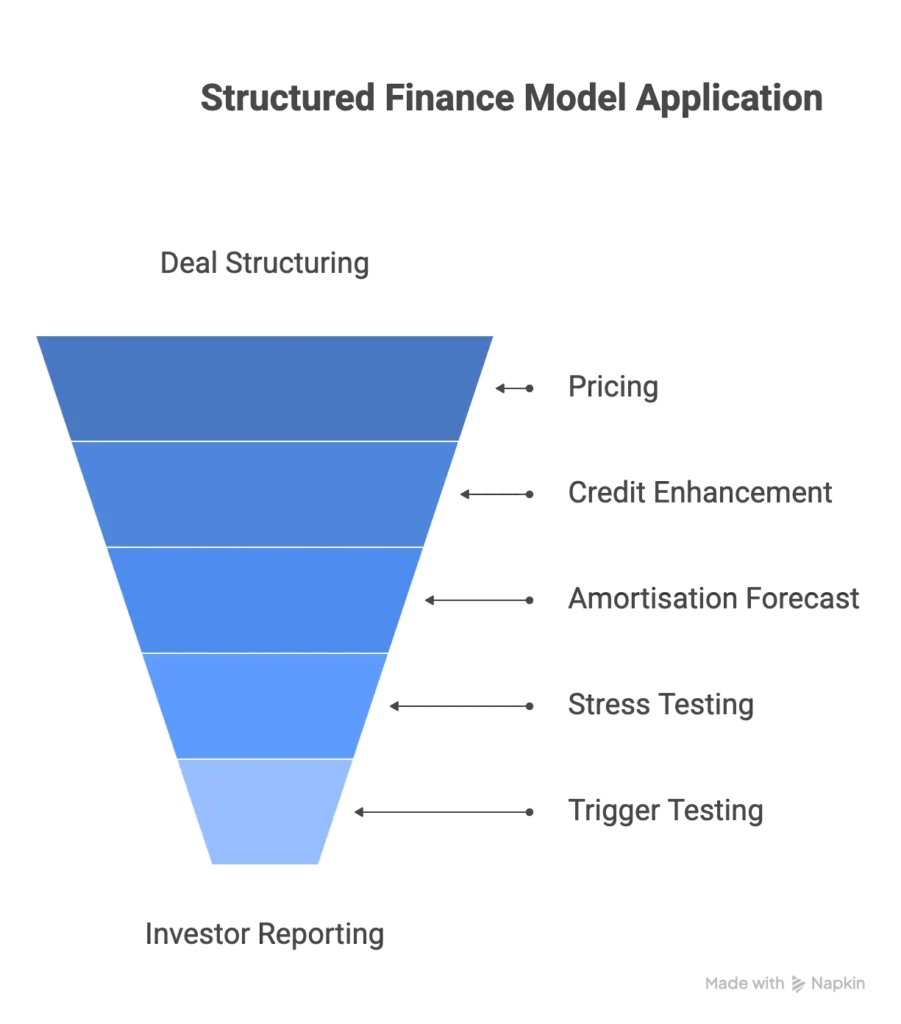
In practice, these models are working tools used to:
- Structure and price new deals
- Set the right level of credit enhancement
- Forecast the pace of amortisation
- Run rating style stresses
- Test triggers and coverage ratios
- Produce ongoing investor reporting
Examples:
- An arranger doubles default assumptions on a mortgage pool to test the rating outcome.
- A mezzanine ABS investor slows prepayments and increases arrears to see if their tranche still repays within five years.
These same cash flow dynamics also underpin structures like NAV lending, where repayment depends on future asset performance.
A servicer runs the model each period to check interest or principal coverage tests. If a trigger fails, the waterfall diverts cash to repay senior notes faster.
Who Uses Structured Finance Modelling and What They Focus on
Arrangers and Issuers
Care about funding cost and marketability.
Questions: how much subordination is needed and what coupon levels keep the deal profitable?
Investors and Asset Managers
Care about downside risk and cash flow timing.
Questions: how likely am I to lose money and how reliable is my expected return?
Rating Agencies
Care about extreme stress scenarios. You can see examples in formal structured finance methodologies published by rating agencies
Questions: do senior notes still pay in full under severe assumptions and how do losses flow through?
Bank Risk and Treasury Teams
Care about liquidity, capital and concentration.
Questions: how does the structure behave under regulatory stress tests and how does it affect the bank’s funding profile?
Core Building Blocks of Structured Finance Modelling
A structured finance model has three core engine parts, the asset pool, the cash flow engine and the waterfall. Around these sit two supporting layers: structural protections, and the outputs that investors and arrangers rely on. Together they form the five building blocks that show how a deal actually behaves.
1. Asset pool: data and key assumptions
The model begins with the loan tape. This contains one row per loan with fields such as:
- Balance
- Interest rate and margin
- Term and remaining life
- Borrower type
- Interest type
- Collateral value
- Arrears status
On top of this raw data, the modeller sets pool level assumptions:
- Default rate
- Prepayment rate
- Recovery rate
- Recovery timing
These assumptions determine the shape and consistency of the cash flows that feed the structure.
2. Cash flow engine: turning loan behaviour into monthly numbers
The cash flow engine applies those assumptions to each loan, period by period. Typical monthly calculations include:
- Scheduled interest
- Scheduled principal
- Prepayments
- Defaults and loss amounts
- Recoveries
Adding these gives total collections for the period.
Models typically run several scenarios: base case, moderate stress, severe stress and rating style stresses. The logic is identical across scenarios, only the inputs shift, which makes deviations easy to compare.
3. Waterfall and tranches: how cash is allocated
The waterfall sets the priority of payments each period. A simple structure will typically pay:
- Fees and expenses
- Senior note interest
- Mezzanine and junior interest
- Senior principal, then lower tranches
- Any remaining cash to equity
Protection for each tranche comes from subordination, overcollateralisation, reserves and excess spread. The model applies this hierarchy every period so users can see exactly how cash and losses move through the structure.
This structure mirrors how mezzanine financing and other layers of the capital stack absorb losses before senior debt
4. Triggers, tests and reserves
Most deals include protections that act as safety switches when performance weakens. Common examples include:
- Interest coverage tests
- Principal coverage tests
- Cumulative loss triggers
- Delinquency triggers
- Liquidity and cash reserves
If a trigger fails, the structure usually shifts to a more conservative waterfall that accelerates senior pay-down. A clean model applies these tests consistently across all periods.
5. Outputs: IRR, WAL, amortisation and stress results
Users need outputs that summarise the behaviour of each tranche. Typical outputs include:
- Tranche balances over time
- Expected maturity dates
- Weighted average life (WAL)
- Internal rate of return (IRR)
- Loss coverage
- Trigger pass or fail history
- Scenario comparisons
These results show how resilient the structure is and how each tranche behaves as conditions change.
Practical Tips for Building or Reviewing Structured Finance Modelling
Keep the Model Clean and Traceable
- Separate inputs, logic and outputs
- Avoid hidden hard coded numbers
- Make assumptions easy to locate
A reviewer should be able to trace one unit of principal from the loan sheet through the waterfall into the final investor payment.
Use Straightforward Scenarios
Test higher defaults, lower recoveries, slower prepayments and simple rate shocks.
Ask three questions: who loses, how much and how quickly is protection used?
Avoid Common Errors
- Relying on pool averages where loan level detail matters
- Mixing up default and delinquency
- Leaving out fees
- Forgetting trigger logic
- Not validating outputs with charts
Conclusion
Structured finance modelling transforms loan behaviour into investor cash flows and shows how a structure absorbs stress. The essential steps are clear: understand the asset pool, build a transparent cash flow engine, apply a clean waterfall and test how the structure behaves when conditions change.
If you focus on those principles, even complex securitisations become manageable. Start with a simple mortgage backed example, then add features such as triggers and reserves.
And always ask yourself: can you explain where each pound goes and what happens when the loans do not perform as planned?
Need a Fast, Discreet Assessment of a Live Transaction?
If you have a transaction that needs funding or a data room that requires tightening, we can review it and outline the secured options available. We work with public companies, property groups and private clients who want clarity, speed and a confidential process.
Contact Forbes Le Brock