
Credit Market 2026: The Reset and What It Means for Borrowers

A developer who assumed a 68 per cent refinance eighteen months ago is now being offered 52 per cent on the same asset, with the same income, from the same lender relationship. Nothing about the property changed. The credit market 2026 did.
That gap is not a pricing dispute. It is the reset working exactly as intended: lenders repricing risk with more precision than the market has seen since before the low-rate era. There is substantial capital available across private credit and fixed income markets.
The constraint borrowers are encountering is increasingly not the existence of capital, but the terms on which lenders are prepared to deploy it.
This post sets out what has actually changed in how lenders behave in the credit market 2026, and what a borrower needs in place before approaching one.\
What the Credit Market 2026 Reset Actually Means
A reset is not a crash. It looks like business as usual on the surface while the mechanics underneath change.
The 2026 Global Credit Conditions Outlook frames the year as shaped less by the business cycle and more by structural change: sticky inflation, political fragmentation, and tight credit spreads that leave lenders little cushion for error.
The result is a market that prices risk with surgical precision rather than lifting all borrowers together.
The Mechanics of the Reset:
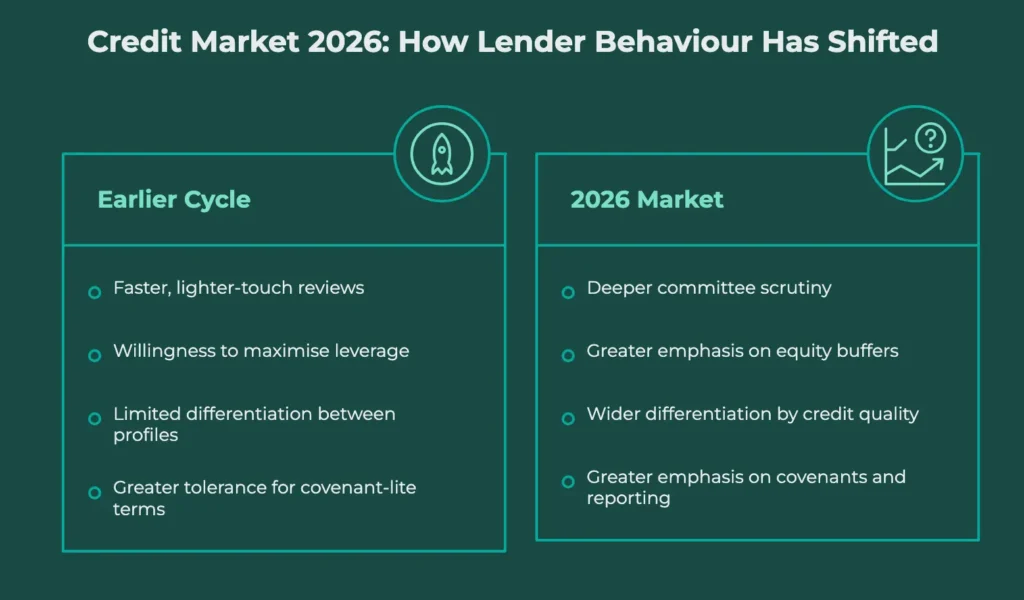
- Approvals are taking longer. Investment committees are demanding deeper diligence, particularly where valuation, sponsor quality or exit assumptions are difficult to underwrite.
- Leverage is compressing. Lenders are generally seeking larger equity buffers against valuation volatility rather than underwriting to the maximum theoretical LTV.
- Pricing is bifurcating. Strong, well-documented borrowers continue to attract competitive terms, while complexity, weak documentation and uncertain exits attract a materially higher risk premium.
- Documentation standards are hardening. Covenants, reporting obligations and information undertakings are receiving greater scrutiny than they did during the easier-credit period.
For the borrower, the practical consequence is narrative consistency. A growth story pitched to an equity investor and a stability story pitched to a debt provider are now cross-checked in diligence, and the discrepancy is flagged immediately.
Why This Reset Matters More for Borrowers Than Investors
There is a clear asymmetry in how the credit market 2026 treats the two sides of a transaction. Investors have optionality: they can hold cash, buy government bonds, or wait for better terms, and they are being paid reasonably well for that patience.
Borrowers rarely have that luxury. A refinancing wall, an acquisition, or a capital expenditure need is driven by the calendar, not by market sentiment.
That asymmetry holds regardless of what sits behind the facility. Whether the collateral is real estate, receivables, or a securities-based lending portfolio, the lender is pricing the liquidity and volatility of the underlying asset, not its headline value.
In the credit market 2026, liquidity is gated by scrutiny, and the borrower with a fixed deadline carries the weight of that gate.
The Reset in Practice: A Worked Example
The scale of the reset is easiest to see in a single worked transaction. The figures below are illustrative, built around a realistic UK logistics refinancing to show how the mechanics above actually move a deal.
A mid-market UK developer holds a stabilised 140,000 sq ft logistics asset in the South East, fully let on a weighted average unexpired lease term of six years. The existing £24 million facility matures in nine months.
Based on the last transaction comparable in the sub-market, completed in early 2024, the sponsor’s advisers assumed a refinance at 68 per cent LTV against a valuation of roughly £35 million, implying a new facility close to £24 million with headroom for a modest equity release.
The lender’s credit committee, working from a fresh RICS valuation and a cap rate widened by 60 basis points against the 2024 comparable, values the asset at £31 million and caps the facility at 52 per cent LTV, roughly £16.1 million.
The gap between the sponsor’s assumption and the lender’s offer is close to £7.9 million.
The sponsor closes it with a mezzanine tranche priced at a meaningful premium to the senior facility, sized to a strict debt service coverage covenant, and the closing timeline extends by roughly ten weeks while the fresh valuation, revised legal documentation, and a rebuilt cash flow model move through committee.
Nothing about the underlying tenancy or the asset’s income changed between the two valuations.
What changed was the lender’s view of exit liquidity in a wider cap rate environment, and its unwillingness to underwrite the 2024 assumption into a 2026 facility.
That is the reset, expressed in a single transaction rather than a market average.
Why Lenders Are Becoming More Selective
The tightening is not arbitrary. Five forces are compounding at the same time.
1. Tight Spreads and Risk Compensation
When the spread between risk-free rates and corporate credit is narrow, lenders are not being paid a premium to take on excessive risk.
Capital naturally migrates toward the highest quality borrowers, leaving the middle market to compete harder for the same attention.
2. Rate-Cut Uncertainty and Duration Risk
The path to lower rates in 2026 remains uneven rather than smooth. Lenders are reluctant to lock in long term pricing for borrowers with fragile fundamentals, favouring shorter tenors and floating structures that protect their own balance sheets from duration risk.
3. Economic Headwinds and the Labour Market
A softening labour market feeds through to consumer spending and, eventually, corporate earnings.
Lenders are stress-testing against scenarios where growth assumptions do not hold, and a facility that depends on aggressive earnings growth is the first to fail that test.
4. The Maturation of Private Credit
Private credit has grown from a niche allocation into a dominant source of capital, and size has brought scrutiny from the pension funds and insurers who allocate to it.
That pressure flows down to the borrower: funds are underwriting more like banks, not less.
The structural side of that shift, including the growth of secondaries markets and asset-based finance within private credit, is covered in full in Private Credit Trends 2026.
5. Structural Forces: AI and Geopolitics
Capital is being reallocated toward AI and data centre infrastructure at scale, competing directly with traditional borrowers for the same pools of capital.
At the same time, geopolitical fragmentation means credit is less fungible than it was: a lender comfortable with UK or US risk may be closed to specific markets entirely.
Lender Insight: How Lenders Are Actually Behaving in the Reset
The dimensions lenders weigh when underwriting any facility, cashflow durability, collateral quality, sponsor character and capital cushion, are covered in full in our guide to private credit underwriting in 2026.
What has changed for the credit market 2026 specifically is not that checklist, it is the bar each item must clear before a deal moves forward, and the behaviour that follows when it does not.
Pricing differentiation has become more visible in practice than it was a year ago. Two borrowers with broadly comparable credit profiles can now see a materially wider spread between them, driven almost entirely by documentation quality and exit clarity rather than by the underlying asset.
Lenders are increasingly pricing each file on its own preparation, rather than averaging risk across a book of similar deals.
Covenant packages that were negotiated away during the growth years are being reintroduced without much room for discussion.
Maintenance covenants, quarterly reporting obligations and information undertakings that a borrower could once negotiate down to an annual check-in are now close to standard, and lenders are enforcing the reporting cadence rather than treating it as a formality.
Portfolio-level concentration is shaping individual decisions more than it did in prior cycles. A lender can decline or scale back an otherwise sound deal purely because its existing book is already heavy in that sector or geography, independent of the borrower’s own credit quality.
This is a portfolio constraint rather than a credit judgement, and it is one of the more common reasons a strong deal stalls without a clear explanation.
Stale or inconsistent documentation is now treated as a pricing trigger, not just a delay. A gap in a data room reads as an oversight; a contradiction between two versions of a cash flow model reads as concealment, and lenders are pricing that perception into the terms they offer rather than simply asking for clarification.
What Borrowers Must Consider: The 2026 Checklist
Hope is not a strategy in the credit market 2026. The market is currently pricing in a premium for organisation and transparency, and that premium is earned before the first conversation with a lender, not during it.
□ Build a lender-grade data room before you approach the market. A sloppy data room signals a sloppy management team before a lender reads a single financial statement. See our guide on Data Room for Lending for the standard now expected.
□ Refresh valuations and financials. Data older than six months invites the assumption that you are hiding the current picture, not that you are simply behind on paperwork.
□ Go in with a conservative leverage ask. A request for 75 per cent LTV is likely to be viewed as unrealistic in most sub-markets today, while a request closer to 55 per cent with a clear debt service path is more likely to open a negotiation.
□ Strengthen the exit narrative beyond “we will sell the asset.” Lenders want a named buyer pool, evidence of market depth, and a model that holds up if the sale takes twelve months longer than planned. Build that resilience into your structured finance modelling rather than bolting it on after the term sheet.
□ Prioritise a visible liquidity buffer. A borrower with cash on the balance sheet is generally better placed to negotiate than one running lean, even against a comparable underlying asset.
Sponsor diligence and approval timelines are both lengthening in parallel, and both are covered in more depth in our guide to the credit committee approval process. The short version: disclose anything reputational early, and start the process three to six months before you actually need the capital.
Credit Market 2026 – The Role of AI
AI cuts both ways for borrowers in this market. Lenders are using it to process bank statements and audit reports in minutes, surfacing discrepancies a human analyst might miss, which raises the bar for how clean the underlying numbers need to be.
At the same time, AI and data centre infrastructure has become a capital magnet in its own right: borrowers providing the physical shell, power and cooling for that build-out are finding a genuinely receptive audience, provided the credit quality of the off-take contracts behind the facility is solid.
The lesson for the general borrower is straightforward. Lenders are applying more rigour to assessing you. Apply the same rigour to assessing yourself before the file reaches them.
Credit Market 2026: The Strategic Mindset Shift
The credit market 2026 is not closed. It is gated, and the gate opens for borrowers who prepare like institutional sponsors rather than opportunists.
The loose structures, high leverage and minimal reporting that defined the previous cycle are incompatible with where lenders are now, and the borrowers who adapt with discipline are finding that the relationships that remain are deeper and more durable for it.
If you have upcoming maturities, a disposal, or a significant liquidity need in the next twelve to twenty four months, the preparation described here takes time to build properly. Waiting until the term sheet is on the table is not a strategy many lenders will reward in this market.
If you are approaching a refinancing or acquisition in the current credit market 2026 and want to make sure your structure and preparation reflect where lenders actually are, we welcome a discreet conversation. Contact us today.
For a more structured breakdown of how these standards are applied in practice, see the Borrower Trust & Due Diligence Playbook.