
Is Deepseek Safe to Use? Privacy, Security & Risks Explained

Introduction: Is Deepseek Safe to Use in AI-Driven Finance?
Is Deepseek safe to use? As artificial intelligence evolves at breakneck speed, new tools are emerging that promise greater efficiency, smarter decisions, and competitive edge. Deepseek, a fast-rising AI research lab, has gained attention for its coding and language model capabilities. But for executives, investors, and high net worth individuals, the real question is whether it’s secure and trustworthy.
The appeal of cutting edge AI must be weighed against potential privacy risks and cybersecurity threats. Any tool that handles sensitive data demands close scrutiny, especially those built in jurisdictions with different data privacy laws. This article provides a balanced review of Deepseek’s benefits, security posture, and the AI risks in finance that decision makers need to consider.
Understanding Deepseek AI: Capabilities and Origins
Before assessing safety and asking yourself is deepseek safe to use, it’s crucial to understand what Deepseek is. Deepseek isn’t just a single chatbot; it’s an AI research lab based in China, known for developing sophisticated AI models, including powerful large language models (LLMs) and specialised coding models like Deepseek Coder. Their models have demonstrated strong performance, sometimes rivalling established players like OpenAI’s ChatGPT and Anthropic’s Claude.
Key aspects include:
- Chinese Origins: Deepseek is a Chinese company, specifically a Chinese artificial intelligence research entity reportedly backed by private funding, including potentially a Chinese hedge fund. This origin is central to many privacy concerns.
- Advanced Capabilities: Their models excel in areas like code generation, translation, and complex reasoning tasks, making the Deepseek AI app attractive for developers and potentially for automating certain business processes.
- Accessibility: Deepseek offers access via an API and user-facing applications (like their chatbot), making it relatively easy to integrate or experiment with.
Is Deepseek Safe to Use? Privacy Risk Breakdown
The answer the question is Deepseek safe to use is complex and depends heavily on your specific use case, risk tolerance, and the sensitivity of the data involved. There isn’t a simple “yes” or “no.” Instead, decision makers must evaluate several key risk factors.
General risks associated with many AI apps include:
- Data Collection: AI models learn from vast datasets and often collect user interaction data (queries, prompts, feedback) to improve performance.
- Data Storage: Where and how this collected data is stored raises security questions.
- Data Usage: How the company utilises collected data (for training, analytics, etc.) is often opaque.
- Potential for Leaks: Like any digital platform, AI services are susceptible to breaches.
However, using Deepseek introduces specific considerations primarily linked to its origin.
Deep Dive: Is Deepseek Safe to Use for Data Privacy and Security
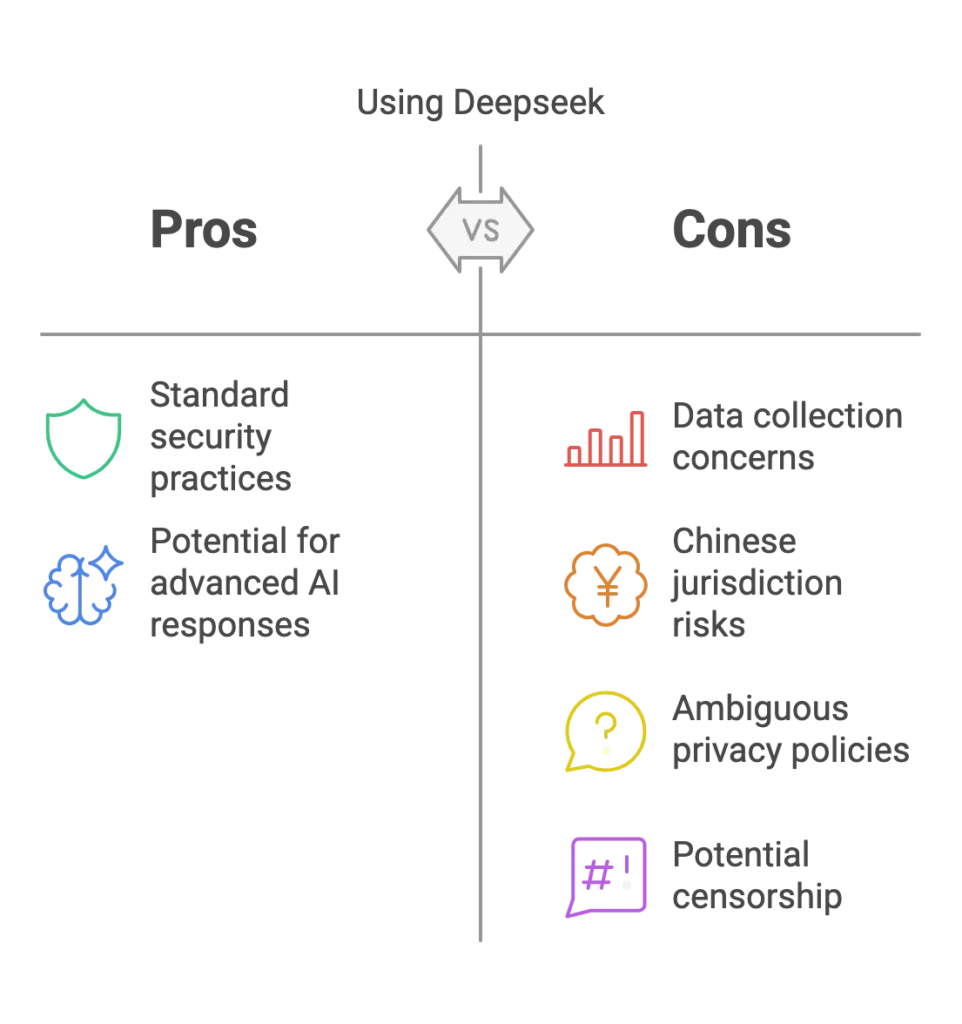
When evaluating, is Deepseek is safe to use, several specific areas warrant close examination:
- Data Collection Practices:
- What specific user data does Deepseek collect? According to typical AI practices and likely outlined (though perhaps vaguely) in their Terms of Service, this could include prompts, generated responses, IP addresses, device information, and potentially account details if registration is required.
- The critical concern is whether personal information or sensitive data inadvertently entered into the AI chatbot (e.g., proprietary code, confidential business strategies, client information) is collected and retained.
- Data Storage and Jurisdiction:
- A primary concern is where data is stored. Given Deepseek is a Chinese company, it’s highly probable that data is stored on servers in China.
- This is significant because data stored in China falls under Chinese jurisdiction and laws, including the National Security Law, which can compel companies to provide data to state authorities upon request. This raises serious national security concerns for international users, particularly businesses.
- Transparency and Security Measures:
- How transparent is Deepseek about its data collection and usage policies? Often, privacy policies can be ambiguous.
- What cybersecurity measures are in place to protect user data from breaches or malicious actors? While Deepseek likely employs standard security practices, independent verification is difficult. Concerns were highlighted when researchers at Wiz (a cloud security company) identified potential vulnerabilities in some AI platforms (though specific, persistent vulnerabilities in Deepseek haven’t been widely confirmed in the same vein as some other apps, the potential exists across the AI industry).
- Potential for Censorship and Monitoring:
- There have been anecdotal reports and user tests suggesting that AI chatbots developed by Chinese companies, including potentially those like Deepseek, may censor outputs related to politically sensitive topics (e.g., Taiwan, the 1989 Tiananmen Square massacre). While this primarily affects content generation, it hints at underlying monitoring and filtering mechanisms potentially influenced by state directives.
The ‘China Factor’: Geopolitical Risks and National Security Implications for Deepseek
For C-suite executives and investors, the geopolitical context is paramount. Using technology developed by a Chinese artificial intelligence company involves navigating a complex landscape:
- Data Sovereignty: Data entered into Deepseek could be subject to access by the Chinese government, posing risks to intellectual property, trade secrets, and sensitive corporate or client information. This is a significant hurdle for industries with strict compliance and confidentiality requirements (e.g., finance, defense, healthcare).
- Regulatory Differences: China’s privacy laws differ significantly from GDPR (Europe) or CCPA (California). While China has implemented data protection laws (like PIPL), the state’s access rights often supersede individual or corporate privacy expectations held in Western jurisdictions.
- Supply Chain Risk: Relying heavily on a foreign AI provider, especially from a region with potential geopolitical friction, introduces strategic risk. Access could be restricted, or policies could change unexpectedly. This contrasts with using US tech companies like OpenAI or Anthropic, which operate under different legal and geopolitical frameworks.
Comparing Deepseek to Alternatives like ChatGPT and Claude
When considering is Deepseek is safe to use, comparing it to alternatives is useful:
- OpenAI (ChatGPT) & Anthropic (Claude): These are leading US tech companies. While not immune to security concerns or data privacy debates (e.g., questions around training data), they operate under US and EU legal frameworks. They offer enterprise tiers with stronger privacy commitments (e.g., not using API data for training). However, using their free or consumer versions still involves data collection.
- Jurisdiction: The key difference lies in jurisdiction and the potential for government access. Data handled by US companies is subject to US laws (like FISA 702), while data handled by Deepseek is subject to Chinese laws. The level of perceived risk often differs based on the user’s location and threat model.
Potential Benefits vs. Risks for Finance Decision Makers

- Potential Benefits:
- Advanced Capabilities: Deepseek models might offer superior performance in specific tasks (especially coding).
- Innovation Access: Experimenting with diverse AI tools can foster innovation.
- Cost: Depending on pricing models, Deepseek might offer a cost-effective alternative.
- Significant Risks:
- Data Security & Privacy: High risk, especially for sensitive information, due to potential state access and jurisdictional issues.
- IP Protection: Risk of proprietary information exposure.
- Compliance: Potential violation of data residency or privacy regulations (e.g., GDPR if EU citizen data is processed without adequate safeguards).
- Reputational Risk: Association with tools perceived as insecure or linked to state surveillance could damage brand reputation.
Practical Steps: Staying Safe with Deepseek
If you or your organisation are considering is Deepseek is safe to use, adopting a cautious, risk mitigation approach, with a strong emphasis on AI fraud protection, is essential.
- Assume No Privacy for Sensitive Data: Never input confidential corporate information, client data, intellectual property, trade secrets, or sensitive personal data into the public version of Deepseek or any AI tool where you don’t have explicit, enterprise grade privacy guarantees.
- Review Terms of Service and Privacy Policies: Understand what Deepseek says it collects and how it uses data, but read critically, acknowledging the legal framework it operates within.
- Use for Non-Sensitive Tasks Only: Limit usage to tasks involving publicly available information or non-proprietary activities (e.g., general knowledge queries, brainstorming non-sensitive ideas, working with open-source code).
- Implement Strict Internal Policies: Establish clear guidelines within your organisation about acceptable AI tool usage, specifying which tools are approved for which types of data.
- Consider Sandboxing: For technical teams exploring capabilities, use isolated environments (sandboxes) that don’t connect to internal networks or sensitive databases.
- Stay Informed: Monitor news regarding Deepseek security posture, data breaches (Deepseek suffered any?), and evolving geopolitical tensions or regulations. Follow research from cybersecurity firms like Wiz.
- Prioritise Secure Alternatives: For tasks involving sensitive data, opt for enterprise level AI solutions from providers offering robust data privacy agreements, clear jurisdictional standing (preferably aligned with your own), and strong security certifications (e.g., OpenAI Enterprise, Microsoft Azure OpenAI Service, Anthropic’s enterprise offerings).
Conclusion: A Calculated Risk Requiring Strategic Oversight
So, is Deepseek safe to use? For high-profile decision makers, investors, and HNWIs, the answer leans towards significant caution. While its AI capabilities are impressive, the associated privacy risks, data security concerns, and geopolitical implications raise red flags. For low risk, public facing tasks, it may be usable with care. But for sensitive data or strategic operations, Deepseek’s current risk profile is likely too high for most UK- and EU-based organisations.
Next Steps
Before integrating any AI tool like Deepseek, ensure you’ve conducted proper due diligence and risk assessment.
If you’re evaluating AI for your business or portfolio, we serve clients across the UK, Europe, and Asia-Pacific. Contact us today for a strategic consultation on managing AI risks, protecting data, and using artificial intelligence safely within your financial or operational environment.
We’ll help you build the right governance and make informed, risk aware decisions.
FAQs: Is Deepseek Safe to Use?
1. What is Deepseek and why is it attracting interest in finance and AI circles?
Deepseek is a fast rising AI platform known for its large language models and code generation capabilities. It has attracted significant attention for its advanced performance, especially among developers and data-driven industries.
2. Is Deepseek safe to use with sensitive financial data?
For sensitive or confidential information, the risks are considerable. Deepseek’s origin and unclear data handling practices raise serious concerns for firms governed by GDPR, UK data laws, or financial compliance standards.
3. Why are experts questioning is Deepseek is safe to use?
The concern comes from its data privacy posture, lack of transparency, and jurisdictional control. Being a China-based platform introduces uncertainty around how user data is stored, accessed, or monitored.
4. Can Deepseek be used safely for non sensitive tasks?
Yes, but with caution. For general research or tasks that do not involve private data, Deepseek may be a useful tool. That said, clear internal usage policies and strict data handling protocols are still recommended.
5. How does Deepseek compare to other AI tools from a risk perspective?
Compared to platforms developed in the UK, EU, or US, Deepseek lacks regulatory clarity. It is harder to verify whether it meets international standards for data security, transparency, and user consent.
6. What are best practices for anyone unsure is Deepseek is safe to use?
Conduct a risk assessment, restrict use to sandboxed environments, and avoid inputting sensitive client data or intellectual property. Where compliance is a priority, consider alternative AI platforms hosted within your own jurisdiction.
Prefer to listen? Check out the Deep Dive into: Is Deepseek Safe to Use🎙️Listen here